
Recently, you may have noticed an extra one or two very bright stars in the sky, just after sunset. That’s because we’re currently experiencing a rather special celestial treat: a relatively rare positioning of all eight planets (and, three minor planets!) into just a bit more than one side of the sky - at nearly the same time! Alignments like this aren’t exactly common, so, go outside and take a look - while it’s still not too late! (This celestial configuration will begin to deteriorate over the coming weeks).
Starting at sunset, in their order of appearance, relative to their apparent distance from the sun, and just to the west of the sun, is Mercury, the first planet out from the sun, which is now so close to our star, from our perspective, that it’s easily lost in the glare and a bit hard on the eyes for that reason, without a telescope, but it’s there - just about 6 degrees to the southwest, at stellar magnitude +.60.**
Believe it or not, next up - we’re already at the outer reaches of the Solar system - minor, or dwarf planet, Pluto! But that’s because of its position against the sky, in the relative background, as compared to the other, and much closer planets. For now - just know that it’s there, about 15 degrees to the east of Saturn. It bottoms out at a dim +14.4 magnitude, accessible only in a moderate to large-sized telescope.
Next, moving, now, East of the sun is a dwarf planet, Ceres. You’ll need a small telescope to spot it. Ceres was discovered, telescopically, in 1801, and at that time, it was realized that Ceres was much closer to Earth than were the stars - but smaller than any planet; therefore, it was cataloged as an asteroid. And, it kept that label, until relatively recent years when it was re-labeled a minor planet. Under that heading is the sub-heading of, ‘dwarf planet’, and that’s where Ceres currently resides, "taxonomically", anyway. The reasons for the changes to Ceres, 4 Vesta, and Pluto as dwarf planets are entirely logical and valid; you’ll have to take my word for that. You’ll find Ceres if you dare - and, if you have a medium-sized telescope - between the sun and Venus, at a dim, +8.8 magnitude.
Now, on our way to Venus. Venus, the second planet from the sun - is the brightest thing in the sky (sans the moon and sun). Seemingly hanging there, low in the west, Venus shines its stunning, white brilliance down on us - at a staggering magnitude -4.4, and at about 12 degrees east of the sun. If you miss it - well, you’re just not paying attention!
Now - look down at the ground by your feet. There sits Earth, the third planet from the sun. If you were to see yourself standing there, from the perspective of the orbiting, International Space Station, you’d first note that you were standing, nearby some dividing line - the line delineating light from the darkness: the terminator, dividing night from day. You are just about, literally, to enter and cross into, the "Twilight Zone"! (Now, how many people can say that they’ve, knowingly, done that - hmmm?!) And this is a good thing because it represents the progression of time, and the rotation of Earth on its axis and, thereby, rolling you - or, perhaps, dragging you - into the deep, dark night. But this is an even better thing because the passage of the early evening hours will bring, up into the sky, from over the eastern horizon, three of our Solar system's showpieces; Jupiter, Saturn, and Mars.
First, sitting, watchfully - almost “king-like” - and due South, at an elevation of around 30 degrees, is His Deified Majesty, Jove - also known by the Romans, as Jupiter. With just about any pair of binoculars, you’ll get to see four of, giant Jupiter’s, giant moons - Callisto, Europa, Ganymede, and Io - that is, unless one or two of them happen to be in Jupiter’s shadow at the time of your observation. But don’t worry; they don’t stay in the shadow behind the planet long! With a telescope, you may also see some, very pastel, cloud bands, near the planet’s equatorial region. Jupiter is now, the third brightest light, in the sky, at a bright, white-ish, magnitude of -2.70.
Have you ever seen ‘rings’ around any celestial object before?; I mean, for yourself - with your very own eyes?! Probably, you haven’t - so now’s your chance! - that is if you happen to have access to, at least, a small telescope, or high-powered binoculars.
If not, don’t worry about it; you still cannot help but notice Saturn, anyway, because it’s now such a bright, yellowish-white, at an apparent magnitude of +.70: one of the very brightest lights currently in the sky, best seen around 9:00PM. But in a telescope, you will make out Saturn’s ring system, currently lying at an oblique angle to its plane of rotation, so that they will appear to be, almost, “wide-open” at this time around the planet - and that is a wonderful, and rare thing, indeed; Saturn’s rings go through long cycles of appearing open or closed, from our perspective, about every 27 years! Right now they are “wide-open” - you may never get to see this, again…
After Saturn is another object out there, just worth noting, and going unseen without a telescope: dwarf planet, and former asteroid, 4 Vesta. Its feeble light, just creeps through our atmosphere at a dismal +6.4 magnitude, well beyond the abilities of the average, human eye.
Now, comes Mars. Make sure you identify this small-ish, ruddy world for long-term memory: Mars is closer to Earth than it has been in 157 years! Though the red planet closes in on Earth every two years, due to the proximity of the orbits of both planets, there is another component to the Martian orbits’, slightly elongated shape which brings it even closer, periodically. This happens when the point in its orbit that lies closest to the sun, is in sync with the Earth’s position - and that is right about now!
Mars is currently experiencing one of the relatively rare, long-duration, global sandstorms that it's known for. The raging storm has been going on, for about 3 months now. I saw Mars through the telescope about two weeks ago, at high magnification. Though the planet, normally, has a variety of surface features to offer the observer, in the form of dark grey patches, volcanic calderas, white polar caps, and such, it now presents a uniform, planet-wide rust color, as atmospheric particulates from the dust storm circulate around its small, thin blanket of air. However - Mars is the second brightest thing in the sky, right now, after Venus - looking more like a reddish "blob", hanging in the air, toward the South than it does a star or a planet. There is a distinct perception of a disk to this orb, due to its slightly larger angular size in the sky than that of the other planets and, due to its current proximity to Earth. Mars is now glowing, distinctly reddish, at magnitude -2.6, rising at around 8:30PM and well placed for viewing, high up in the sky, by 11:00PM. It’s worth the view, with or without a telescope or binoculars!
And, nearly last, but not, nearly least - by any stretch - are Uranus and Neptune - the seventh and eighth planets of our Solar system - far beyond the reach of the unaided eye, but within telescopic range. They are nearby each other, well into the small hours, at around 30 degrees and 60 degrees, east, of Mars, and +5.7 and +7.8 magnitudes, respectively.
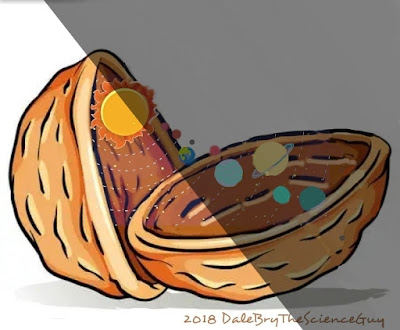
This leaves our own, familiar moon, Luna, now (at the time of this writing), as a dainty, waxing crescent, sitting just above Venus, but moving progressively toward the east, as the nights of the month wear on. And, there you have It - our entire Solar system, in a “night”-shell (well, you just know I couldn’t resist that one!)
** The system used by astronomers to denote the relative, apparent brightnesses in celestial objects, is the Stellar Magnitude Scale. Beginning at 0, the scale uses both positive and negative numbers: those in the minus range, are brighter than those in the plus range. Though it's called the ‘stellar’ magnitude scale, it is used to mark the brightnesses of all celestial objects; stars, planets, comets, and asteroids included. On that note, the consistently, brightest point of light that can be seen from the Earth, is the star, Sirius, in the constellation Canis Major (the 'Big Dog'). It is given the negative magnitude number, -1.4. The planet Venus, currently, is at magnitude -4.3 - several times brighter than Sirius - but Venus’ albedo varies over time, and, although Venus is the brightest object in the sky, after the sun and moon - it is a planet. On the plus side of the scale, the human eye can see stars down to about, a fairly dim, magnitude +6, on a very dark, clear night. And so, the answer to the oft-asked question: “What is the brightest star in the night sky?”, is, technically, the star Sirius, at magnitude -1.4.
Read More
Starting at sunset, in their order of appearance, relative to their apparent distance from the sun, and just to the west of the sun, is Mercury, the first planet out from the sun, which is now so close to our star, from our perspective, that it’s easily lost in the glare and a bit hard on the eyes for that reason, without a telescope, but it’s there - just about 6 degrees to the southwest, at stellar magnitude +.60.**

Believe it or not, next up - we’re already at the outer reaches of the Solar system - minor, or dwarf planet, Pluto! But that’s because of its position against the sky, in the relative background, as compared to the other, and much closer planets. For now - just know that it’s there, about 15 degrees to the east of Saturn. It bottoms out at a dim +14.4 magnitude, accessible only in a moderate to large-sized telescope.
Next, moving, now, East of the sun is a dwarf planet, Ceres. You’ll need a small telescope to spot it. Ceres was discovered, telescopically, in 1801, and at that time, it was realized that Ceres was much closer to Earth than were the stars - but smaller than any planet; therefore, it was cataloged as an asteroid. And, it kept that label, until relatively recent years when it was re-labeled a minor planet. Under that heading is the sub-heading of, ‘dwarf planet’, and that’s where Ceres currently resides, "taxonomically", anyway. The reasons for the changes to Ceres, 4 Vesta, and Pluto as dwarf planets are entirely logical and valid; you’ll have to take my word for that. You’ll find Ceres if you dare - and, if you have a medium-sized telescope - between the sun and Venus, at a dim, +8.8 magnitude.
Now, on our way to Venus. Venus, the second planet from the sun - is the brightest thing in the sky (sans the moon and sun). Seemingly hanging there, low in the west, Venus shines its stunning, white brilliance down on us - at a staggering magnitude -4.4, and at about 12 degrees east of the sun. If you miss it - well, you’re just not paying attention!
Now - look down at the ground by your feet. There sits Earth, the third planet from the sun. If you were to see yourself standing there, from the perspective of the orbiting, International Space Station, you’d first note that you were standing, nearby some dividing line - the line delineating light from the darkness: the terminator, dividing night from day. You are just about, literally, to enter and cross into, the "Twilight Zone"! (Now, how many people can say that they’ve, knowingly, done that - hmmm?!) And this is a good thing because it represents the progression of time, and the rotation of Earth on its axis and, thereby, rolling you - or, perhaps, dragging you - into the deep, dark night. But this is an even better thing because the passage of the early evening hours will bring, up into the sky, from over the eastern horizon, three of our Solar system's showpieces; Jupiter, Saturn, and Mars.
First, sitting, watchfully - almost “king-like” - and due South, at an elevation of around 30 degrees, is His Deified Majesty, Jove - also known by the Romans, as Jupiter. With just about any pair of binoculars, you’ll get to see four of, giant Jupiter’s, giant moons - Callisto, Europa, Ganymede, and Io - that is, unless one or two of them happen to be in Jupiter’s shadow at the time of your observation. But don’t worry; they don’t stay in the shadow behind the planet long! With a telescope, you may also see some, very pastel, cloud bands, near the planet’s equatorial region. Jupiter is now, the third brightest light, in the sky, at a bright, white-ish, magnitude of -2.70.
Have you ever seen ‘rings’ around any celestial object before?; I mean, for yourself - with your very own eyes?! Probably, you haven’t - so now’s your chance! - that is if you happen to have access to, at least, a small telescope, or high-powered binoculars.
If not, don’t worry about it; you still cannot help but notice Saturn, anyway, because it’s now such a bright, yellowish-white, at an apparent magnitude of +.70: one of the very brightest lights currently in the sky, best seen around 9:00PM. But in a telescope, you will make out Saturn’s ring system, currently lying at an oblique angle to its plane of rotation, so that they will appear to be, almost, “wide-open” at this time around the planet - and that is a wonderful, and rare thing, indeed; Saturn’s rings go through long cycles of appearing open or closed, from our perspective, about every 27 years! Right now they are “wide-open” - you may never get to see this, again…
After Saturn is another object out there, just worth noting, and going unseen without a telescope: dwarf planet, and former asteroid, 4 Vesta. Its feeble light, just creeps through our atmosphere at a dismal +6.4 magnitude, well beyond the abilities of the average, human eye.
Now, comes Mars. Make sure you identify this small-ish, ruddy world for long-term memory: Mars is closer to Earth than it has been in 157 years! Though the red planet closes in on Earth every two years, due to the proximity of the orbits of both planets, there is another component to the Martian orbits’, slightly elongated shape which brings it even closer, periodically. This happens when the point in its orbit that lies closest to the sun, is in sync with the Earth’s position - and that is right about now!
Mars is currently experiencing one of the relatively rare, long-duration, global sandstorms that it's known for. The raging storm has been going on, for about 3 months now. I saw Mars through the telescope about two weeks ago, at high magnification. Though the planet, normally, has a variety of surface features to offer the observer, in the form of dark grey patches, volcanic calderas, white polar caps, and such, it now presents a uniform, planet-wide rust color, as atmospheric particulates from the dust storm circulate around its small, thin blanket of air. However - Mars is the second brightest thing in the sky, right now, after Venus - looking more like a reddish "blob", hanging in the air, toward the South than it does a star or a planet. There is a distinct perception of a disk to this orb, due to its slightly larger angular size in the sky than that of the other planets and, due to its current proximity to Earth. Mars is now glowing, distinctly reddish, at magnitude -2.6, rising at around 8:30PM and well placed for viewing, high up in the sky, by 11:00PM. It’s worth the view, with or without a telescope or binoculars!
And, nearly last, but not, nearly least - by any stretch - are Uranus and Neptune - the seventh and eighth planets of our Solar system - far beyond the reach of the unaided eye, but within telescopic range. They are nearby each other, well into the small hours, at around 30 degrees and 60 degrees, east, of Mars, and +5.7 and +7.8 magnitudes, respectively.
This leaves our own, familiar moon, Luna, now (at the time of this writing), as a dainty, waxing crescent, sitting just above Venus, but moving progressively toward the east, as the nights of the month wear on. And, there you have It - our entire Solar system, in a “night”-shell (well, you just know I couldn’t resist that one!)
** The system used by astronomers to denote the relative, apparent brightnesses in celestial objects, is the Stellar Magnitude Scale. Beginning at 0, the scale uses both positive and negative numbers: those in the minus range, are brighter than those in the plus range. Though it's called the ‘stellar’ magnitude scale, it is used to mark the brightnesses of all celestial objects; stars, planets, comets, and asteroids included. On that note, the consistently, brightest point of light that can be seen from the Earth, is the star, Sirius, in the constellation Canis Major (the 'Big Dog'). It is given the negative magnitude number, -1.4. The planet Venus, currently, is at magnitude -4.3 - several times brighter than Sirius - but Venus’ albedo varies over time, and, although Venus is the brightest object in the sky, after the sun and moon - it is a planet. On the plus side of the scale, the human eye can see stars down to about, a fairly dim, magnitude +6, on a very dark, clear night. And so, the answer to the oft-asked question: “What is the brightest star in the night sky?”, is, technically, the star Sirius, at magnitude -1.4.

