Clear November night skies offer incredible celestial sights for stargazers to be thankful for, so bundle up and get outside for stargazing fun!
Transit of Mercury
On November 11th from 04:34 to 10:30 PST, Mercury will pass directly in front of the sun. Visible as a tiny shadow against the disk of the sun, a telescope with a properly installed solar filter is essential. This transit will next occur 13 years from now in 2032, so don't miss seeing it! Grab a solar filter for your telescope, or a convenient solar telescope to view the transit safely!
CAUTION: Never look at the Sun, either directly or through a telescope, without a professionally made protective solar filter installed that completely covers the front of the instrument, or permanent eye damage could result.
The Pleiades
November is sometimes called "the month of the Pleiades," since the star cluster is visible all night long for observers in the Northern hemisphere. From a dark sky site, M45 is easy to see with the unaided eye and resembles a small "teaspoon" pattern in the sky. Use astronomy binoculars for immersive views of this open star cluster, or use a telescope with a lower-power eyepiece for a closer look at the Seven Sisters.
November 26th will be the best time of the month to observe the fainter deep-sky objects such as galaxies and star clusters because there is no moonlight to interfere.
Leonids Meteor Shower
Bundle up and get outside after midnight on November 17th to see the peak of the Leonids meteor shower as "shooting stars" appear to radiate outwards from the constellation Leo. The Moon will rise just before midnight, so the best time for meteor gazing will be before then when the skies will be nice and dark. The estimated peak rate is about 15 meteors per hour.
Double Cluster in Perseus
Use a pair of big binoculars or a shorter focal length telescope with a wide-field eyepiece in November to seek out the sparkling Double Cluster in Perseus - two side-by-side open star clusters NGC 884 and NGC 869.
All objects described above can easily be seen with the suggested equipment from a dark sky site, a viewing location some distance away from city lights where light pollution and when bright moonlight does not overpower the stars.
Read More
 |
| The May 9th, 2016 Mercury Transit at 9:15 am EDT - Image by Nolan D. |
Transit of Mercury
On November 11th from 04:34 to 10:30 PST, Mercury will pass directly in front of the sun. Visible as a tiny shadow against the disk of the sun, a telescope with a properly installed solar filter is essential. This transit will next occur 13 years from now in 2032, so don't miss seeing it! Grab a solar filter for your telescope, or a convenient solar telescope to view the transit safely!
CAUTION: Never look at the Sun, either directly or through a telescope, without a professionally made protective solar filter installed that completely covers the front of the instrument, or permanent eye damage could result.
 |
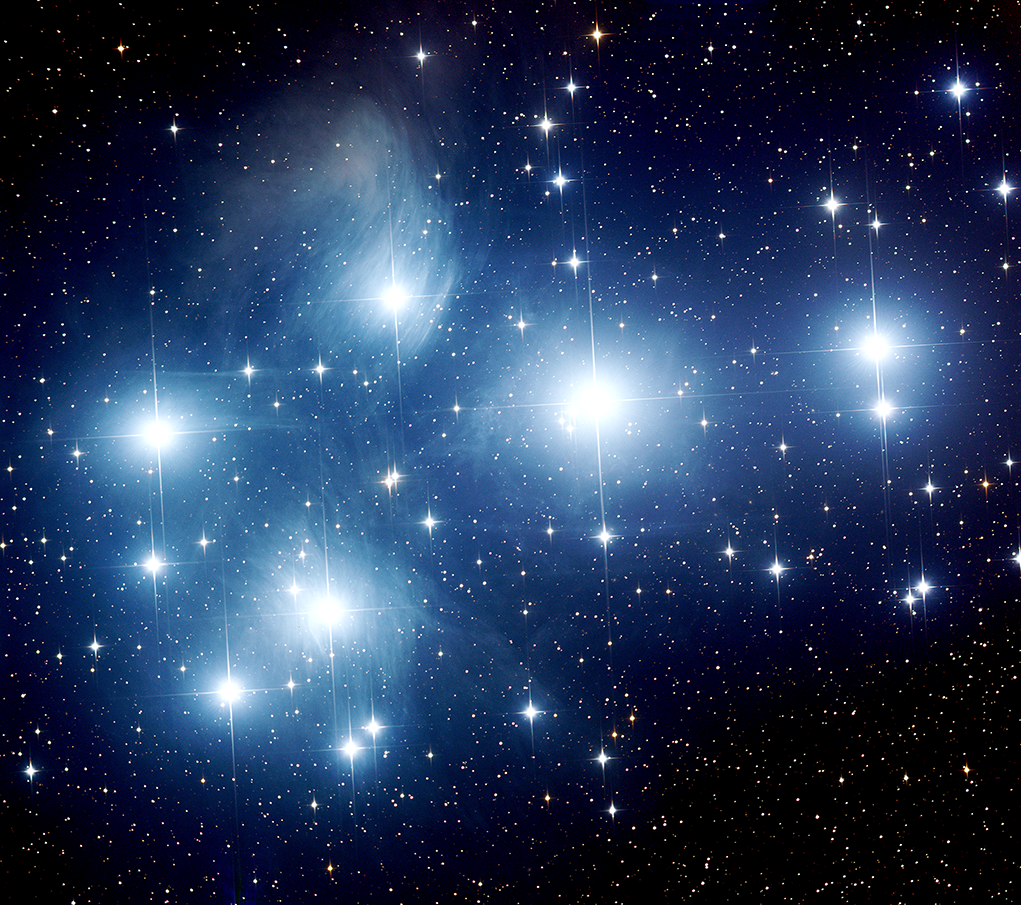
| M45 - The Pleiades imaged at LRGB 600 sec, 2x2 bin on ATEO-1 by Insight Observatory. |
The Pleiades
November is sometimes called "the month of the Pleiades," since the star cluster is visible all night long for observers in the Northern hemisphere. From a dark sky site, M45 is easy to see with the unaided eye and resembles a small "teaspoon" pattern in the sky. Use astronomy binoculars for immersive views of this open star cluster, or use a telescope with a lower-power eyepiece for a closer look at the Seven Sisters.
November 26th will be the best time of the month to observe the fainter deep-sky objects such as galaxies and star clusters because there is no moonlight to interfere.
 |
| Radiant of the Leonid Meteor Shower - Illustration by Universe Today. |
Leonids Meteor Shower
Bundle up and get outside after midnight on November 17th to see the peak of the Leonids meteor shower as "shooting stars" appear to radiate outwards from the constellation Leo. The Moon will rise just before midnight, so the best time for meteor gazing will be before then when the skies will be nice and dark. The estimated peak rate is about 15 meteors per hour.
Double Cluster in Perseus
Use a pair of big binoculars or a shorter focal length telescope with a wide-field eyepiece in November to seek out the sparkling Double Cluster in Perseus - two side-by-side open star clusters NGC 884 and NGC 869.
All objects described above can easily be seen with the suggested equipment from a dark sky site, a viewing location some distance away from city lights where light pollution and when bright moonlight does not overpower the stars.