-->

Bringing the Universe to Classrooms
and Homes Around the World!

What's Happening at Insight Observatory...

Showing posts with label new moon. Show all posts

Friday, April 2, 2021

Deep-Sky Targets for New Moon - April 2021

The New Moon is fast approaching! Here are some deep-sky target suggestions for imaging on the Astronomical Telescopes for Educational Outreach (ATEO) remote telescope locations by Insight Observatory's partner, Telescopius.com...

M4 - Globular Cluster

M4 - Globular Cluster
Constellation Scorpius
Mag.: 5.40 - Size: 36'
RA 16hr 23' 35" DEC -27º 28' 30"
ATEO-3 - Deep Sky Chile - altitude 87.1º at 05:29 hrs
Tr 16 - Open cluster

Tr 16 - Open Cluster
Constellation Carina
Mag.: 5.00 – Size: 10'
RA 10hr 45' 06" DEC -60º 16' 59"
ATEO-3 - Deep Sky Chile - altitude 87.1º at 05:29 hrs
M101 - Pinwheel Galaxy

M101 - Pinwheel Galaxy
Constellation Ursa Major
Mag.: 7.90 – Size: 28.8'
RA 14hr 03' 12" DEC 54º 20' 58"
ATEO-1 - SkyPi Remote Observatory - altitude 70.0º at 02:34 hrs.
M67 - Open Cluster

M67 - Open Cluster
Constellation Cancer
Mag.: 6.90 – Size: 25'
RA 08hr 51' 17" DEC 11º 48' 59"
ATEO-2A - SkyPi Remote Observatory - altitude 67.5º at 21:22 hrs.
M8 - Lagoon Nebula

M8 - Lagoon Nebula
Constellation Sagittarius
Mag.: 5.00 – Size: 45'
RA 18hr 03' 41" DEC -25º 37' 00"
ATEO-3 - Deep Sky Chile - altitude 84.9° at 07:09 hrs.
M3 - Globular Cluster

M3 - Globular Cluster
Constellation Canes Venatici
Mag.: 6.30 – Size: 18'
RA 13hr 42' 11" DEC 28º 22' 34"
ATEO-1 - SkyPi Remote Observatory - altitude 84.1º at 02:13 hrs.
IC 2948 - Bright Nebula

IC 2948 - Bright Nebula
Constellation Centaurus
Mag.: 7.00 – Size: 1.3º
RA 11hr 39' 24" DEC -64º 31' 59"
ATEO-3 - Deep Sky Chile - altitude 56.0° at 00:45 hrs.
HCG 44 - Galaxy Cluster

HCG 44 - Galaxy Cluster
Constellation Leo
Mag.: 10.00 – Size: 16.4'
RA 10hr 18' 00" DEC 21º 48' 43"
ATEO-1 - SkyPi Remote Observatory - altitude 77.5º at 22:49 hrs.
NGC 3324 - Gabriela Mistral Nebula

NGC 3324 - Gabriela Mistral Nebula
Constellation Carina
Mag.: 6.70 – Size: 16'
RA 10hr 37' 18" DEC -59º 19' 59"
ATEO-3 - Deep Sky Chile - altitude 60.8° at 23:43 hrs.
NGC 5033 - Spiral Galaxy

NGC 5033 - Spiral Galaxy
Constellation Canes Venatici
Mag.: 10.20 – Size: 10.7'
RA 13hr 13' 27" DEC 36º 35' 36"
ATEO-1 - SkyPi Remote Observatory - altitude 87.7º at 01:44 hrs

Help support Insight Observatory's educational outreach efforts by submitting your deep-sky image requests today on our Personal Image Request (PIR) application or logging in to your ATEO Portal account to request on our Basic or Advanced Image Request forms.
Read More

Wednesday, July 1, 2020

What's In The Sky - July 2020

Get ready for summer stargazing! With the weather warming up, July is a great time of year to enjoy relaxing evenings under starry skies with your telescope or astronomy binoculars. Here are a few of Orion Telescopes and Binoculars picks for July stargazing...

Gas Giants at Opposition

Jupiter and Saturn both reach opposition one week apart this year, making July the perfect opportunity for planetary viewing! Opposition is when the Earth passes directly between a planet and the Sun. This coincides with the planets closest approach to Earth, providing an excellent opportunity for great views in a telescope. Both planets are easy to find in the Southern sky, about 7 degrees apart from each other. Jupiter reaches opposition on July 14th and Saturn about a week later on the 20th. During opposition, Saturn’s rings will be inclined at 21 degrees towards Earth, close to their maximum angle of 27 degrees. Combined with the planet's close approach to Earth, this makes July an excellent time to observe Saturn and its rings!

Jupiter imaged on 12/07/2012 with an Orion 180mm Maksutov-Cassegrain Telescope Optical Tube. Imaged by Cherdphong V. from Bangkok, Thailand.

Grab a high magnification eyepiece or a Barlow lens, and check out the gas giants during opposition!

New Moon

July 20th is the darkest night of the month and therefore the best time to observe the more faint objects like galaxies and star clusters. Grab your observing gear and enjoy!

Hercules almost directly overhead and Scorpius

With constellation Hercules almost directly overhead and Scorpius to the south, there's plenty to see in July skies as summer continues. Check out globular star clusters M13 and M92 in Hercules, and explore Scorpius to find numerous deep-sky objects including open clusters M6 and M7, and globular clusters M4 and M80.

The Summer Milky Way

From a dark sky location in mid-July, the glorious Summer Milky Way shines as a band of light that stretches from the southern horizon to nearly overhead. As the night progresses, the Milky Way will arch across the entire sky. From a dark observing site, scan the Milky Way with 50mm or larger binoculars or a wide-angle telescope to explore some of the hundreds of open star clusters, emission nebulae and planetary nebulae that lurk among the star clouds.

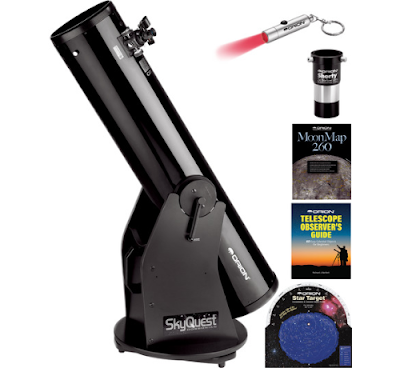
Orion SkyQuest XT8 Classic Dobsonian Telescope Kit.

July Challenge Object — Hercules Galaxy Cluster

About half a billion light-years from Earth in the constellation Hercules, not far from the star Beta Hercules in the southwest corner of the "keystone" asterism, lies the "Hercules Galaxy Cluster." This association is a group of 200-300 distant galaxies, the brightest of which is NGC 6050 at about 10th magnitude and can be seen with an 8" reflector like the Orion SkyQuest XT8 Classic Dobsonian under very dark skies with good seeing conditions. A larger aperture, 14"-16" telescope like the Orion SkyQuest XX14g GoTo Truss Dobsonian will begin to show about a half-dozen or more galaxies in one field-of-view. How many can you see in your telescope?

Orion SkyQuest XX14g GoTo Truss Tube Dobsonian Telescope.

All objects described above can easily be seen with the suggested equipment from a dark sky site, a viewing location some distance away from city lights where light pollution and when bright moonlight does not overpower the stars.
Read More

Saturday, February 1, 2020

What's In The Sky - February 2020

Clear February nights present some great stargazing opportunities. Be sure to bundle up and keep warm while you get outside for some stargazing fun!

Here are a few of Orion Telescopes and Binoculars' top picks for February stargazing:

New Moon

February 23rd should be one of the best nights for deep-sky viewing as the New Moon phase will provide the darkest night of the short month. Use Orion Broadband Filters to enhance your view.

On the evening of Monday, Feb. 10, Mercury (orbit is shown as red curve) will reach its widest separation, 18 degrees east of the sun. With Mercury sitting above a nearly vertical evening ecliptic, this will be the best appearance of the planet in 2020 for Northern Hemisphere observers. The optimal viewing times fall between 6 and 7 p.m. local time. Viewed in a telescope (inset), the planet will exhibit a waning half-illuminated phase. Image credit: Starry Night.
On the evening of Monday, February 9th, Mercury (orbit is shown as a red curve) will reach its widest separation, 18 degrees east of the sun. With Mercury sitting above a nearly vertical evening ecliptic, this will be the best appearance of the planet in 2020 for Northern Hemisphere observers. The optimal viewing times fall between 6 and 7 p.m. local time. Viewed in a telescope (inset), the planet will exhibit a waning half-illuminated phase. Image credit: Starry Night.

Mercury High In The Sky

On February 9th, Mercury will be at its greatest eastern elongation, meaning it is at its greatest separation from the Sun. Mercury will be at an altitude of approximately 16 degrees when the Sunsets at 17:34 PST, making it an ideal time to observe this tricky target.

Planetary Lineup Get up early on President's Day, February 17th, to see a lineup of three planets and the Moon. At dawn, the crescent Moon and Mars, Jupiter, and Saturn will form a line spanning about 39 degrees in the southeastern sky.

Before sunrise on the next day, February 18th, viewers in North America can watch the Moon occult Mars! Better yet, try snapping a sequence of high-magnification pics of the event.

Betelgeuse In The News

Betelgeuse has been in the news lately since dimming down to a magnitude of around 1.5, the lowest brightness in more than a century. The red supergiant is normally variable, but the unusual dimming has brought up the question of whether a supernova is imminent. Betelgeuse is close enough that if it went supernova it would be brighter than the full moon, a spectacular astronomical event. However, the consensus is that this probably won't be happening soon. The best estimate is sometime in the next 100,000 years, so it is more likely that this variability is normal, and we've still got a few millennia before the light show.

It may not be as flashy, but if you want to see a supernova now astronomer Koichi Itagaki discovered a supernova on January 12th. Located in the galaxy NGC 4636 in the constellation Virgo, it should be visible with a 6" or larger telescope. Referred to as SN2020ue, it is currently at magnitude 12.1 and should be visible under dark skies at around 60-100x magnification as a dim star just outside of the galaxy's core.


Galaxies M81 and M82 in Ursa Major - 5 x 300 Second LRGB Image by Insight Observatory.

Bright Galaxies

In late February, bright galaxies M81 and M82 will be about as high in the sky as they will get for North American stargazers. From a dark sky site, these galaxies are visible with a 50mm or larger binocular, but we suggest you use a large telescope to chase these galaxies down just off the leading edge of the Big Dipper asterism. Many observers consider M81 & M82 the best pairing of visual galaxies in the sky!

If you would like to receive image data of galaxies such as M81 and M82 and other deep-sky objects taken on the Astronomical Telescopes for Educational Outreach (ATEO), please visit Insight Observatory's Custom Image Data Request form.

All objects described above can easily be seen with the suggested equipment from a dark sky site, a viewing location some distance away from city lights where light pollution and when bright moonlight does not overpower the stars.
Read More