-->

Bringing the Universe to Classrooms
and Homes Around the World!

What's Happening at Insight Observatory...

Showing posts with label Orion Nebula. Show all posts

Tuesday, March 2, 2021

What's In The Sky - March 2021

Take your family on a journey to the stars from the comfort of your own backyard! Here are some of Orion Telescope and Binoculars' top picks for March stargazing:

Orion Continues to Shine

Constellation Orion is still well-placed in March skies for telescopic study. Check out the bright nebula M42, also called the Orion Nebula, which is visible as the middle "star" of Orion's "sword" just south of the three recognizable stars of Orion's belt. While easily detected in astronomy binoculars, the wispy Orion Nebula will reveal more intricate details in a telescope. After March, Orion's namesake constellation will get lower and lower in the west, making it harder to see as the Sun moves eastward in the sky.

Planetary group of Saturn, Jupiter, Mercury, and the Moon in the south-eastern sky on March 10th around 5:40 am MST. Graphic created from Stellarium.

Morning Planetary Group

March 10th brings a nice group of planets. Saturn, Jupiter, Mercury, and the Moon will all be grouped together. Get up early, grab a telescope and take a look!

M45 - The Pleiades star cluster (left) imaged on ATEO-1 and processed by Chris Lin using Insight Observatory's online Personal Image Request (PIR) application and the Double Cluster in Perseus imaged and processed by ATEO-1 user Claudio Tenreiro.
M45 - The Pleiades star cluster (left) was imaged on ATEO-1 and processed by Chris Lin using Insight Observatory's online Personal Image Request (PIR) application and the Double Cluster in Perseus was imaged and processed by ATEO-1 user Claudio Tenreiro.

Brilliant Binocular Clusters

Grab a pair of 50mm or larger astronomy binoculars in March for great views of the Pleiades star cluster (M45), the Beehive cluster (M44), and the must-see Double Cluster in Perseus. These sparkling sky gems are simply beautiful when observed with big binoculars, or use a wide-field eyepiece and short focal length telescope for a closer look.

Leo Triplet of galaxies M65, M66, and NGC 3628 (left) imaged and processed on ATEO-1 by Utkarsh Mishra and M51 - The Whirlpool Galaxy imaged on ATEO-1 and processed by Jeff Padell using Insight Observatory's online Personal Image Request (PIR) application.

Galaxies Galore

By about 9-10pm throughout March, Ursa Major, Leo, and the western edge of the Virgo galaxy cluster are high enough in the eastern sky to yield great views of some of our favorite galaxies. Check out the bright pair of M81 and M82 just above the Big Dipper asterism. Look east of bright star Regulus to observe the Leo Triplet of galaxies M65, M66, and NGC 3628. In the northeastern sky, check out the famous Whirlpool Galaxy (M51). While the Whirlpool can be seen with modest 50mm binoculars, using a 10" or 12" telescope in a location with dark skies will display the distant galaxy's beautiful spiral arms. With an 8" or larger telescope and a dark sky, this region of the sky harbors dozens of galaxies - try to find them all!

All objects described above can easily be seen with the suggested equipment from a dark sky site, a viewing location some distance away from city lights where light pollution and when bright moonlight does not overpower the stars.
Read More

Friday, January 1, 2021

What's In The Sky - January 2021

January kicks off the New Year with wonderful sights for backyard astronomers to enjoy. Don't forget to bundle up on clear, cold evenings as you explore the sparkling night sky. Here are a few top picks for January stargazers from Orion Telescopes and Binoculars...

Quadrantid Meteor Shower

Bundle up and get outside on the night of January 2nd into the early morning hours of the 3rd to see the Quadrantids meteor shower peak. Some meteors associated with the Quadrantids are expected to be visible until January 12th, but the shower peaks after midnight on the night of January 2nd-3rd, with up to 120 meteors expected per hour. This year, the waning gibbous Moon will outshine fainter meteors, but you can still enjoy the brightest "shooting stars" as they appear to radiate from the constellation Boötes. You don't need a telescope to enjoy the show, just a clear, dark sky and a comfy chair or blanket.

Stargazers pointing out the constellation Orion. Original image by Night Skygaze.
Stargazers point out the constellation Orion. Original image by Night Skygaze.

Hunting the Hunter

Our favorite constellation, Orion, continues to be high in the night sky in January, providing backyard astronomers with spectacular sights throughout the month. Take a closer look at the middle star of Orion's sword with binoculars to reveal amazing views of the bright emission nebula M42. Use a telescope to resolve the system of four "newborn" stars that form a trapezoid at the center of M42, known as the Trapezium. If you'll be viewing in a light-polluted area, use an Orion UltraBlock filter to boost contrast for better views.

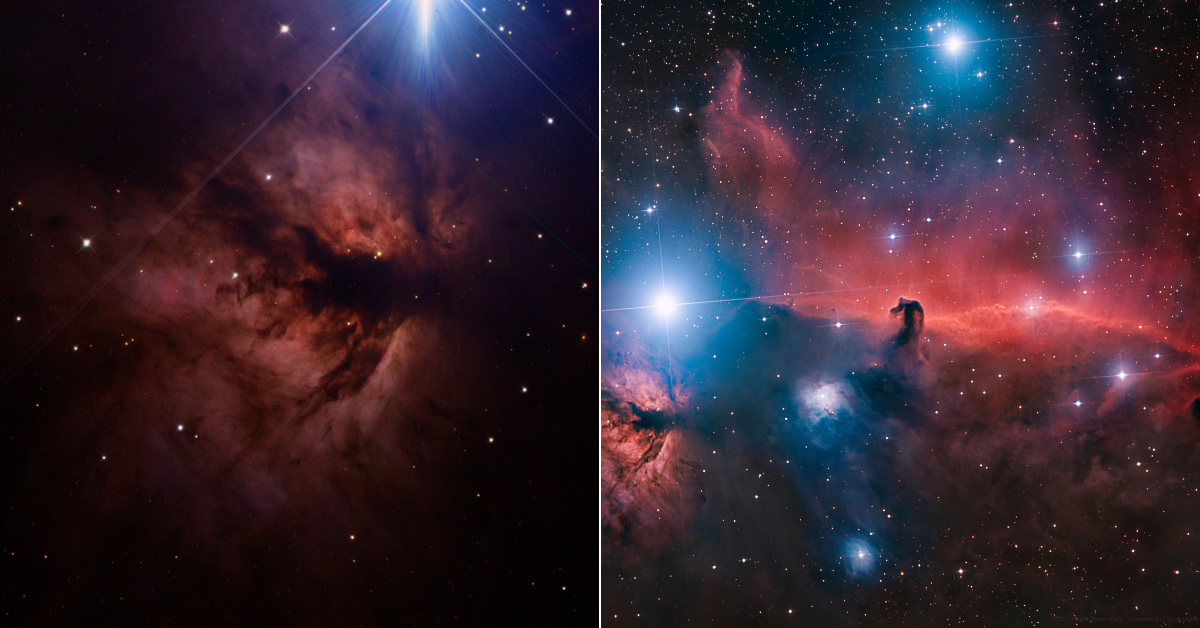
NGC 2024 -The Flame Nebula imaged by students from Barnstable High School, MA using remote telescope, ATEO-3 located in Chile (left) and Barnard 33 - The Horsehead Nebula processed by Insight Observatory Starbase subscriber, Daniel Nobre.
NGC 2024 -The Flame Nebula imaged by students from Barnstable High School, MA, using a remote telescope, ATEO-3 located in Chile (left), and Barnard 33 - The Horsehead Nebula processed by Insight Observatory Starbase subscriber, Daniel Nobre.

Just above Alnitak, the easternmost star of Orion's belt, the Flame Nebula (NGC 2024) can be found in larger telescopes. Dark lanes of dust give this emission nebula its fiery appearance. The picturesque absorption nebula Barnard 33, also called the Horsehead Nebula, can be found in large telescopes just south of Alnitak. Use a Hydrogen-Beta filter to improve your chances of spotting the elusive Horsehead.

Reflection nebula, M78 in the constellation Orion imaged on ATEO-1 by Vincent M. using Insight Observatory's online Personal Image Request (PIR) application (left) and M42 - The Orion Nebula imaged on ATEO-3 by 5th-grade students from Plymouth South Elementary School, MA (right).
Reflection nebula, M78 in the constellation Orion, imaged on ATEO-1 by Vincent M. using Insight Observatory's online Personal Image Request (PIR) application (left), and M42 - The Orion Nebula imaged on ATEO-3 by 5th-grade students from Plymouth South Elementary School, MA (right).

Scan the skies above and to the east of belt star Alnitak to find reflection nebula M78. Since M78 is much fainter than M42, a 4.5" or larger telescope is recommended for the best views.

Hind's Crimson Star

Just South of Orion is the constellation Lepus, the Hare. In the constellation Lepus, you can catch a glimpse of the rare winter globular cluster M79, as well as R Lepori, a well-known variable star that varies between magnitudes +5.5 (just visible to the naked eye) to +11.7 with a period of about 427 days. What's interesting about this star is that because it is a "carbon star," it is very red; when at its brightest, the red color is unmistakable.

January Challenge Object

Just west of Rigel, the bright blue/white star that marks the western "knee" of Orion, lies the Witch Head Nebula (IC 2118), in the neighboring constellation Eridanus. The Witch-Head is a reflection nebula that shines from reflected light off of Rigel, like the reflection nebula in the Pleiades, M45. You don't need a big telescope; a wide field of view, low power, and a dark sky are needed to see this challenging nebula. (Hint: Don't use filters).

IC 2118 - The Witch Head Nebula imaged on ATEO-1
by Tom L. using Insight Observatory's online
Personal Image Request (PIR) application.

All objects described above can easily be seen with the suggested equipment from a dark sky site, a viewing location some distance away from city lights, where light pollution and bright moonlight do not overpower the stars.
Read More

Sunday, March 1, 2020

What's In The Sky - March 2020

Take your family on a journey to the stars from the comfort of your own backyard! Here are some of Orion Telescopes and Binoculars' top picks for March stargazing:

M42, The Orion Nebula imaged on Insight Observatory's ATEO-3 remote telescope by Jimmy D. from Plymouth South Middle School, Plymouth, Massachusetts.

Orion Continues to Shine

Constellation Orion is still well-placed in March skies for telescopic study. Check out the bright nebula M42, also called the Orion Nebula, which is visible as the middle "star" of Orion's "sword" just south of the three recognizable stars of Orion's belt. While easily detected in astronomy binoculars, the wispy Orion Nebula will reveal more intricate details in a telescope. After March, our namesake constellation will get lower and lower in the west, making it harder to see as the Sun moves eastward in the sky.

Brilliant Binocular Clusters

Grab a pair of 50mm or larger astronomy binoculars in March for great views of the Pleiades star cluster (M45), the Beehive cluster (M44), and the must-see Double Cluster in Perseus. These sparkling sky gems are simply beautiful when observed with big binoculars, or use a wide-field eyepiece and short focal length telescope for a closer look.

Galaxies M81 and M82 in Ursa Major imaged on Insight Observatory's ATEO-1 remote telescope and processed by Utkarsh Mishra from almost 5 hours of image data.
Galaxies M81 and M82 in Ursa Major were imaged on Insight Observatory's ATEO-1 remote telescope and processed by Utkarsh Mishra from almost 5 hours of image data.


Galaxies Galore

By about 9-10pm throughout March, Ursa Major, Leo, and the western edge of the Virgo galaxy cluster are high enough in the eastern sky to yield great views of some of our favorite galaxies. Check out the bright pair of M81 and M82 just above the Big Dipper asterism. Look east of bright star Regulus to observe the Leo Triplet of galaxies M65, M66, and NGC 3628. In the northeastern sky, check out the famous Whirlpool Galaxy (M51). While the Whirlpool can be seen with modest 50mm binoculars, using a 10" or 12" telescope in a location with dark skies will display the distant galaxy's beautiful spiral arms. With an 8" or larger telescope and a dark sky, this region of the sky harbors dozens of galaxies — try to find them all!

Orion Telescopes and Binoculars 10", 12" and 8" Dobsonian Telescopes are ideal for viewing deep-sky objects such as M42, the Orion Nebula and galaxies M81 and M82 in Ursa Major. Image credits: Orion Telescope and Binoculars.
Orion Telescopes and Binoculars 10", 12", and 8" Dobsonian Telescopes are ideal for viewing deep-sky objects such as M42, the Orion Nebula, and galaxies M81 and M82 in Ursa Major. Image credits: Orion Telescope and Binoculars.

Morning Close Approaches

Starting on March 19th and for the next two mornings, Mars and Jupiter will be less than 1 degree apart. At around 60x magnification they should both fit in the field of view of a telescope. The pair rise around 04:30 in the southeastern sky, and for observers near 40 degrees latitude will reach an altitude of approximately 25 degrees by sunrise at 07:00. Saturn isn't too far away either, about 7 degrees away from the pair that morning.

On March 31st Mars continues its trek across the morning sky to meet with Saturn for a close approach of 54 arcminutes as the Sun rises.

All objects described above can easily be seen with the suggested equipment from a dark sky site, a viewing location some distance away from city lights where light pollution and when bright moonlight does not overpower the stars.
Read More