-->

Bringing the Universe to Classrooms
and Homes Around the World!

What's Happening at Insight Observatory...

Showing posts with label dobsonian. Show all posts

Wednesday, July 1, 2020

What's In The Sky - July 2020

Get ready for summer stargazing! With the weather warming up, July is a great time of year to enjoy relaxing evenings under starry skies with your telescope or astronomy binoculars. Here are a few of Orion Telescopes and Binoculars picks for July stargazing...

Gas Giants at Opposition

Jupiter and Saturn both reach opposition one week apart this year, making July the perfect opportunity for planetary viewing! Opposition is when the Earth passes directly between a planet and the Sun. This coincides with the planets closest approach to Earth, providing an excellent opportunity for great views in a telescope. Both planets are easy to find in the Southern sky, about 7 degrees apart from each other. Jupiter reaches opposition on July 14th and Saturn about a week later on the 20th. During opposition, Saturn’s rings will be inclined at 21 degrees towards Earth, close to their maximum angle of 27 degrees. Combined with the planet's close approach to Earth, this makes July an excellent time to observe Saturn and its rings!

Jupiter imaged on 12/07/2012 with an Orion 180mm Maksutov-Cassegrain Telescope Optical Tube. Imaged by Cherdphong V. from Bangkok, Thailand.

Grab a high magnification eyepiece or a Barlow lens, and check out the gas giants during opposition!

New Moon

July 20th is the darkest night of the month and therefore the best time to observe the more faint objects like galaxies and star clusters. Grab your observing gear and enjoy!

Hercules almost directly overhead and Scorpius

With constellation Hercules almost directly overhead and Scorpius to the south, there's plenty to see in July skies as summer continues. Check out globular star clusters M13 and M92 in Hercules, and explore Scorpius to find numerous deep-sky objects including open clusters M6 and M7, and globular clusters M4 and M80.

The Summer Milky Way

From a dark sky location in mid-July, the glorious Summer Milky Way shines as a band of light that stretches from the southern horizon to nearly overhead. As the night progresses, the Milky Way will arch across the entire sky. From a dark observing site, scan the Milky Way with 50mm or larger binoculars or a wide-angle telescope to explore some of the hundreds of open star clusters, emission nebulae and planetary nebulae that lurk among the star clouds.
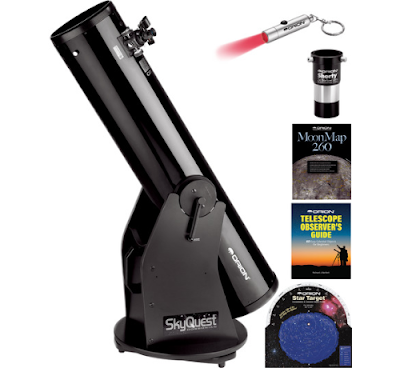
Orion SkyQuest XT8 Classic Dobsonian Telescope Kit.

July Challenge Object — Hercules Galaxy Cluster

About half a billion light-years from Earth in the constellation Hercules, not far from the star Beta Hercules in the southwest corner of the "keystone" asterism, lies the "Hercules Galaxy Cluster." This association is a group of 200-300 distant galaxies, the brightest of which is NGC 6050 at about 10th magnitude and can be seen with an 8" reflector like the Orion SkyQuest XT8 Classic Dobsonian under very dark skies with good seeing conditions. A larger aperture, 14"-16" telescope like the Orion SkyQuest XX14g GoTo Truss Dobsonian will begin to show about a half-dozen or more galaxies in one field-of-view. How many can you see in your telescope?

Orion SkyQuest XX14g GoTo Truss Tube Dobsonian Telescope.

All objects described above can easily be seen with the suggested equipment from a dark sky site, a viewing location some distance away from city lights where light pollution and when bright moonlight does not overpower the stars.
Read More

Monday, June 1, 2020

What's In The Sky - June 2020

Get ready for summer stargazing! With the weather warming up, June is a great time of year to enjoy relaxing evenings under starry skies with your telescope or astronomy binoculars. Here are a few of Orion Telescopes and Binoculars' top picks for June 2020 stargazing and observing:

Solar System Trio

Rising in the southeast on June 7th and 8th, Jupiter, Saturn, and the Moon are well placed for observation, with 5 degrees of separation between Jupiter and Saturn. On the 7th the Moon approaches Jupiter with a separation of 6 degrees, and on the 8th it is 4.5 degrees away from Saturn. They will rise around 11pm, and reach their highest point in the sky around 4am, providing ample observing time. Grab a planetary guide set to identify surface details or a Barlow lens for high-magnification viewing!

M13 - The Great Globular Cluster in Hercules imaged on Insight Observatory's 16" f/3.7 astrograph reflector (ATEO-1). Image data acquired by Muir Evenden and processed by Utkarsh Mishra.
M13 - The Great Globular Cluster in Hercules imaged on Insight Observatory's 16" f/3.7 astrograph reflector (ATEO-1). Image data was acquired by Muir Evenden and processed by Utkarsh Mishra.

Summer is the Globular Season!

Globular star clusters are densely packed balls of stars that are concentrated toward the center of the Milky Way. June skies offer some of the finest globular cluster viewing opportunities. While you can detect most globular clusters in 50mm or larger binoculars, a moderate to the high-power eyepiece in a 6" or larger telescope offers the best chance to resolve individual stars. In the constellation Hercules, look for M92 and the "Great Cluster" M13. In Scorpius, look for M4 and M80. The constellation Ophiuchus is home to six globulars - M10, M12, M14, M107, M9, and M19. Can you spot them all?

Summertime Staycation

Take advantage of the New Moon on June 20th and the galaxies and globular clusters visible for a great Staycation at home! Not only will the dark skies of the moonless night provide great opportunities to see fainter objects more clearly, but the warm June weather will make it easy to enjoy starry sights all night long. The New Moon also brings an annular solar eclipse, but this is only visible from parts of Africa and Asia.

M51 - The Whirlpool Galaxy in Canes Venatici (left) and M101 - The Pinwheel Galaxy (right) in Ursa Major imaged on Insight Observatory's ATEO-1 by Michael Petrasko (M51) and Utkarsh Mishra (M101).
M51 - The Whirlpool Galaxy in Canes Venatici (left) and M101 - The Pinwheel Galaxy (right) in Ursa Major imaged on Insight Observatory's ATEO-1 by Michael Petrasko (M51) and Utkarsh Mishra (M101). 

Swirling Spirals

Around 10pm in mid-June, two glorious, face-on spiral galaxies M51 and M101 will both be in a great position for viewing and imaging. Look for M51, the Whirlpool Galaxy, to the southwest of the star Alkaid at the end of the Big Dipper's "handle". Scan the sky to the northeast of Alkaid to find M101, the Pinwheel Galaxy. Under very dark skies, these distant galaxies can barely be detected in smaller telescopes, but a 10" or larger reflector will reveal much more impressive views. If you're viewing from an especially dark location, try to resolve the delicate spiral arms of M51 in a 10" or larger telescope.


Orion Telescopes and Binoculars 10" Dobsonian Telescopes

Gems of the Summer Triangle

By 10pm in mid-northern latitudes, the Summer Triangle, comprising beacon stars Vega (in Lyra), Deneb (in Cygnus), and Altair (in Aquila), will be fully visible above the horizon. Several celestial gems lie within its confines, including the Ring Nebula (M57), the Dumbbell Nebula (M27), open star cluster M29, and the visually challenging Crescent Nebula (NGC 6888). To catch a glimpse of the elusive Crescent, you'll almost certainly need an Orion Oxygen-III Filter in a larger telescope.

Summer Sky Challenge

Discovered in 1825 by the German astronomer Friedrich Georg Wilhelm von Struve, NGC 6572 is bright enough to be seen in a humble 60mm refractor telescope from a dark sky site; but it is very, very small! At only 8 arc seconds in size, it takes a lot of magnification to distinguish this from a star. The easiest way to find it is to look in the target area for a green star. NGC 6572 is one of the most intensely colored objects in the night sky. Some say this is green, and some say it is blue; what do you think?

All objects described above can easily be seen with the suggested equipment from a dark sky site, a viewing location some distance away from city lights where light pollution and when bright moonlight does not overpower the stars.
Read More

Friday, May 1, 2020

What's In The Sky - May 2020

Get outside with your telescope on clear May evenings to see celestial treats! With the weather warming up and skies clearing up, there's no shortage of celestial delicacies to view with telescopes and binoculars. Here are a few of Orion Telescopes and Binoculars' top suggestions for May observing:

Eta Aquarid Meteor Shower

Grab a blanket or a comfy lounge chair to sit back, relax and watch the Eta Aquarids meteor shower, one of two annual showers caused by dust particles from Halley's Comet. Catch the peak of the dazzling show before dawn on May 5th. The approximate peak rate is 10-30 per hour, but meteors should be visible from April 19th through May 28th. Look for meteors appearing to radiate from the constellation Aquarius. We've selected some useful equipment for viewing meteor showers, including ultra-wide-angle binoculars, and star charts.

M97, The Owl Nebula in Ursa Major imaged on Insight Observatory's 16" f/3.7 astrograph reflector (ATEO-1).

Four Big Planetary Nebulae

Use a 6" or larger telescope and an Oxygen-III filter to catch nice views of four relatively large planetary nebulae in May skies. See the "Ghost of Jupiter," NGC 3242 in Hydra; M97, "the Owl Nebula" in the Big Dipper; NGC 4361 in Corvus, and the famous "Ring Nebula", M57 in Lyra just a few degrees from the bright star Vega. To help you locate these objects, use the Orion DeepMap 600.

New Moon, Dark Skies

Take advantage of the dark skies provided by the New Moon on May 22nd to scope out the many star clusters, galaxies, and other deep-sky gems on display. Pack up your astronomy gear using our full line of telescope and accessory cases and head to a dark sky site for the best viewing conditions.

M13, The Great Cluster in Hercules (left) processed by Utkarsh Mishra and M3, a globular cluster in the northern constellation Canes Venatici by Michael Petrasko. Both clusters imaged on ATEO-1.
M13, The Great Cluster in Hercules (left) processed by Utkarsh Mishra, and M3, a globular cluster in the northern constellation Canes Venatici by Michael Petrasko. Both clusters were imaged on ATEO-1.

Five Glittering Globulars

Five picture-perfect examples of globular star clusters will be visible in May skies. Check out M3 in the constellation Bootes. M13, the "Great Cluster in Hercules" will be visible near the zenith. M5 can be found in Serpens and M92 in the northern section of Hercules. Be sure to track down M4 (NGC 6121) in Scorpius on May 27th, as it will be in a great position for telescopic study throughout the night, reaching zenith around midnight. Big telescopes will provide the best views, but even a pair of humble 50mm or larger binoculars will show you these dense balls of stars from a dark sky site.

M101, The Pinwheel Galaxy in Ursa Major processed by Utkarsh Mishra and Michael Petrasko (left) and M51, The Whirpool Galaxy in Canes Venatici (right) imaged on ATEO-1 processed by Michael Petrasko.

Four Face-On Spirals

Use a large telescope to see the classic pinwheel shapes of galaxies M101 and M51 in the Big Dipper asterism of Ursa Major, and M99 and M100 in the Virgo galaxy cluster. There are also dozens of additional galaxies to explore in the Virgo cluster with a large-aperture telescope.

May's Challenge Object

May skies present some of the best opportunities to grab a view of Omega Centauri - the brightest globular star cluster in the sky! While it's big and bright, even visible as a "fuzzy" star in binoculars, the challenge Omega Centauri presents is its low position in southern skies, which can make it unobservable from higher northern latitudes. If you're having trouble locating the famous globular cluster, Bruce McClure from EarthSky.org suggests letting the sparkling blue-white star Spica help you. He explains that when Spica climbs highest up for the night, so does Omega Centauri - look for it 35 degrees directly below Spica.

Classic Dobsonians from Orion Telescopes and Binoculars.
Classic Dobsonian Telescopes from Orion Telescopes and Binoculars.

All objects described above can easily be seen with the suggested equipment from a dark sky site, a viewing location some distance away from city lights where light pollution and when bright moonlight does not overpower the stars.
Read More