Showing posts with label mercury. Show all posts

Saturday, February 1, 2020

What's In The Sky - February 2020

Clear February nights present some great stargazing opportunities. Be sure to bundle up and keep warm while you get outside for some stargazing fun!

Here are a few of Orion Telescopes and Binoculars' top picks for February stargazing:

New Moon

February 23rd should be one of the best nights for deep-sky viewing as the New Moon phase will provide the darkest night of the short month. Use Orion Broadband Filters to enhance your view.

On the evening of Monday, Feb. 10, Mercury (orbit is shown as red curve) will reach its widest separation, 18 degrees east of the sun. With Mercury sitting above a nearly vertical evening ecliptic, this will be the best appearance of the planet in 2020 for Northern Hemisphere observers. The optimal viewing times fall between 6 and 7 p.m. local time. Viewed in a telescope (inset), the planet will exhibit a waning half-illuminated phase. Image credit: Starry Night.
On the evening of Monday, February 9th, Mercury (orbit is shown as a red curve) will reach its widest separation, 18 degrees east of the Sun. With Mercury sitting above a nearly vertical evening ecliptic, this will be the best appearance of the planet in 2020 for Northern Hemisphere observers. The optimal viewing times fall between 6 and 7 p.m. local time. Viewed in a telescope (inset), the planet will exhibit a waning half-illuminated phase. Image credit: Starry Night.

Mercury High In The Sky

On February 9th, Mercury will be at its greatest eastern elongation, meaning it is at its greatest separation from the Sun. Mercury will be at an altitude of approximately 16 degrees when the Sun sets at 17:34 PST, making it an ideal time to observe this tricky target.

Planetary Lineup: Get up early on President's Day, February 17th, to see a lineup of three planets and the Moon. At dawn, the crescent Moon and Mars, Jupiter, and Saturn will form a line spanning about 39 degrees in the southeastern sky.

Before sunrise on the next day, February 18th, viewers in North America can watch the Moon occult Mars! Better yet, try snapping a sequence of high-magnification pics of the event.

Betelgeuse In The News

Betelgeuse has been in the news lately since dimming down to a magnitude of around 1.5, the lowest brightness in more than a century. The red supergiant is normally variable, but the unusual dimming has brought up the question of whether a supernova is imminent. Betelgeuse is close enough that if it went supernova, it would be brighter than the full moon, a spectacular astronomical event. However, the consensus is that this probably won't be happening soon. The best estimate is sometime in the next 100,000 years, so it is more likely that this variability is normal, and we've still got a few millennia before the light show.

It may not be as flashy, but if you want to see a supernova now, astronomer Koichi Itagaki discovered a supernova on January 12th. Located in the galaxy NGC 4636 in the constellation Virgo, it should be visible with a 6" or larger telescope. Referred to as SN2020ue, it is currently at magnitude 12.1 and should be visible under dark skies at around 60-100x magnification as a dim star just outside of the galaxy's core.


Galaxies M81 and M82 in Ursa Major - 5 x 300 Second LRGB Image by Insight Observatory.

Bright Galaxies

In late February, bright galaxies M81 and M82 will be about as high in the sky as they will get for North American stargazers. From a dark sky site, these galaxies are visible with a 50mm or larger binocular, but we suggest you use a large telescope to chase these galaxies down just off the leading edge of the Big Dipper asterism. Many observers consider M81 & M82 the best pairing of visual galaxies in the sky!

If you would like to receive image data of galaxies such as M81 and M82 and other deep-sky objects taken on the Astronomical Telescopes for Educational Outreach (ATEO), please visit Insight Observatory's Custom Image Data Request form.

All objects described above can easily be seen with the suggested equipment from a dark sky site, a viewing location some distance away from city lights where light pollution does not overpower the stars, and when bright moonlight does not overpower the stars.
Read More

Sunday, December 8, 2019

The 2019 Mercury Transit

Transits of Mercury occur more frequently than transits of Venus, but the next Mercurian transit won't happen again until November 13, 2032!

A transit of Mercury happens only 13-14 times per century, currently, either in May or in November. But the reasons for their occurrence - at all - rely on Keplerian orbital elements, which are far too complex to even begin to describe here.

Map of where 2019 Mercury Transit was visible from.
Map of where the 2019 Mercury Transit was visible from.

The last transit before the most current one occurred on May 9, 2016. A typical transit lasts several hours. I timed the 5+ hour transit of November 11th, using SkySafari 5, for Android.

The 2019 Mercury Transit imaged on an 8" Schmidt-Cassegrain telescope with a Celestron Eclipsmart Solar Filter and a Canon 70D. Location was from the Costa Esmeralda Panama Republic of Panama. Images by Luis Velasquez.
The 2019 Mercury Transit was imaged on an 8" Schmidt-Cassegrain telescope with a Celestron Eclipsmart Solar Filter and a Canon 70D. The location was Costa Esmeralda, Panama, Republic of Panama. Images by Luis Velasquez.

According to that app, the transit began (from my location at Cape Cod) at 7:31:08 EST and ended at 12:57:25 EST, with the third contact (the eastern limb of the planet making contact with the Sun's Eastern limb) at 12:55:46 - a difference of 1.79 minutes. This brief interval demonstrates the small size of the planet against the size of the Sun.


Video of the 2019 Mercury Transit through some clouds courtesy of Luis Velasquez.


Dale Alan Bryant
Senior Contributing Science Writer
Read More

Thursday, August 1, 2019

What's In The Sky - August 2019

Warm summer nights seem like they're tailor-made for backyard astronomers. Evenings throughout August are great opportunities to get the whole family outside for summer stargazing fun with a telescope or your favorite pair of binoculars. Here are a few of Orion Telescopes and Binoculars' top picks for August stargazing...

Perseid Meteor Shower 2012. Image by David Kingham.

Perseid Meteor Shower

Go outside on the night of August 12th-13th for the best chances to see the peak of the Perseid meteor shower! Some may be visible each night from July 23rd through August 20th, but the peak is on the 12th -13th. Unfortunately, the Moon will be 12 days old at this time, which will limit visibility due to its brightness. However, with up to 80 meteors per hour expected at maximum, this is still one of the most popular meteor showers of the year.

Mercury high in the sky

On the morning of August 9th, Mercury will be at its greatest Western elongation, rising early before sunrise. Because Mercury is so close to the Sun, it is best viewed during an elongation like this, since it is at its maximum separation from the Sun. Look above the Eastern horizon before sunrise to catch a glimpse of the innermost planet!

Messier 16, the Eagle Nebula imaged by Utkarsh Mishra and Zhuoqun Wu.
Messier 16, the Eagle Nebula, imaged by Utkarsh Mishra and Zhuoqun Wu.

Nebulas

Many excellent examples of gaseous nebulas are on display in the skies of August. The brightest are M16, the Eagle Nebula, M17, the Swan Nebula, M20, the Trifid Nebula, and the very bright M8, the Lagoon Nebula. All are visible in binoculars from dark locations with good seeing. Use a small to moderate aperture telescope with the aid of an Oxygen-III eyepiece filter or SkyGlow Broadband Filter to see these nebulae from locations plagued by light pollution.

New Moon

New Moon is August 30th and therefore the best time to observe the fainter objects like galaxies and star clusters. Grab your gear and enjoy!

August Challenge Object

Orion's challenge this month is a surprisingly easy object to see with a telescope, but not so easy with binoculars. Look for M27, the Dumbbell Nebula in the constellation of Vulpecula, just south of Cygnus. M27 is one of the nearest and brightest planetary nebulae visible from Earth. It's so big that it can be spotted in humble 7 x 50 binoculars, but it does present a challenge! Try to track M27 down this August with your astronomy binoculars; it will be a small dot, slightly larger than the surrounding stars, but definitely visible through 50mm or larger binoculars.

All objects described above can easily be seen with the suggested equipment from a dark sky site, a viewing location some distance away from city lights where light pollution and bright moonlight do not overpower the stars.
Read More

Thursday, November 1, 2018

What's In the Sky - November 2018

Clear November night skies offer incredible celestial sights for stargazers to be thankful for, so bundle up and get outside for stargazing fun! Brought to you by Orion Telescopes and Binoculars.

Taurids Meteor Shower

On the night of November 5, the Taurids Meteor Shower will peak, and with an early setting moon, there should be desirable dark skies for viewing. Look near the constellation Taurus, but be aware that meteors can appear anywhere in the sky.

Radiant of the Leonid Meteor Shower - Graphic by Univers Today.
Radiant of the Leonid Meteor Shower - Illustration by Universe Today.

Leonid Meteor Shower

Bundle up and get outside after midnight on November 17th to see the peak of the Leonids meteor shower as "shooting stars" appear to radiate outwards from the constellation Leo. The waxing gibbous Moon will set shortly after midnight, so the best time for meteor-gazing will be in the wee hours of November 18th when the skies will be nice and dark.

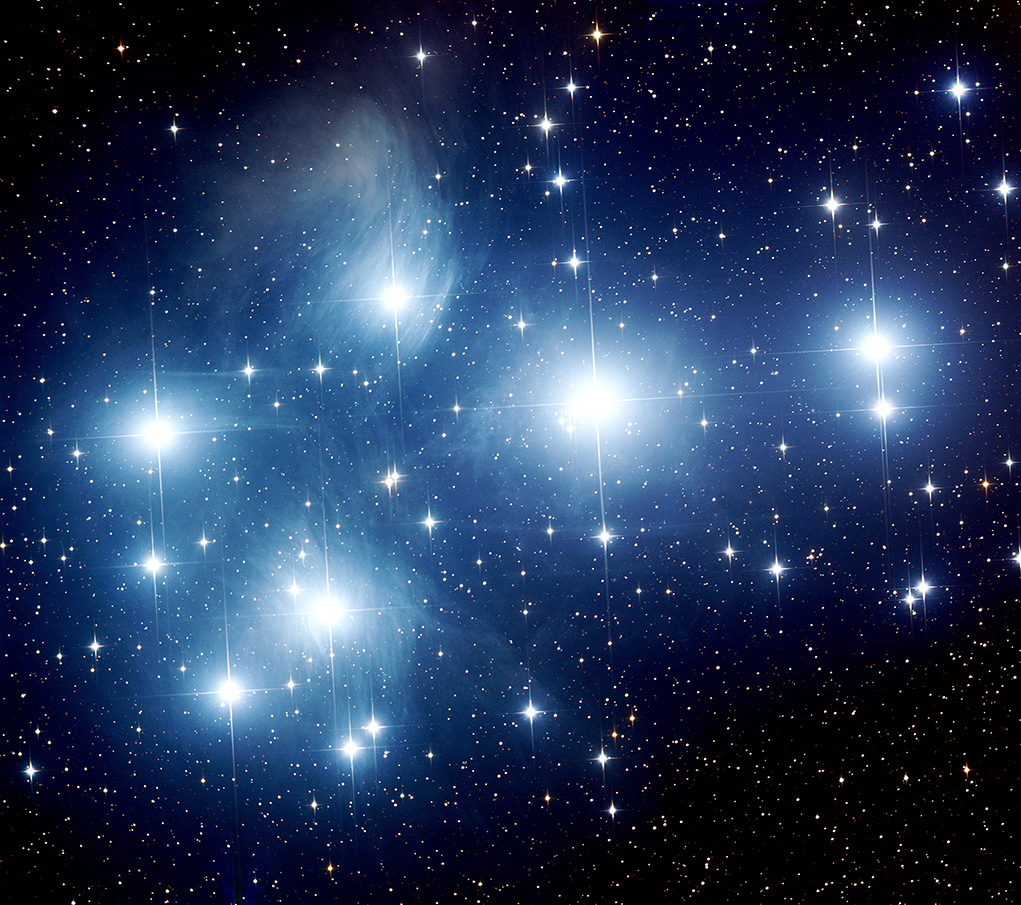
M45 - The Pleiades (the Seven Sisters) - Image by Insight Observatory.

The Pleiades

November is sometimes called "The month of the Pleiades," since the star cluster is visible all night long for observers in the Northern hemisphere. From a dark sky site, M45 is easy to see with the unaided eye and resembles a small "teaspoon" pattern in the sky. Use astronomy binoculars for immersive views of this open star cluster, or use a telescope with a lower-power eyepiece for a closer look at the Seven Sisters.

Mercury

The next night, November 6, will be the best time to observe the smallest and innermost planet in the Solar System as it will be at its greatest eastern elongation. It'll be low in the western sky shortly after sunset.

New Moon

This is the best time of the month to observe the fainter deep-sky objects such as galaxies and star clusters because there is no moonlight to interfere.

Double Cluster in Perseus

Use a pair of big binoculars or a shorter focal length telescope with a wide-field eyepiece in November to seek out the sparkling Double Cluster in Perseus - two side-by-side open star clusters NGC 884 and NGC 869.

All objects described above can easily be seen with the suggested equipment from a dark sky site, a viewing location some distance away from city lights where light pollution and bright moonlight does not overpower the stars.
Read More

Friday, August 17, 2018

The Solar System In a Night-Shell

Recently, you may have noticed an extra one or two very bright stars in the sky, just after sunset. That’s because we’re currently experiencing a rather special celestial treat: a relatively rare positioning of all eight planets (and, three minor planets!) into just a bit more than one side of the sky - at nearly the same time! Alignments like this aren’t exactly common, so, go outside and take a look - while it’s still not too late! (This celestial configuration will begin to deteriorate over the coming weeks).

Starting at sunset, in their order of appearance, relative to their apparent distance from the sun, and just to the west of the sun, is Mercury, the first planet out from the sun, which is now so close to our star, from our perspective, that it’s easily lost in the glare and a bit hard on the eyes for that reason, without a telescope, but it’s there -  just about 6 degrees to the southwest, at stellar magnitude +.60.**

The Solar System In a Night-shell

Believe it or not, next up - we’re already at the outer reaches of the Solar system - minor, or dwarf planet, Pluto! But that’s because of its position against the sky, in the relative background, as compared to the other, and much closer planets. For now - just know that it’s there, about 15 degrees to the east of Saturn. It bottoms out at a dim +14.4 magnitude, accessible only in a moderate to large-sized telescope.

Next, moving, now, East of the sun is a dwarf planet, Ceres. You’ll need a small telescope to spot it. Ceres was discovered, telescopically, in 1801, and at that time, it was realized that Ceres was much closer to Earth than were the stars - but smaller than any planet; therefore, it was cataloged as an asteroid. And, it kept that label, until relatively recent years when it was re-labeled a minor planet. Under that heading is the sub-heading of, ‘dwarf planet’, and that’s where Ceres currently resides, "taxonomically", anyway. The reasons for the changes to Ceres, 4 Vesta, and Pluto as dwarf planets are entirely logical and valid; you’ll have to take my word for that. You’ll find Ceres if you dare - and, if you have a medium-sized telescope - between the sun and Venus, at a dim, +8.8 magnitude.

Now, on our way to Venus. Venus, the second planet from the sun - is the brightest thing in the sky (sans the moon and sun). Seemingly hanging there, low in the west, Venus shines its stunning, white brilliance down on us - at a staggering magnitude -4.4, and at about 12 degrees east of the sun. If you miss it - well, you’re just not paying attention!

Now - look down at the ground by your feet. There sits Earth, the third planet from the sun. If you were to see yourself standing there, from the perspective of the orbiting, International Space Station, you’d first note that you were standing, nearby some dividing line - the line delineating light from the darkness: the terminator, dividing night from day. You are just about, literally, to enter and cross into, the "Twilight Zone"! (Now, how many people can say that they’ve, knowingly, done that - hmmm?!) And this is a good thing because it represents the progression of time, and the rotation of Earth on its axis and, thereby, rolling you - or, perhaps, dragging you - into the deep, dark night. But this is an even better thing because the passage of the early evening hours will bring, up into the sky, from over the eastern horizon, three of our Solar system's showpieces; Jupiter, Saturn, and Mars.

First, sitting, watchfully - almost “king-like” - and due South, at an elevation of around 30 degrees, is His Deified Majesty, Jove - also known by the Romans, as Jupiter. With just about any pair of binoculars, you’ll get to see four of, giant Jupiter’s, giant moons - Callisto, Europa, Ganymede, and Io - that is, unless one or two of them happen to be in Jupiter’s shadow at the time of your observation. But don’t worry; they don’t stay in the shadow behind the planet long! With a telescope, you may also see some, very pastel, cloud bands, near the planet’s equatorial region. Jupiter is now, the third brightest light, in the sky, at a bright, white-ish, magnitude of -2.70.

Have you ever seen ‘rings’ around any celestial object before?; I mean, for yourself - with your very own eyes?! Probably, you haven’t - so now’s your chance! - that is if you happen to have access to, at least, a small telescope, or high-powered binoculars.

If not, don’t worry about it; you still cannot help but notice Saturn, anyway, because it’s now such a  bright, yellowish-white, at an apparent magnitude of +.70: one of the very brightest lights currently in the sky, best seen around 9:00PM. But in a telescope, you will make out Saturn’s ring system, currently lying at an oblique angle to its plane of rotation, so that they will appear to be, almost, “wide-open” at this time around the planet - and that is a wonderful, and rare thing, indeed; Saturn’s rings go through long cycles of appearing open or closed, from our perspective, about every 27 years! Right now they are “wide-open” - you may never get to see this, again…

After Saturn is another object out there, just worth noting, and going unseen without a telescope: dwarf planet, and former asteroid, 4 Vesta. Its feeble light, just creeps through our atmosphere at a dismal +6.4 magnitude, well beyond the abilities of the average, human eye.

Now, comes Mars. Make sure you identify this small-ish, ruddy world for long-term memory: Mars is closer to Earth than it has been in 157 years! Though the red planet closes in on Earth every two years, due to the proximity of the orbits of both planets, there is another component to the Martian orbits’, slightly elongated shape which brings it even closer, periodically. This happens when the point in its orbit that lies closest to the sun, is in sync with the Earth’s position - and that is right about now!

Mars is currently experiencing one of the relatively rare, long-duration, global sandstorms that it's known for. The raging storm has been going on, for about 3 months now. I saw Mars through the telescope about two weeks ago, at high magnification. Though the planet, normally, has a variety of surface features to offer the observer, in the form of dark grey patches, volcanic calderas, white polar caps, and such, it now presents a uniform, planet-wide rust color, as atmospheric particulates from the dust storm circulate around its small, thin blanket of air. However - Mars is the second brightest thing in the sky, right now, after Venus - looking more like a reddish "blob", hanging in the air, toward the South than it does a star or a planet. There is a distinct perception of a disk to this orb, due to its slightly larger angular size in the sky than that of the other planets and, due to its current proximity to Earth. Mars is now glowing, distinctly reddish, at magnitude -2.6, rising at around 8:30PM and well placed for viewing, high up in the sky, by 11:00PM. It’s worth the view, with or without a telescope or binoculars!

And, nearly last, but not, nearly least - by any stretch - are Uranus and Neptune - the seventh and eighth planets of our Solar system - far beyond the reach of the unaided eye, but within telescopic range. They are nearby each other, well into the small hours, at around 30 degrees and 60 degrees, east, of Mars, and +5.7 and +7.8 magnitudes, respectively.

This leaves our own, familiar moon, Luna, now (at the time of this writing), as a dainty, waxing crescent, sitting just above Venus, but moving progressively toward the east, as the nights of the month wear on. And, there you have It - our entire Solar system, in a “night”-shell (well, you just know I couldn’t resist that one!)

** The system used by astronomers to denote the relative, apparent brightnesses in celestial objects, is the Stellar Magnitude Scale. Beginning at 0, the scale uses both positive and negative numbers: those in the minus range, are brighter than those in the plus range. Though it's called the ‘stellar’ magnitude scale, it is used to mark the brightnesses of all celestial objects; stars, planets, comets, and asteroids included. On that note, the consistently, brightest point of light that can be seen from the Earth, is the star, Sirius, in the constellation Canis Major (the 'Big Dog'). It is given the negative magnitude number, -1.4. The planet Venus, currently, is at magnitude -4.3 - several times brighter than Sirius - but Venus’ albedo varies over time, and,  although Venus is the brightest object in the sky, after the sun and moon - it is a planet.  On the plus side of the scale, the human eye can see stars down to about, a fairly dim, magnitude +6, on a very dark, clear night. And so, the answer to the oft-asked question: “What is the brightest star in the night sky?”, is, technically, the star Sirius, at magnitude -1.4.
Read More

Sunday, July 1, 2018

What's In the Sky - July 2018

Get ready for summer stargazing! With the weather warming up, July is a great time of year to enjoy relaxing evenings under starry skies with your telescope or astronomy binoculars. Here are a few of Orion's top picks for July stargazing:

Mars Up Close!

In late July, the red planet Mars will appear bigger and brighter in the sky than it has since 2003! So bright, in fact, that it will outshine even giant Jupiter from early July through early September, grabbing third-place bragging rights for brightness after the Moon and Venus.

Mars - August 2003 Opposition - Image by Muir Evenden
Mars - August 2003 Opposition - Image by Muir Evenden.

Mars reaches opposition on July 27th, which is when the Earth passes directly between Mars and the Sun. Since Mars will be directly opposite the Sun in the sky as seen from Earth, the red planet will rise at sunset and set at sunrise, providing a welcome opportunity for great views through a telescope. And Mars’ closest approach occurs four days later, on July 31st, when its apparent diameter will max out at 24.3 arcseconds. That’s HUGE by Mars standards and is less than one second of arc smaller than in 2003 - which was a nearly 60,000-year record! Indeed, Mars will exceed 24 arcseconds for the period between July 23rd and August 9th. So get out your telescope and a high-power eyepiece and have a look while the looking is good!

You can easily enhance your views of Mars with our exclusive, custom-designed Orion Mars Observation Filter to eke out details of subtle Martian landscape features.

Mercury will reach the greatest eastern elongation

Just after the Sun sets on July 12th, the tiny planet Mercury will reach its greatest eastern elongation. Since Mercury will be at its highest point in the evening sky, it's a great opportunity to observe the tiny planet. It won't be high in the sky for long, though, so look above the western horizon after sunset to catch the elusive planet.

New Moon

July 13th is the darkest night of the month and therefore the best time to observe the fainter objects like galaxies and star clusters. Grab your gear and enjoy!

M13 - Great Globular Cluster in Hercules - Imaged by Summer, Owen, Greg,   Sam, and Rosa from the Plymouth Community Intermediate School.
M13 - Great Globular Cluster in Hercules - Imaged by Summer, Owen, Greg, 
Sam, and Rosa from the Plymouth Community Intermediate School.

Hercules is almost directly overhead and Scorpius

With the constellation Hercules almost directly overhead and Scorpius to the south, there's plenty to see in July skies as summer continues. Check out globular star clusters M13 and M92 in Hercules, and explore Scorpius to find numerous deep-sky objects including open clusters M6 and M7, and globular clusters M4 and M80.

Late July Meteors

July winds down with the Delta Aquarids meteor shower. For the best chance to see meteors, look towards Aquarius after midnight on July 28th into the early morning hours of July 29th. The Delta Aquarids is an average shower that can produce up to 20 meteors per hour. Unfortunately, a bright, nearly full Moon will overpower all but the brightest meteors of this year’s showers.

The Summer Milky Way

From a dark sky location in mid-July, the glorious Summer Milky Way shines as a band of light that stretches from the southern horizon to nearly overhead. As the night progresses, the Milky Way will arch across the entire sky. From a dark observing site, scan the Milky Way with 50mm or larger binoculars or a wide-angle telescope to explore some of the hundreds of open star clusters, emission nebulae, and planetary nebulae that lurk among the star clouds.

July Challenge Object - Hercules Galaxy Cluster

About half a billion light-years from Earth in the constellation Hercules, not far from the star Beta Hercules in the southwest corner of the "keystone" asterism, lies the "Hercules Galaxy Cluster." This association is a group of 200-300 distant galaxies, the brightest of which is NGC 6050 at about 10th magnitude and can be seen with an 8" reflector under very dark skies with good seeing conditions. A larger aperture, 14"-16" telescope will begin to show about a half-dozen or more galaxies in one field of view. How many can you see in your telescope?

All objects described above can easily be seen with the suggested equipment from a dark sky site, a viewing location some distance away from city lights where light pollution and bright moonlight do not overpower the stars.
Read More

Sunday, May 15, 2016

Students Observe the Mercury Transit

On Monday, May 9, 2016, close to 100 students from grades 7 thru 12 walked into the Kohout-Dingley Observatory located on the Sacred Heart High School campus to safely view the rare transit of the planet Mercury crossing the disk of the Sun. This was the first use of the new Baader solar filter manufactured by AstroZap recently purchased specifically for the event. The session, in partnership with the staff of Insight Observatory, hosted entire classes throughout the course of the school day as well as small groups of students visiting during their lunch session. All observers were treated not only to the Mercury transit event but were able to observe groups of sunspots as well.

Sacred Heart Students Observing the Mercury Transit - Photo by Joe Masi.
Sacred Heart Students Observing the Mercury Transit - Photo by Joe Masi.

The early morning hours of May, 9th brought a potential promise of clear observing conditions for the transit. However, just as I was leaving for the observatory to set up for the day, clouds started quickly rolling in. I checked in with the transit's live coverage feed from Sky and Telescope Magazine and J. Kelly Beatty, one of the publication's Chief Editors, was reporting the same weather conditions from Cambridge, Massachusetts. Once I arrived at the school's campus around 8:10 am located in Kingston, Massachusetts, I noticed the clouds were starting to break up and scatter a bit. Joe Masi, a science teacher at the school, assisted me with opening the facility that houses the 11" Celestron Schmidt-Cassegrain Telescope. As the sky proceeded to clear up, we locked the solar filter onto place on the telescope and proceeded to slew the telescope towards the Sun. Remember, NEVER look directly at the Sun find it. As I focused the telescope I immediately detected a defined sharp black dot on the Sun's disk along with a few small groupings of sunspots. Mr. Masi wanted to get a quick peek before his 9:00 am class started. He quickly spotted the tiny planet as well.

A little after 9:00 am, Mr. Masi returned to the observatory with his first class. As the students in groups of 2 or 3 took turns viewing the Mercury transit upstairs at the telescope, the rest of the class below learned about the event taking place with a display set up by Insight Observatory on the first floor. The science teachers were discussing what was actually transpiring as well by using the display as an aide. While Mr. Masi's first class was enjoying the event, he suggested that the students image the transit on their smartphones. Some of the students attempted this throughout the day (as I did myself). However, it was very painstaking trying to hold the device steady enough to get an image in decent focus. A student from the first class, Nolan D., had the most successful image of the day. The morning classes that visited the observatory were treated to excellent views of the transit as the sky completely cleared up. However, the students that stopped by during their lunch period were challenged by fast-moving clouds. As they patiently waited, they were able to get a quick glimpse.

Mercury Transit at 9:15 am EDT - Image by Nolan D.

After the last class left around 2:10 pm, I sat in the observing chair at the telescope and took in the last part of this rare event. I watched the silhouette of the planet slowly disappear at the sun's limb exactly at 2:41 pm EDT. It was a great astronomy education experience and a pleasure in sharing the transit of Mercury with the Sacred Heart students. Some of them are already looking forward to the next one in November 2019.

Special thanks to Frank Lopez of the Stellarvision Astronomy and Science Shop located in Tucson, Arizona for his prompt delivery of the AstroZap Solar Filter allowing us to observe this special event.
Read More

Sunday, May 8, 2016

May 9th 2016 Transit of Mercury

On Monday, May 9th, 2016, a transit of the planet Mercury will take place. The tiny planet will travel across the face of the Sun. Mercury transits are rare events that can be observed from much of the world, however, since they involve viewing the Sun, extreme caution must be taken when attempting to observe them. NEVER look directly at the sun with the unaided eye, binoculars, or telescopes unless they are equipped with special solar filters and supervised by an educator or experienced amateur astronomer. One of the easiest and safest ways to observe this rare event is online via a live web feed. Insight Observatory will be broadcasting a live web of the transit courtesy of Sky and Telescope Magazine's Livestream channel. You can watch the progress of the planet Mercury crossing the Sun's disc on our website.

Sky and Telescope Magazine Diagram
Sky and Telescope Magazine Diagram.

During this transit, the planet Mercury is seen as a tiny black dot moving slowly in an East-to-West direction across the Sun. The 2016 transit begins on May 9th at 11:12 UT (Universal Time, which is equivalent to Greenwich Mean Time) and ends later that same day at 18:42 UT, with mid-transit taking place at 14:57 UT. Here in the northeast, the event begins at 7:22 am with the transiting midpoint at 10:57 am and ending at 2:42 pm. If you’re in western North America, the rising Sun will already display Mercury’s black dot. Easterners and many Western Europeans will be able to watch the entire transit, weather permitting, from Mercury’s first sign of visibility onto the Sun’s face to its final disappearance 7½ hours later.

For the rest of Europe, Africa, and most of Asia, the transit also begins in the daytime but will still be underway when the Sun sets. Observers in Australia and eastern Asia will just have to watch online as it will not be visible to those parts of the globe. For more detailed information on the Mercury transit, please visit Sky and Telescope's article covering the event.

Mercury is the smallest planet; therefore, you'll need a telescope to observe its transit. The black silhouette will appear only 12 arcseconds wide even though Mercury is at inferior conjunction. That’s about 1⁄160 of the Sun’s width and only a fifth the diameter (and 4% of the area) of Venus’s dramatic black disk during the rare transits of Venus. When first viewing, you might mistake Mercury for a small sunspot. It’s precisely round and lacks a gray penumbra. As Mercury travels across the Sun’s vast expanse, how readily can you see its motion? If it passes near a sunspot, can you see that it’s darker than even the sunspot’s umbra? When Mercury departs at egress, the sequence of phenomena at ingress unwinds in reverse order.

Image from In-The-Sky.org

After a May transit, a November transit always occurs 3.5 years later (for instance: May 9, 2016, and November 11, 2019). Transits recur on nearly the same date in cycles of 46 years (for instance: May 9, 2016, and May 10, 2062). November transits, which are more common than May transits, occasionally recur in periods of 7 years, and more frequently in periods of 13 and 33 years. If you simply can’t catch 2016’s Mercury madness, make sure to mark your calendar for the next Mercury transit on November 11, 2019. After that, you’ll be waiting until 2032.

Sources: Sky and Telescope Magazine, NakedEyePlanets.com
Read More