Showing posts with label Personal Image Request Form. Show all posts

Friday, April 2, 2021

Deep-Sky Targets for New Moon - April 2021

The New Moon is fast approaching! Here are some deep-sky target suggestions for imaging on the Astronomical Telescopes for Educational Outreach (ATEO) remote telescope locations by Insight Observatory's partner, Telescopius.com...

M4 - Globular Cluster

M4 - Globular Cluster
Constellation Scorpius
Mag.: 5.40 - Size: 36'
RA 16hr 23' 35" DEC -27º 28' 30"
ATEO-3 - Deep Sky Chile - altitude 87.1º at 05:29 hrs
Tr 16 - Open cluster

Tr 16 - Open Cluster
Constellation Carina
Mag.: 5.00 – Size: 10'
RA 10hr 45' 06" DEC -60º 16' 59"
ATEO-3 - Deep Sky Chile - altitude 87.1º at 05:29 hrs
M101 - Pinwheel Galaxy

M101 - Pinwheel Galaxy
Constellation Ursa Major
Mag.: 7.90 – Size: 28.8'
RA 14hr 03' 12" DEC 54º 20' 58"
ATEO-1 - SkyPi Remote Observatory - altitude 70.0º at 02:34 hrs.
M67 - Open Cluster

M67 - Open Cluster
Constellation Cancer
Mag.: 6.90 – Size: 25'
RA 08hr 51' 17" DEC 11º 48' 59"
ATEO-2A - SkyPi Remote Observatory - altitude 67.5º at 21:22 hrs.
M8 - Lagoon Nebula

M8 - Lagoon Nebula
Constellation Sagittarius
Mag.: 5.00 – Size: 45'
RA 18hr 03' 41" DEC -25º 37' 00"
ATEO-3 - Deep Sky Chile - altitude 84.9° at 07:09 hrs.
M3 - Globular Cluster

M3 - Globular Cluster
Constellation Canes Venatici
Mag.: 6.30 – Size: 18'
RA 13hr 42' 11" DEC 28º 22' 34"
ATEO-1 - SkyPi Remote Observatory - altitude 84.1º at 02:13 hrs.
IC 2948 - Bright Nebula

IC 2948 - Bright Nebula
Constellation Centaurus
Mag.: 7.00 – Size: 1.3º
RA 11hr 39' 24" DEC -64º 31' 59"
ATEO-3 - Deep Sky Chile - altitude 56.0° at 00:45 hrs.
HCG 44 - Galaxy Cluster

HCG 44 - Galaxy Cluster
Constellation Leo
Mag.: 10.00 – Size: 16.4'
RA 10hr 18' 00" DEC 21º 48' 43"
ATEO-1 - SkyPi Remote Observatory - altitude 77.5º at 22:49 hrs.
NGC 3324 - Gabriela Mistral Nebula

NGC 3324 - Gabriela Mistral Nebula
Constellation Carina
Mag.: 6.70 – Size: 16'
RA 10hr 37' 18" DEC -59º 19' 59"
ATEO-3 - Deep Sky Chile - altitude 60.8° at 23:43 hrs.
NGC 5033 - Spiral Galaxy

NGC 5033 - Spiral Galaxy
Constellation Canes Venatici
Mag.: 10.20 – Size: 10.7'
RA 13hr 13' 27" DEC 36º 35' 36"
ATEO-1 - SkyPi Remote Observatory - altitude 87.7º at 01:44 hrs

Help support Insight Observatory's educational outreach efforts by submitting your deep-sky image requests today on our Personal Image Request (PIR) application or logging in to your ATEO Portal account to request on our Basic or Advanced Image Request forms.
Read More

Friday, January 1, 2021

What's In The Sky - January 2021

January kicks off the New Year with wonderful sights for backyard astronomers to enjoy. Don't forget to bundle up on clear, cold evenings as you explore the sparkling night sky. Here are a few top picks for January stargazers from Orion Telescopes and Binoculars...

Quadrantid Meteor Shower

Bundle up and get outside on the night of January 2nd into the early morning hours of the 3rd to see the Quadrantids meteor shower peak. Some meteors associated with the Quadrantids are expected to be visible until January 12th, but the shower peaks after midnight on the night of January 2nd-3rd, with up to 120 meteors expected per hour. This year, the waning gibbous Moon will outshine fainter meteors, but you can still enjoy the brightest "shooting stars" as they appear to radiate from the constellation Boötes. You don't need a telescope to enjoy the show, just a clear, dark sky and a comfy chair or blanket.

Stargazers pointing out the constellation Orion. Original image by Night Skygaze.
Stargazers point out the constellation Orion. Original image by Night Skygaze.

Hunting the Hunter

Our favorite constellation, Orion, continues to be high in the night sky in January, providing backyard astronomers with spectacular sights throughout the month. Take a closer look at the middle star of Orion's sword with binoculars to reveal amazing views of the bright emission nebula M42. Use a telescope to resolve the system of four "newborn" stars that form a trapezoid at the center of M42, known as the Trapezium. If you'll be viewing in a light-polluted area, use an Orion UltraBlock filter to boost contrast for better views.

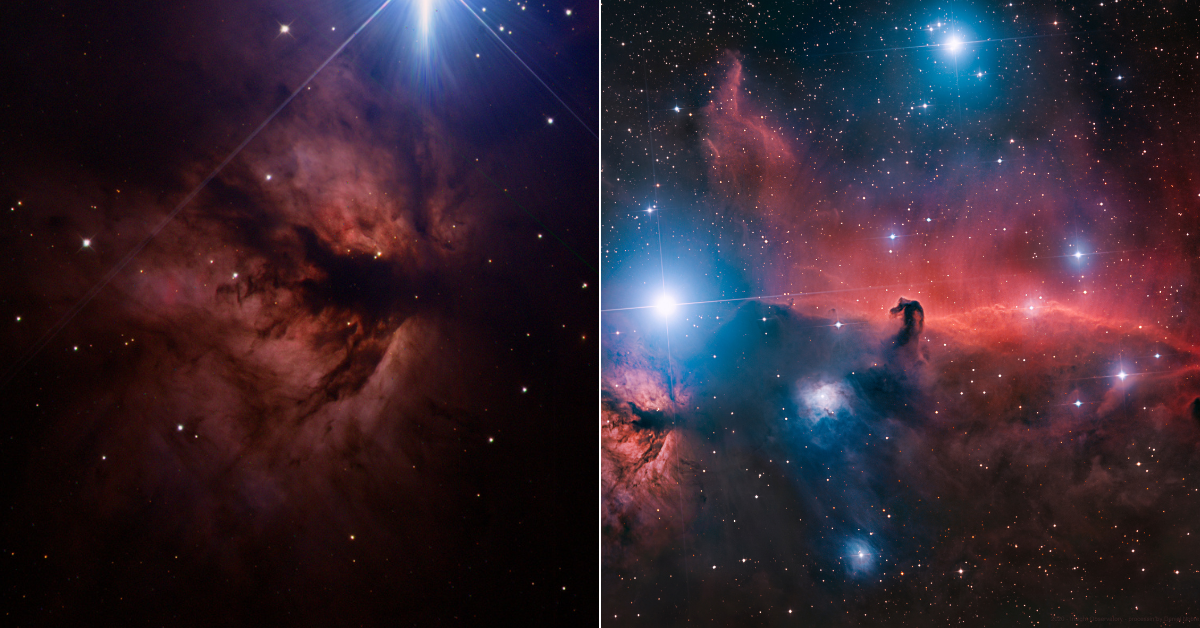
NGC 2024 -The Flame Nebula imaged by students from Barnstable High School, MA using remote telescope, ATEO-3 located in Chile (left) and Barnard 33 - The Horsehead Nebula processed by Insight Observatory Starbase subscriber, Daniel Nobre.
NGC 2024 -The Flame Nebula imaged by students from Barnstable High School, MA, using a remote telescope, ATEO-3 located in Chile (left), and Barnard 33 - The Horsehead Nebula processed by Insight Observatory Starbase subscriber, Daniel Nobre.

Just above Alnitak, the easternmost star of Orion's belt, the Flame Nebula (NGC 2024) can be found in larger telescopes. Dark lanes of dust give this emission nebula its fiery appearance. The picturesque absorption nebula Barnard 33, also called the Horsehead Nebula, can be found in large telescopes just south of Alnitak. Use a Hydrogen-Beta filter to improve your chances of spotting the elusive Horsehead.

Reflection nebula, M78 in the constellation Orion imaged on ATEO-1 by Vincent M. using Insight Observatory's online Personal Image Request (PIR) application (left) and M42 - The Orion Nebula imaged on ATEO-3 by 5th-grade students from Plymouth South Elementary School, MA (right).
Reflection nebula M78 in the constellation Orion, imaged on ATEO-1 by Vincent M. using Insight Observatory's online Personal Image Request (PIR) application (left), and M42 - The Orion Nebula imaged on ATEO-3 by 5th-grade students from Plymouth South Elementary School, MA (right).

Scan the skies above and to the east of the belt star Alnitak to find reflection nebula M78. Since M78 is much fainter than M42, a 4.5" or larger telescope is recommended for the best views.

Hind's Crimson Star

Just South of Orion is the constellation Lepus, the Hare. In the constellation Lepus, you can catch a glimpse of the rare winter globular cluster M79, as well as R Lepori, a well-known variable star that varies between magnitudes +5.5 (just visible to the naked eye) and +11.7 with a period of about 427 days. What's interesting about this star is that because it is a "carbon star," it is very red; when at its brightest, the red color is unmistakable.

January Challenge Object

Just west of Rigel, the bright blue/white star that marks the western "knee" of Orion, lies the Witch Head Nebula (IC 2118), in the neighboring constellation Eridanus. The Witch-Head is a reflection nebula that shines from reflected light off of Rigel, like the reflection nebula in the Pleiades, M45. You don't need a big telescope; a wide field of view, low power, and a dark sky are needed to see this challenging nebula. (Hint: Don't use filters).

IC 2118 - The Witch Head Nebula imaged on ATEO-1
by Tom L. using Insight Observatory's online
Personal Image Request (PIR) application.

All objects described above can easily be seen with the suggested equipment from a dark sky site, a viewing location some distance away from city lights, where light pollution and bright moonlight do not overpower the stars.
Read More

Friday, November 27, 2020

New Wide-Field Remote Telescopes Added

Insight Observatory is excited to announce the addition of two new affiliate remote telescopes to its growing network! These remote imaging systems are both wide-field configurations provided by Insight Observatory's affiliate partner, Lukas Demetz from the SkyGems Observatories Network. Both configurations are close to being identical, with the exception of the imaging camera. Both are Officina Stellare Veloce 200 AT, with focal lengths of 600mm and a focal ratio of f/3.

The designations of these two additions to Insight Observatory's remote telescope network are AFIL-5, located in Hakos, Namibia, and AFIL-6, hosted at AstroCamp in Nerpio, Spain.


IC 434 or Barnard 33 - The Horsehead Nebula in the constellation Orion imaged on the Veloce 200 AT f/3 (AFIL-5) from Hakos, Namibia. Image processed by Utkarsh Mishra. Luminance 10 x 5 min., Red, Green, and Blue each 5 x 5 min.
IC 434 or Barnard 33 - The Horsehead Nebula in the constellation Orion, imaged on the Veloce 200 AT f/3 (AFIL-5) from Hakos, Namibia. Image processed by Utkarsh Mishra. Luminance 10 x 5 min. Red, Green, and Blue each 5 x 5 min.

These new additions can be accessed on Insight Observatory's online Personal Image Request (PIR) application for ONLY $25.00 for a 20-minute LRGB color or monochrome processed image. The raw image files are also available upon request if selected on the PIR.

Proceeds from PIR image purchases go towards supporting Insight Observatory's educational outreach efforts.

Veloce 200 AT wide-field affiliate remote telescope additions AFIL-5 located in Hakos, Namibia (left) and AFIL-6 hosted at AstroCamp in Nerpio, Spain (right).

Specifications of the AFIL-5 Veloce 200 AT Imaging System - Hakos, Namibia:
  • Officina Stellare Veloce 200 AT
  • Focal length 600 mm (24'') - Focal ratio f/3
  • ASA DDM60 mount
  • QHY 600M CCD
  • Filters: LRGB, Ha7 OIII SII

Specifications of the AFIL-6 Veloce 200 AT Imaging System - Nerpio, Spain:
  • Officina Stellare Veloce 200 AT
  • Focal length 600 mm (24'') - Focal ratio f/3
  • ASA DDM60 mount
  • SBIG STF-8300M CCD
  • Filters: LRGB, Ha7, OIII, SII

Read More

Friday, August 7, 2020

New Affiliate Remote Telescopes

Insight Observatory is excited to announce a new collaboration with SkyGems Observatories!

Screenshot of AFIL-3: The 20" f/6.7 iDK Dall-Kirkham remote telescope option being selected on Insight Observatory's online Personal Image Request (PIR) application.

Both of Insight Observatory's online image request applications will now have two additional remote telescope options for capturing deep-sky image data. The Educational Image Request (EIR)  and Personal Image Request (PIR) forms now list the following options...

  • ATEO-1: 16" f/3.7 Astrograph - New Mexico, US
  • ATEO-2A: 5" f/5.8 FLT APO Refractor - New Mexico, US
  • ATEO-3: 12.5" f/6 Ritchey-Chretien - Rio Hurtado Valley, Chile
  • AFIL-3: 20" f/6.7 Dall-Kirkham - Namibia, Southern Africa
  • AFIL-7: 20" f/6.8 Corrected Dall-Kirkham - Nerpio, Spain

AFIL-3: 20" f/6.7 Dall-Kirkham located in Hakos, Namibia (left) and AFIL-7 20" f/6.8 Corrected Dall-Kirkham located in Nerpio, Spain (right).
AFIL-3: 20" f/6.7 Dall-Kirkham located in Hakos, Namibia (left) and AFIL-7 20" f/6.8 Corrected Dall-Kirkham located in Nerpio, Spain (right).

Due to the effects of the monsoon season in the southwest of the US, these additional options will allow students and the public to access deep-sky image data in alternate locations in both the northern and southern hemispheres.

Specifications of the AFIL-3 20" Dall-Kirkham Imaging System:
  • 20" f/6.7 AG Optical iDK Dall-Kirkham
  • ASA DDM85XL mount
  • FLI Proline 16803 CCD
  • Filters: LRGB, Ha7 OIII SII

Specifications of the AFIL-7 20" f/6.8 Corrected Dall-Kirkham Imaging System:
  • 20" f/6.8 Corrected Dall-Kirkham
  • Planewave L-500 mount
  • FLI Proline 16803 CCD
  • Filters: LRGB, Ha7, OIII, SII

This is only the first phase of integrating these two fine imaging systems. Phase 2 will be adding 5 hours or more of deep-sky imaging data to Starbase, Insight Observatory's image set repository, and the final phase will be adding them as options on our new version of the ATEO Portal.

LRGB image of NGC 6357 - Diffuse nebula in the constellation Scorpius imaged on AFIL-3   remote telescope located in Namibia. Image courtesy of Lukas Demetz.
LRGB image of NGC 6357 - Diffuse nebula in the constellation Scorpius imaged on AFIL-3 
remote telescope located in Namibia. Image courtesy of Lukas Demetz.

We would like to express our sincere gratitude to Lukas Demetz of SkyGems Observatories for partnering up with Insight Observatory and contributing to our mission of "Bringing the Universe to Classrooms and Homes Around the World!"

For more information on using the EIR for educational use or the PIR for acquiring a deep-sky image for personal use, please Contact Us.

Read More