-->

Bringing the Universe to Classrooms
and Homes Around the World!

What's Happening at Insight Observatory...

Showing posts with label remote telescope. Show all posts

Saturday, January 8, 2022

New Affiliate Remote Telescopes on Starbase

We are excited to introduce three affiliate remote telescopes added to Insight Observatory's image set repository, Starbase

The first two are an AG Optical 10" truss iDK (AFIL-1) located at Gemini Observatory and a Skyrover 130 APO Pro (AFIL-2) located at Yunling Observatory, China. These two imaging systems are owned and operated by Alpha Zhang.
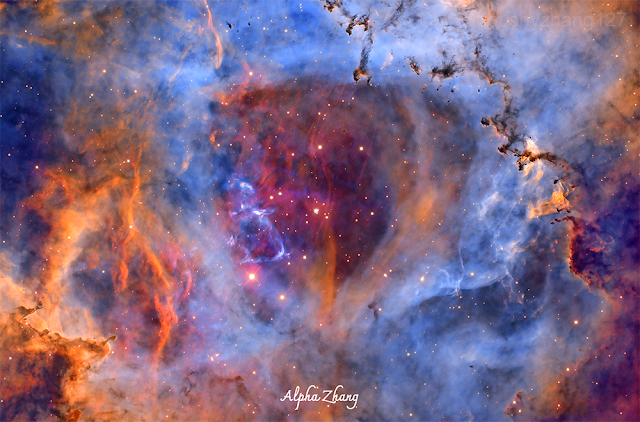
Heart of the Rosette Nebula (NGC 2244) - Imaged data acquired and processed by Alpha Zhang combining image data from image sets on both AFIL-1 and AFIL-2. Both image sets are available on Starbase for purchase.
Heart of the Rosette Nebula (NGC 2244) - Imaged data acquired and processed by Alpha Zhang combining image data from image sets on both AFIL-1 and AFIL-2. Both image sets are available on Starbase for purchase. 

The Heart of the Rosette Nebula (also known as Caldwell 49) is an H II region located near one end of a giant molecular cloud in the Monoceros region of the Milky Way Galaxy. The open cluster NGC 2244 (Caldwell 50) is closely associated with nebulosity, the stars of the cluster having been formed from the nebula's matter.

The third telescope is a Veloce 200 RH f/3 in Hakos, Namibia (AFIL-5). This remote imaging system has been on our remote telescope network for over a year now, offering services on our Basic Image Request (BIR) and Advanced Imaging Request (AIR) online applications. The BIR and AIR are available via the ATEO Portal. AFIL-5 is owned and operated by Lukas Demetz from SkyGems Observatories.
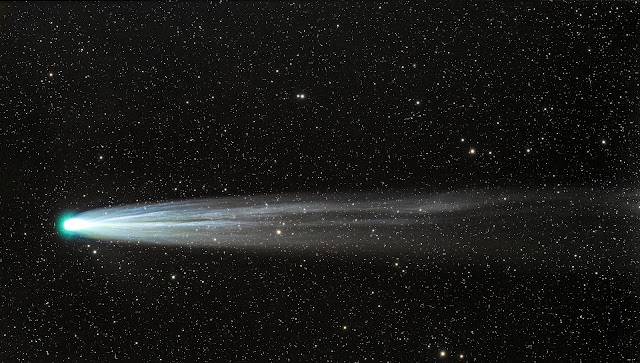

C/2021 A1 Leonard 3x1 mosaic taken from Insight Observatory’s affiliate remote telescope AFIL-5, Veloce 200 RH f/3 in Namibia, on December 30, 2021. 35 minutes of image data acquired by Lukas Demetz and processed by Michael Lewis. Image set available on Starbase for purchase.
C/2021 A1 Leonard 3x1 mosaic taken from Insight Observatory’s affiliate remote telescope AFIL-5, Veloce 200 RH f/3 in Namibia, on December 30, 2021. 35 minutes of image data were acquired by Lukas Demetz and processed by Michael Lewis. The image set is available on Starbase for purchase.

C/2021 A1 (Leonard) is an inbound long-period comet discovered by G. J. Leonard at the Mount Lemmon Observatory on 3 January 2021 when the comet was 5 astronomical units (AU) from the Sun. This was the first comet discovered in 2021, and it has a retrograde orbit.
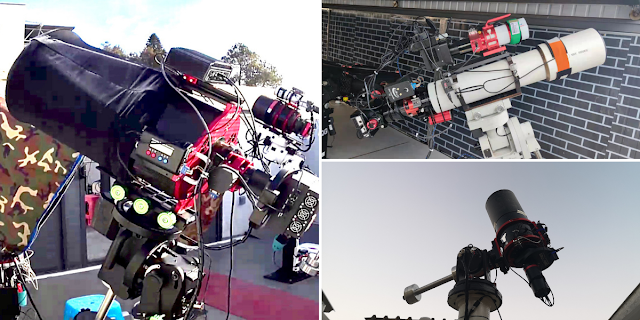


AFIL-1: AG10 CDK f/6.7 f=1665mm (left), AFIL-2: SkyRover 130 APO Pro f/7 f=910mm (upper right), and AFIL-5: Officina Stellare Veloce 200mm f/3 Astrograph (lower left).

Starbase is a repository of image data captured by the Astronomical Telescopes for Educational Outreach (ATEO) and our affiliate remote telescopes (AFIL), organized by the image target into image “sets”. These image sets can be purchased (referred to as “subscribing” to the image set) and downloaded. All proceeds from Starbase subscriptions go towards funding our educational outreach programs.

Read More

Friday, April 2, 2021

Deep-Sky Targets for New Moon - April 2021

The New Moon is fast approaching! Here are some deep-sky target suggestions for imaging on the Astronomical Telescopes for Educational Outreach (ATEO) remote telescope locations by Insight Observatory's partner, Telescopius.com...

M4 - Globular Cluster

M4 - Globular Cluster
Constellation Scorpius
Mag.: 5.40 - Size: 36'
RA 16hr 23' 35" DEC -27º 28' 30"
ATEO-3 - Deep Sky Chile - altitude 87.1º at 05:29 hrs
Tr 16 - Open cluster

Tr 16 - Open Cluster
Constellation Carina
Mag.: 5.00 – Size: 10'
RA 10hr 45' 06" DEC -60º 16' 59"
ATEO-3 - Deep Sky Chile - altitude 87.1º at 05:29 hrs
M101 - Pinwheel Galaxy

M101 - Pinwheel Galaxy
Constellation Ursa Major
Mag.: 7.90 – Size: 28.8'
RA 14hr 03' 12" DEC 54º 20' 58"
ATEO-1 - SkyPi Remote Observatory - altitude 70.0º at 02:34 hrs.
M67 - Open Cluster

M67 - Open Cluster
Constellation Cancer
Mag.: 6.90 – Size: 25'
RA 08hr 51' 17" DEC 11º 48' 59"
ATEO-2A - SkyPi Remote Observatory - altitude 67.5º at 21:22 hrs.
M8 - Lagoon Nebula

M8 - Lagoon Nebula
Constellation Sagittarius
Mag.: 5.00 – Size: 45'
RA 18hr 03' 41" DEC -25º 37' 00"
ATEO-3 - Deep Sky Chile - altitude 84.9° at 07:09 hrs.
M3 - Globular Cluster

M3 - Globular Cluster
Constellation Canes Venatici
Mag.: 6.30 – Size: 18'
RA 13hr 42' 11" DEC 28º 22' 34"
ATEO-1 - SkyPi Remote Observatory - altitude 84.1º at 02:13 hrs.
IC 2948 - Bright Nebula

IC 2948 - Bright Nebula
Constellation Centaurus
Mag.: 7.00 – Size: 1.3º
RA 11hr 39' 24" DEC -64º 31' 59"
ATEO-3 - Deep Sky Chile - altitude 56.0° at 00:45 hrs.
HCG 44 - Galaxy Cluster

HCG 44 - Galaxy Cluster
Constellation Leo
Mag.: 10.00 – Size: 16.4'
RA 10hr 18' 00" DEC 21º 48' 43"
ATEO-1 - SkyPi Remote Observatory - altitude 77.5º at 22:49 hrs.
NGC 3324 - Gabriela Mistral Nebula

NGC 3324 - Gabriela Mistral Nebula
Constellation Carina
Mag.: 6.70 – Size: 16'
RA 10hr 37' 18" DEC -59º 19' 59"
ATEO-3 - Deep Sky Chile - altitude 60.8° at 23:43 hrs.
NGC 5033 - Spiral Galaxy

NGC 5033 - Spiral Galaxy
Constellation Canes Venatici
Mag.: 10.20 – Size: 10.7'
RA 13hr 13' 27" DEC 36º 35' 36"
ATEO-1 - SkyPi Remote Observatory - altitude 87.7º at 01:44 hrs

Help support Insight Observatory's educational outreach efforts by submitting your deep-sky image requests today on our Personal Image Request (PIR) application or logging in to your ATEO Portal account to request on our Basic or Advanced Image Request forms.
Read More

Monday, March 22, 2021

Vela Nebula Image Sets from ATEO-3

There are new image sets available in Starbase, Insight Observatory's image set repository. These sets consist of combinations of H-Alpha, Oxygen III, and Red, Green, and Blue filtered image data of a section of the Vela Nebula (supernova remnant) located in the southern constellation of Vela. These image sets were acquired by Franck Jobard on Insight Observatory's 12.5" f/9 Ritchey-Chretien affiliate remote telescope ATEO-3 hosted at Deep Sky Chile.

The Vela supernova remnant's source Type II supernova exploded approximately 11,000 to 12,300 years ago. The association of the Vela supernova remnant with the Vela pulsar, made by astronomers at the University of Sydney in 1968, was direct observational evidence that supernovae form neutron stars.

An HaRGB section of the Vela Nebula supernova remnant acquired and processed by Franck Jobard on Insight Observatory's 12.5" f/9 Ritchey-Chretien affiliate remote telescope located at Deep Sky Chile.

This supernova remnant includes NGC 2736. It also overlaps the Puppis A supernova remnant, which is four times more distant. Both the Puppis and Vela remnants are among the largest and brightest features in the X-ray sky.

The Vela supernova remnant (SNR) is one of the closest known to us. The Geminga pulsar is closer (and also resulted from a supernova), and in 1998 another near-Earth supernova remnant was discovered, RX J0852.0-4622, which from our point of view appears to be contained in the southeastern part of the Vela remnant. One estimate of its distance puts it only 200 parsecs away (about 650 ly), closer than the Vela remnant, and, surprisingly, it seems to have exploded much more recently, in the last thousand years, because it is still radiating gamma rays from the decay of titanium-44. This remnant was not seen earlier because, in most wavelengths, it is lost because of the presence of the Vela remnant.

The Moon is the biggest single object in the night sky that’s visible to the eye alone. But many objects that are too faint to see are much bigger. The nebula spans about 16 times the width of the Moon, almost the size of your fist held at arm’s length and it’s getting bigger all the time.

Inverted image of the Vela Nebula supernova remnant imaged in Ha (upper left), and in Ha, OIII, and RGB (right), and ATEO-3, the 12.5" f/9 Ritchey-Chretien located at Deep Sky Chile.

When the supergiant star exploded, blasting its outer layers into space, those layers rammed into surrounding clouds of gas and dust, causing them to glow. If you look across the entire spectrum - from radio waves to X-rays - the nebula looks like a mound of billowing clouds.

When the star exploded, the outer layers were expelled at up to a few percent of the speed of light. So over the millennia, the nebula has inflated to a diameter of more than a hundred light-years. And it’s still expanding - at more than two million miles per hour.

Sources: Wikipedia and Stardate Online.

Search for Vela Nebula in the "Name" field in Starbase to access the Vela Nebula - Ha 6nm (2021) Vela Nebula - OIII 3nm (2021), and Vela Nebula - RGB (2021) image sets.


Read More