-->

Bringing the Universe to Classrooms
and Homes Around the World!

What's Happening at Insight Observatory...

Showing posts with label Sun. Show all posts

Wednesday, July 1, 2020

What's In The Sky - July 2020

Get ready for summer stargazing! With the weather warming up, July is a great time of year to enjoy relaxing evenings under starry skies with your telescope or astronomy binoculars. Here are a few of Orion Telescopes and Binoculars picks for July stargazing...

Gas Giants at Opposition

Jupiter and Saturn both reach opposition one week apart this year, making July the perfect opportunity for planetary viewing! Opposition is when the Earth passes directly between a planet and the Sun. This coincides with the planets closest approach to Earth, providing an excellent opportunity for great views in a telescope. Both planets are easy to find in the Southern sky, about 7 degrees apart from each other. Jupiter reaches opposition on July 14th and Saturn about a week later on the 20th. During opposition, Saturn’s rings will be inclined at 21 degrees towards Earth, close to their maximum angle of 27 degrees. Combined with the planet's close approach to Earth, this makes July an excellent time to observe Saturn and its rings!

Jupiter imaged on 12/07/2012 with an Orion 180mm Maksutov-Cassegrain Telescope Optical Tube. Imaged by Cherdphong V. from Bangkok, Thailand.

Grab a high magnification eyepiece or a Barlow lens, and check out the gas giants during opposition!

New Moon

July 20th is the darkest night of the month and therefore the best time to observe the more faint objects like galaxies and star clusters. Grab your observing gear and enjoy!

Hercules almost directly overhead and Scorpius

With constellation Hercules almost directly overhead and Scorpius to the south, there's plenty to see in July skies as summer continues. Check out globular star clusters M13 and M92 in Hercules, and explore Scorpius to find numerous deep-sky objects including open clusters M6 and M7, and globular clusters M4 and M80.

The Summer Milky Way

From a dark sky location in mid-July, the glorious Summer Milky Way shines as a band of light that stretches from the southern horizon to nearly overhead. As the night progresses, the Milky Way will arch across the entire sky. From a dark observing site, scan the Milky Way with 50mm or larger binoculars or a wide-angle telescope to explore some of the hundreds of open star clusters, emission nebulae and planetary nebulae that lurk among the star clouds.
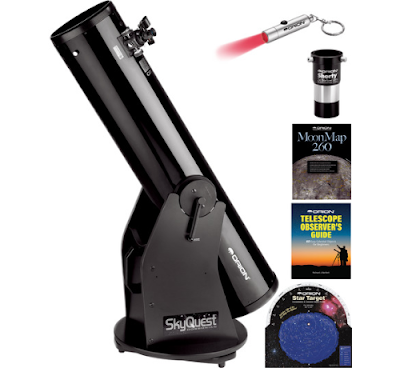
Orion SkyQuest XT8 Classic Dobsonian Telescope Kit.

July Challenge Object — Hercules Galaxy Cluster

About half a billion light-years from Earth in the constellation Hercules, not far from the star Beta Hercules in the southwest corner of the "keystone" asterism, lies the "Hercules Galaxy Cluster." This association is a group of 200-300 distant galaxies, the brightest of which is NGC 6050 at about 10th magnitude and can be seen with an 8" reflector like the Orion SkyQuest XT8 Classic Dobsonian under very dark skies with good seeing conditions. A larger aperture, 14"-16" telescope like the Orion SkyQuest XX14g GoTo Truss Dobsonian will begin to show about a half-dozen or more galaxies in one field-of-view. How many can you see in your telescope?

Orion SkyQuest XX14g GoTo Truss Tube Dobsonian Telescope.

All objects described above can easily be seen with the suggested equipment from a dark sky site, a viewing location some distance away from city lights where light pollution and when bright moonlight does not overpower the stars.
Read More

Sunday, November 3, 2019

Primary Sources

How do we know that the sun is a star? -- and, that we live in a galaxy full of stars?

How do we know what the distances between those stars are?

How did we conclude that the moon and planets are illuminated by reflected sunlight, and, not through their own, intrinsic illumination?

How do we know how big the universe is, and, of what materials it is composed?

By guesswork? By simple reasoning? By concluding what we want to conclude?!

No -- never...

Vintage Engraving, Early Spectroscope Using Prisms -  Drawing by Luisa Vallon Fumi
Vintage Engraving, Early Spectroscopy Using Prisms -  Drawing by Luisa Vallon Fumi

The answers to some of those questions come by way of Newton, Galileo, Herschel, the telescope, and the spectroscope - (and, yes - true, genuine, unadulterated genius, at least, in the case of Newton).

To understand these things, one has got to have some grasp, of the long hours of hard work, done by many people - sometimes, extended out, over several generations.

But, all of it was done, methodically, one step at a time. Those steps are preserved in records - written at the time, by the very people who took those steps - and exist in the various university libraries, public archives, etc. These documents, and others like them, are known as, "Primary Sources", or, "Original Sources". One notable example of an original source document, is Galileo Galilei's letter to the Duchess of Tuscany, on what he had observed through his telescope, which, has been, ever since, preserved by the Royal Archives, in Great Britain, and is available for public view. Most any college or university has a Primary Source repository, or access, to one.

One, major distinction, in perusing any primary source, is its wonderful lack of hype, sensationalism, opinions, fake news, and, perhaps, best of all (in my opinion) -- no "pseudo scientists"!

Insight Observatory's network of remote robotic telescopes - ATEO-1, ATEO-2A and ATEO-3.
Insight Observatory's network of remote robotic telescopes - ATEO-1, ATEO-2A, and ATEO-3.

Astronomers - professional, amateur, and citizen, alike - are, still, today needed to make observations, visually, or photographically of the night sky. One way to do this is by the use of remote, robotic telescopes and astrographs, like those, here at Insight Observatory.

Dale Alan Bryant
Senior Contributing Science Writer
Read More

Monday, August 27, 2018

The Great American Eclipse Remembered

Note: This is the article I should have written one year ago, so now it has become a chance to revisit the past as we so often do on anniversaries. So let us take a look back on August 21, 2017...

“The Great American Eclipse” of August 21, 2017, started its journey across the continental US on the Oregon coast, crossing the town of Corvallis (home of my brother and his wife) about 50 miles inland; this was to be our spot for viewing the eclipse as it dovetailed nicely with our vacation plans to visit them in the summer.


My first thought was to bring a small telescope and capture the eclipse close up, but soon realized that I didn’t want to get hung up on all the work and equipment needed - I've seen many different eclipse photos over the years and I didn't feel like duplicating what has been done before. I was more interested in just experiencing the eclipse as it happened via the naked eye, as well as everything around me - something you can't capture from close-up pictures of the event. I settled on using a simple GoPro camera (which has a wide-angle perspective) and recording a video of the eclipse starting about 20 minutes before totality and ending 20 minutes after, right from my brother's backyard. What we have below is a short excerpt from that video around totality:

August 21, 2017 Total Solar Eclipse from Corvallis, Oregon

Although nothing can really replicate 100% of our eclipse experience, I think this video successfully captures some of the feeling of what it was like during the eclipse - it was truly (for a lack of a better description) "awe-inspiring", definitely the best astronomical event I have seen in my lifetime. If you never have seen one "in person" it is highly recommended.
Read More

Saturday, August 19, 2017

Solar Eclipse Activities for Everyone

Of the people who will be viewing an eclipse (total or partial) on August 21st, many will be young. Young enough that you'll want to double and triple-check their solar viewers before letting them look up at the Sun, and young enough, too, that you'll want other activities for them (and you!) as the Sun makes its way through the long partial phases. Not to mention, young enough that this will be their very first eclipse, and you'll want to make every moment count!

During the partial eclipse, two crossed hands create many holes that act as pinhole projectors.
Photo by J. Kelly Beatty.

Viewing the Eclipse with Kids

The first and simplest activity is to make an eclipse viewer see the Sun. Note: Don't look at the Sun directly or through anything other than safe solar viewers or No. 14 arc welder's glass during the partial phases of the eclipse. It's completely safe to look at the blocked Sun during totality though.

If you weren't able to procure a pair of glasses, there are other options: Pinhole projectors work just as well, if not better, to view the Sun, and they come with the side benefit that they only work when you face your back to the Sun — eye safety guaranteed.

Find a cereal box, scissors, some tin foil, a pushpin or toothpick, and tape, and you'll have everything you need to make a pinhole projector to view the solar eclipse. Watch NASA's video for easy-to-follow instructions...

See the full Source Article by Monica Young at http://www.skyandtelescope.com/2017-total-solar-eclipse/solar-eclipse-activities-kids-families/
Read More

Thursday, August 17, 2017

The "Great American" Solar Eclipse

This upcoming solar eclipse is almost exclusive to the continental US, and all of the US will see it, in some fraction. It is, I think, going to change American lives, in some pretty profound ways.

Most of us have seen lunar eclipses, or, eclipses of the moon. But most of us (myself excluded), have never seen a total eclipse of the sun.

the Great American Eclipse - 21 August 2017
Graphic Created by Dale Alan Bryant.

Lunar eclipses are, pretty much, non-interactive events. If we don't happen to look up at the moon, we might miss it, entirely. Not so with a total eclipse of the sun. For those fortunate enough to be in the 'path of totality,  it will envelop them completely. They won't be able to escape it. But, total solar eclipses involve us in ways we wouldn't expect: Here's what I remember from the total solar eclipse I saw when I was a kid, from Woods Hole, Mass:

* Even though the solar eclipse I saw from Woods Hole was total, and this upcoming eclipse is partial, for most of the U.S., it will get dark enough in the eastern half of the country at mid-eclipse, that, if we're driving, we'll have to put the headlights on! If you're inside, you might want to turn on some lamps - for a few minutes anyway.

* When the moon begins to clear the face of the sun, the birds will begin singing - thinking that it's dawn again!

* For, possibly, the very first time - you will see whole crowds of people become silent. Everyone will start whispering.

This is not only a visual event but a mental and spiritual one, as well. It's the kind of event that turns kids into amateur astronomers - and into professional ones, when they grow up!

The eclipse will bring people together in ways we rarely get to witness.

Dale Alan Bryant
Senior Contributing Science Writer
Read More

Monday, April 17, 2017

Get Ready for the 2017 Solar Eclipse

The Total Solar Eclipse is just about four months from now!

A total solar eclipse occurs when the Moon covers the face of the Sun as seen from Earth. The complete coverage allows us to see the day as if it were night, and it reveals the solar corona's ghostly wisps. The next total solar eclipse will occur this summer on August 21, 2017, and the eclipse path will cross the continental United States.

Solar Eclipse During Totality in 2015. Image by Miloslav Druckmüller, Shadia Habbal, Peter Aniol, Pavel Štarha
Solar Eclipse During Totality in 2015. Image by Miloslav Druckmüller, Shadia Habbal, Peter Aniol, Pavel Štarha.

The solar eclipse begins on August 21, 2017, at 16:48:33 Universal Time (UT), when the shadow descends down on the Pacific Ocean and the Moon takes its first small piece out of the Sun. Totality begins at 18:24:11.9 UT.

August 21, 2017, seemed a long way off from when we first started talking about this event a few years ago, but for the astronomically savvy the clock has been ticking, and there was no time to waste. Between the last couple of years and now we needed to figure out how to ensure a good experience for the estimated 500 million people across North America who will stand in the Moon's shadow that day.

Path of the 2017 Total Solar Eclipse.
Most will see only a partial solar eclipse, but tens of millions within a 65-mile-wide track from Oregon to South Carolina will (weather permitting) witness one of Nature's grandest events. In what is being called the "Great American Eclipse", the Moon will completely block the Sun's bright face for up to 2 minutes 42 seconds, turning day into night and making visible the otherwise hidden and always breathtaking solar corona. Please visit NASA's Solar Eclipse page for more information on the best locations to view the solar eclipse.

Observe the Total Solar Eclipse Safely!

You should NEVER look directly at the sun, but there are ways to safely observe an eclipse. If you do plan to observe the August 2017 eclipse, remember: NEVER look directly at the sun without proper eye protection, except when the solar disk is completely occluded (during the brief period of totality); serious and permanent eye damage can result. However, we wouldn't recommend looking toward the sun without proper eye protection during any part of the eclipse.

"Proper eye protection" includes specially made solar filters, eclipse glasses, or No. 14 welder's glass. There are also Solar Eclipse Kits that are available for viewing this rare event. Observing the eclipse can be done without any astronomical equipment by making a pinhole camera or watching shadows cast by trees. (The gaps between leaves act as natural pinholes.)

Below are a few items that will allow you to view the eclipse safely:


4.30" ID Set of Orion Binocular Solar Filters Orion Solar Eclipse Safe Viewer, 5-pack
4.30 Orion Solar Eclipse Safe Viewer, 5-pack

You may also safely see the eclipse the old-fashioned way by building a Shoebox Pinhole Camera. Finally, if you miss out on the August 2017 event, don't panic, as you'll get another chance seven years later. In 2024, a total solar eclipse will darken the skies above Mexico and Texas, up through the Midwest and the northeastern U.S.
Read More

Sunday, May 15, 2016

Students Observe the Mercury Transit

On Monday, May 9, 2016, close to 100 students from grades 7 thru 12 walked into the Kohout-Dingley Observatory located on the Sacred Heart High School campus to safely view the rare transit of the planet Mercury crossing the disk of the Sun. This was the first use of the new Baader solar filter manufactured by AstroZap recently purchased specifically for the event. The session, in partnership with the staff of Insight Observatory, hosted entire classes throughout the course of the school day as well as small groups of students visiting during their lunch session. All observers were treated not only to the Mercury transit event but were able to observe groups of sunspots as well.

Sacred Heart Students Observing the Mercury Transit - Photo by Joe Masi.
Sacred Heart Students Observing the Mercury Transit - Photo by Joe Masi.

The early morning hours of May, 9th brought a potential promise of clear observing conditions for the transit. However, just as I was leaving for the observatory to set up for the day, clouds started quickly rolling in. I checked in with the transit's live coverage feed from Sky and Telescope Magazine and J. Kelly Beatty, one of the publication's Chief Editors, was reporting the same weather conditions from Cambridge, Massachusetts. Once I arrived at the school's campus around 8:10 am located in Kingston, Massachusetts, I noticed the clouds were starting to break up and scatter a bit. Joe Masi, a science teacher at the school, assisted me with opening the facility that houses the 11" Celestron Schmidt-Cassegrain Telescope. As the sky proceeded to clear up, we locked the solar filter onto place on the telescope and proceeded to slew the telescope towards the Sun. Remember, NEVER look directly at the Sun find it. As I focused the telescope I immediately detected a defined sharp black dot on the Sun's disk along with a few small groupings of sunspots. Mr. Masi wanted to get a quick peek before his 9:00 am class started. He quickly spotted the tiny planet as well.

A little after 9:00 am, Mr. Masi returned to the observatory with his first class. As the students in groups of 2 or 3 took turns viewing the Mercury transit upstairs at the telescope, the rest of the class below learned about the event taking place with a display set up by Insight Observatory on the first floor. The science teachers were discussing what was actually transpiring as well by using the display as an aide. While Mr. Masi's first class was enjoying the event, he suggested that the students image the transit on their smartphones. Some of the students attempted this throughout the day (as I did myself). However, it was very painstaking trying to hold the device steady enough to get an image in decent focus. A student from the first class, Nolan D., had the most successful image of the day. The morning classes that visited the observatory were treated to excellent views of the transit as the sky completely cleared up. However, the students that stopped by during their lunch period were challenged by fast-moving clouds. As they patiently waited, they were able to get a quick glimpse.

Mercury Transit at 9:15 am EDT - Image by Nolan D.

After the last class left around 2:10 pm, I sat in the observing chair at the telescope and took in the last part of this rare event. I watched the silhouette of the planet slowly disappear at the sun's limb exactly at 2:41 pm EDT. It was a great astronomy education experience and a pleasure in sharing the transit of Mercury with the Sacred Heart students. Some of them are already looking forward to the next one in November 2019.

Special thanks to Frank Lopez of the Stellarvision Astronomy and Science Shop located in Tucson, Arizona for his prompt delivery of the AstroZap Solar Filter allowing us to observe this special event.
Read More

Sunday, May 8, 2016

May 9th 2016 Transit of Mercury

On Monday, May 9th, 2016, a transit of the planet Mercury will take place. The tiny planet will travel across the face of the Sun. Mercury transits are rare events that can be observed from much of the world, however, since they involve viewing the Sun, extreme caution must be taken when attempting to observe them. NEVER look directly at the sun with the unaided eye, binoculars, or telescopes unless they are equipped with special solar filters and supervised by an educator or experienced amateur astronomer. One of the easiest and safest ways to observe this rare event is online via a live web feed. Insight Observatory will be broadcasting a live web of the transit courtesy of Sky and Telescope Magazine's Livestream channel. You can watch the progress of the planet Mercury crossing the Sun's disc on our website at http://www.insightobservatory.com/p/real-time-astronomical-event.html.

Sky and Telescope Magazine Diagram
Sky and Telescope Magazine Diagram.

During this transit, the planet Mercury is seen as a tiny black dot moving slowly in an East-to-West direction across the Sun. The 2016 transit begins on May 9th at 11:12 UT (Universal Time, which is equivalent to Greenwich Mean Time) and ends later that same day at 18:42 UT, with mid-transit taking place at 14:57 UT. Here in the northeast, the event begins at 7:22 am with the transiting midpoint at 10:57 am and ending at 2:42 pm. If you’re in western North America, the rising Sun will already display Mercury’s black dot. Easterners and many Western Europeans will be able to watch the entire transit, weather permitting, from Mercury’s first sign of visibility onto the Sun’s face to its final disappearance 7½ hours later.

For the rest of Europe, Africa, and most of Asia, the transit also begins in the daytime but will still be underway when the Sunsets. Observers in Australia and eastern Asia will just have to watch online as it will not be visible to those parts of the globe. For more detailed information on of the Mercury transit, please visit Sky and Telescope's article covering the event.

Mercury is the smallest planet, therefore, you'll need a telescope to observe its transit. The black silhouette will appear only 12 arcseconds wide even though Mercury is at inferior conjunction. That’s about 1⁄160 of the Sun’s width and only a fifth the diameter (and 4% of the area) of Venus’s dramatic black disk during the rare transits of Venus. When first viewing, you might mistake Mercury for a small sunspot. It’s precisely round and lacks a gray penumbra. As Mercury travels across the Sun’s vast expanse, how readily can you see its motion? If it passes near a sunspot, can you see that it’s darker than even the sunspot’s umbra? When Mercury departs at egress, the sequence of phenomena at ingress unwinds in reverse order.

Image from In-The-Sky.org

After a May transit, a November transit always occurs 3.5 years later (for instance: May 9, 2016, and November 11, 2019). Transits recur on nearly the same date in cycles of 46 years (for instance: May 9, 2016, and May 10, 2062). November transits, which are more common than May transits, occasionally recur in periods of 7 years, and more frequently in periods of 13 and 33 years. If you simply can’t catch 2016’s Mercury madness, make sure to mark your calendar for the next mercury transit on November 11, 2019. After that, you’ll be waiting until 2032.

Sources: Sky and Telescope Magazine, NakedEyePlanets.com
Read More

Friday, March 11, 2016

An Eclipse Chaser’s Tale: February 16, 1980

Among astronomers, Eclipse Chasers are generally defined as those lucky enough and well-financed enough to travel the globe, placing themselves in the moon’s shadow wherever and whenever it falls. Some witness dozens of these stunning events during a lifetime. Me, well not so much. I’ve witnessed exactly one. Yet I am an “Eclipse Chaser” of a sort, nonetheless.

Glow of the Solar Corona During Totality All Photos by Harry Hammond
The glow of the Solar Corona During Totality All Photos by Harry Hammond.

Dirt roads in the bush of Africa can be notoriously lumpy, carved with ridges, and scalloped with potholes galore. Bouncing around in a safari-style van, we steered from village to village in the Southern corner of Kenya, seeking our quarry of clear skies. No matter the discomfort, though; totality was approaching, and we still could not dodge the thin morning clouds overhead while staying within the predicted path of totality. Our driver, a local called “Eddie” was a native Kikuyu, and knew his way around; we trusted him to make the best guesses at where we would find clear skies. As we quite literally bounced up and down, to and fro, we occasionally stuck our heads out windows, peering through handheld solar filters to get a look at the partial phases. We checked our watches nervously. We needed to pick a site soon.

Moon Eclipsing the Sun
Moon Eclipsing the Sun.

With perhaps 30 minutes until totality, we skidded to a dusty stop in a remote village and chose a clearing near a sagging and well-worn schoolhouse to set up equipment. Our group ranged in experience from neophytes to experts, and gear ranged from the simple naked eye to plastic-covered Mylar filters to sophisticated astrographs. At 11:19 local time, we experienced what we came to see. It was four-plus minutes of incredible sensation. Observing totality is, well, surreal. Breathtaking, moving, life-changing; all you’ve read about, and more.

As the moon continued past totality and partial phases resumed, the local school kids (perhaps aged six to ten) happily celebrated with us. One of the most memorable experiences of the entire trip was watching these youngsters see the eclipse through a telescope. Invariably, as the view settled in the eyepiece, they would give a shriek of excitement, pull back, laugh uproariously, and begin dancing. What a delight! A dozen or more barefoot, raucous kids running in circles, jumping, laughing, and shrieking joyously. They had just witnessed the unreal, the magical.

Solar Prominences During Totality
Solar Prominences During Totality.

You do not have to travel to Kenya or any other exotic locale to see next year’s solar eclipse. If you live in the United States, on August 21, 2017, will find a host of “Eclipse Chasers” heading for the 70-mile wide path of the moon’s shadow as it travels almost diagonally across the U.S., from Oregon to South Carolina. Those outside this path will see the sun partially obscured by the moon, the amount dependent on the observer's distance from the centerline. You can chase this one on modern, four-lane highways. Don’t miss it.

Information on solar eclipses, along with a century’s worth of scheduling can be found on eclipse.gsfc.nasa.gov/

Harry Hammond
Mashpee, MA
Read More

Monday, July 27, 2015

Astronomy Questions and Answers

I'd like to thank Mike Petrasko for inviting me here to share some of my experiences in astronomy, which, more often than not, included Mike himself! I'm an Amateur Astronomer with something like 35 years of experience being bent over the eyepiece of a telescope (and boy is my neck sore!) Mike and I have had, probably some of the most interesting, sometimes bizarre (but usually entertaining) experiences in the history of observational astronomy. I will share them with you here as I recall them...

M66 Imaged by Adam Block.

After having read my recent article on supernova SN1989B, my brother (not an astronomer!), texted me the following questions one night, included here with my answers:

Q: In your article, you talked about a star going supernova. If there was a planet with life orbiting the star, how much warning would their scientists have to save their civilization?

A: Scientists would know about the star’s condition long before it went supernova and would have had time to prepare—that is if there were actually any other place to go. However, after the explosion, the ejected material from the star would be traveling toward the planet at 10% of the speed of light and would reach the planet within just a few hours. The planet would be vaporized instantly.

Q: So, what could happen to our Sun to cause us a problem here on Earth?

A: The Sun has done nothing out of the ordinary in its entire history. It is a very stable star. It has an 11-year sunspot and solar flare cycle which occasionally causes us electrical problems here on Earth, but that’s about it. Its internal nuclear forces are able to balance its gravitational forces which will not allow it to collapse in on itself and then explode.

Q: So the Sun will never go supernova?

A: No, the Sun is not massive enough. Only stars 3 solar masses and more can go supernova. A supernova explodes after it uses up its nuclear fuel and collapses under its own weight. What’s left, if it has enough mass, will collapse even further to the point of no return and become a black hole—with a gravitational pull so strong that not even light can escape. If the star doesn’t have enough mass to become a black hole, it may become a sphere of carbon under pressure. We all know what happens to carbon under extreme pressure—it becomes a diamond! Yes, there are stars out there that are pure diamonds. "Up above the world so high, Like a diamond in the sky” was more accurate than anybody knew, at the time! But if it continues to collapse, it will become a neutron star; literally, a ball of neutrons packed so tightly together that a teaspoonful would weigh millions of tons!

Q: So, just what will happen to the Sun?

A: The Sun, being a rather small star (specifically, a type G2 Yellow Dwarf), will begin to swell as it ages and move off the Main Sequence of stellar evolution to become a red giant star—a very slow process so no surprises here. Its edges will reach out to almost the orbit of the Earth. This is not good news for anybody sticking around as the Earth will be burned to a cinder! But there will be plenty of time to prepare; it will not happen for another 4.5 billion years.

Q: How are we related to all of this, supernovae I mean?

A: Well, the heavy elements such as iron, nickel, copper, magnesium, zinc, beryllium and the rest of the metals that make up terrestrial planets like Earth, and even our own bodies, were forged in the interiors of supernovae. That’s the only place in the universe these elements are created, along with minerals and silicates that become rock, sand, and dust. They travel across space together to cool and condense into planets - and people! So, the atoms in our bodies once existed in the interiors of stars! To quote the late Cornell University professor of astronomy, Carl Sagan - “We are all star stuff.”

Dale Alan Bryant
Senior Contributing Science Writer
Read More