-->

Bringing the Universe to Classrooms
and Homes Around the World!

What's Happening at Insight Observatory...

Showing posts with label bolide. Show all posts

Monday, May 11, 2020

The O-TEAM: A Thousand and One Nights - Part 2

Once upon a time, at a tiny cul-de-sac, in the village of North Falmouth, Cape Cod, Mass -

"This morning - was something to remember"...

So the note goes, written in pencil, on an official Edmund Scientific observing notes template, on the warm, sunny morning of 8 May 1983, by one, Mike Petrasko - one-third, of that notorious 3-member "gang" of optical aficionados, the "O-Team".

But, I think the tone of the note, was an understatement;

as observing sessions go, this one was outstanding, on several accounts! We had a guest for this session, a friend of Mike's, Shawn, who had never really had an opportunity, before this, to observe the sky with a telescope (and - he may not have, since!)
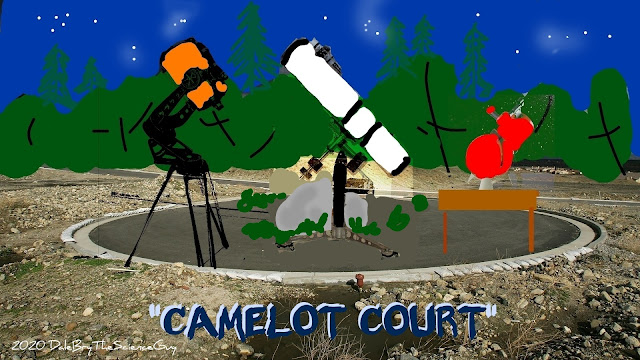
Graphic of O-Team members telescopes at Camelot Court


I arrived, on location, at around 2:00am. The others - Mike, Muir, and Shawn, were just waking from a short night's sleep, camped out at the center of an unused, undeveloped, someday-to-be, cul-de-sac neighborhood called, "Camelot Court", in North Falmouth, Mass. We had chosen this location for its proximity, open view of the sky, and, for its relative isolation from outdoor lighting - and other, unwelcomed intrusions.

In the span of 3 hours of telescope time, we had assessed, 5 Messier objects, an unknown open cluster, an unknown globular cluster (to us, at the time), and 8 sporadic meteors.

The wee hours of the night present some of the best opportunities for the amateur observational astronomer: fewer episodes of sporadic lighting, fewer people, less traffic, increased meteor activity, and, most of all, quiet.

M57, The Ring Nebula in Lyra imaged on ATEO-1 processed by Utkarsh Mishra (left) and M27, The Dumbell Nebula in Vulpecula imaged on ATEO-1 processed by Michael Petrasko.
M57, The Ring Nebula in Lyra imaged on ATEO-1 processed by Utkarsh Mishra (left), and M27, The Dumbell Nebula in Vulpecula imaged on ATEO-1 processed by Michael Petrasko (right).

Our, "optical ambush", begins with M57 - the "Ring" nebula, in Lyra. Though this emission nebulosity does, indeed, appear ring-like through the eyepiece, that is an illusion of perspective. This structure is, in reality, a spherical shell of excited gas molecules, outlining the shock bow from a centralized supernova event. M56, to me, has always appeared to be, a lone "Cheerio", floating in the darkness! It sits, almost squarely, between the two, lower corner stars of the "lyre" shape, Gamma and Beta Lyrae. It can be observed well with a 4" telescope.

The next object was M27, in Vulpecula - the "Dumbbell" nebula.

This, also, can be seen easily in a 4" inch scope. I know this, because Mike had a 4" Edmund Scientific Astroscan, at the time, and usually found these objects before I did. It is a twin-lobed remnant, also of a supernova. Burnham's Celestial Handbook describes it as, "large and shining", at several times the size of M57. About then, we broke out some nutrition to keep up our ambitions: "Nutty Bars", "M&M's" (plain), and a bag of "Doritos". Now, there's some "energy food"!

Edmund Scientific's Astroscan 4" f/4.2 reflector telescope (left) with the original observing log entry this post was adapted from back on May 8th, 1983 written by Insight Observatory Co-Founder Michael Petrasko when he was 17 years old. Image credits: Astroscan - Glenn Votava, Observers Log - Dale Alan Bryant.

Next on our list was M13 - the Hercules cluster (globular cluster, not referring to the cluster of galaxies within that constellation). Easily seen in good binoculars, this is one of my favorite collections. Of stars, that is. A nearly, perfectly symmetrical, uniformly dense, globe-shaped cluster of stars within the halo of globular clusters that orbits the Milky Way galaxy. Well, that's a technical description – but, see it for yourself, and you'll likely choose other, more prosaic wording, I'm sure of it.

M11 - is an open star cluster in the constellations Scutum. Open star clusters are loose congregations of stars, bound together, gravitationally, as are globular clusters, only, not as tightly. It's commonly called, the "Wild Duck" cluster (for reasons I never quite grasped). I have a favorite open cluster, not on this list: the double cluster, NGC'S 864 and 889, in Perseus. At over 7,000 light-years, the stars in the cluster appear as tiny, brilliant, and colorful jewels.

M13, The Great Hercules Globular Cluster imaged on ATEO-1 processed by Utkarsh Mishra (left) and M51, The Whirlpool Galaxy in Canes Venatici imaged on ATEO-1 processed by Michael Petrasko (right).
M13, The Great Hercules Globular Cluster imaged on ATEO-1 processed by Utkarsh Mishra (left), and M51, The Whirlpool Galaxy in Canes Venatici imaged on ATEO-1 processed by Michael Petrasko (right).

Next up, M51 - the "Whirlpool" galaxy. M51 is another "Grand Design" spiral galaxy, in reference to its near-perfection. Actually, it's an interactive pair of galaxies - the larger one, slowly consuming the smaller of the two. Located in Canes Venatici, its brightness and relative isolation in the darkness make it an easy target for small scopes.

As for the unknown open and globular clusters, I could only guess at what they would have been; likely, something in Ophiuchus - an area, rich, in such wonders.

And that leaves eight meteors; possibly, or not, connected to the Eta Aquarid meteor shower. Meteors are a fascinating subject, all on their own. The months of April and May have, historically, produced some very large fireballs and bolides, in historic times. Ask Mike or me, about that, sometime!

Dale Alan Bryant
Senior Contributing Science Writer
Read More

Sunday, April 19, 2020

Northern Hemisphere Forecast for April and May: Showers - With A Chance Of Bolides!

This time of year, presents us with a unique, "all-sky", observing situation: double-header meteor showers - and, the possibility of 'fireballs', and/or, 'bolide' meteors, thrown in!

First comes the Lyrid meteor shower, peaking on 22APR and followed by the Eta Aquarids, peaking on 5MAY.

Ah-Ha! But - the bases are loaded...

There is also, a good chance, for spotting a 'fireball' meteor or two, and, even a "near-once-in-a-lifetime" bolide. This annual recurring situation is where the term, "April Fireballs" comes from (see my article, "The Great Fireball of 1966").

A meteor from the Lyrids meteor shower crossing the milky way - single exposure. Image credit: iStock by Getty Images.

Lyrid meteors originate with the short, long-period comet, C/1861 G1. This comet has one of the shortest periods of all, long-period comets, at just over 400 years. Therefore, its 'wake' is broad and rather dense. Zenithal Hourly Rates (ZHR), are only around 10, for most years - but, with meteor showers, one can never tell. The Lyrids have provided, in, roughly, 60-year outbursts, up to 90 meteors, per hour! The Lyrid radiant in Lyra is close to that constellation's brightest star, Vega, which rises around 8:30 p.m., in the east.

The Eta Aquarids, peaking on 5MAY, is the debris train, left, by the 76-year period comet, 1P/Halley (yes, that one - "Halley's Comet", for you newcomers (oh, you'll learn!))

The Eta Aquarids radiant rises at around 2:45 a.m. and the hour or two just before dawn will be the best viewing (That's what you get for becoming an Astronomer!) The Eta Aquarids occur, this year, near the full moon - but a full moon was never a deterrent to me, for a meteor shower. And, there is assistance at hand...

Meteor showers are the type of event that, you don't want to use a telescope at; at least, not for watching meteors. Typically, meteor showers are viewed with the unaided eye. Some observers will use, low powered, standard-style binoculars - I've tried that myself and, probably, missed, half of the meteors during a shower, by constricting my field of view in using them!

Orion 2 x 54 Ultra Wide-Angle Binoculars

Orion Telescopes and Binoculars have come up with a unique-sounding aid directed at the meteor shower, and, Milky Way density viewer: Orion 2 x 54 Ultra Wide-Angle Binoculars! Somebody finally did it!

Although I haven't tried these, for myself, I get it -- I've imagined similar optics in my, "deep-astronomical" past (around 50 yrs., total!)

Rather than missing out on some meteors by using the confined field of a standard pair of binoculars - these 2x54 ultra-wides sound, more like, an enhanced, 'unaided-eye' field of view, with their offering of a 36° FOV, and 70°, apparent field of view. I can only imagine what the denser portions of the Milky Way look like through these!

IF YOU DO HAPPEN ACROSS A BOLIDE – LET ME KNOW ABOUT IT!

Dale Alan Bryant
Senior Contributing Science Writer
Read More

Friday, June 2, 2017

"Hey Rocky - Watch Me Pull an Asteroid Out of My Hat!"

In Feb of 2012, Earth collided with a 65ft. in diameter asteroid, which exploded over the Russian town of Chelyabinsk. We all know the fortunate outcome there--they were extremely lucky, in that, the sonic boom, created by the disintegrating rock (at a height of 15 miles as it careened through our atmosphere toward the ground at 45,000 miles per hour), caused thousands of injuries, partially demolished buildings and shattered windows. Had the asteroid entered the atmosphere at a steeper angle, the results would have been catastrophic.

This is the trail of Chelyabinsk asteroid which exploded about 14 miles above the ground  with a force nearly 30 times more powerful than the Hiroshima atomic bomb in 2013.  Credit: Neuromainker via YouTube/Screenshot by Irene Klotz for Discovery News.
This is the trail of the Chelyabinsk asteroid which exploded about 14 miles above the ground
with a force nearly 30 times more powerful than the Hiroshima atomic bomb in 2013.
Credit: Neuromainker via YouTube/Screenshot by Irene Klotz for Discovery News.

And we never saw it coming. This meteor snuck right upon us from the direction of the sun, out of sight in the blinding light of day, as if some celestial magician had pulled it out of a hat--then threw it at us.

But, guess what? There's more to this celestial magic act...  


Bullwinkle pulling an asteroid from his hat

Let's start here...

This past April, Earth's orbit intersected the orbit of an asteroid debris field--the debris train, left in the wake of an orbiting, cometary, or, asteroidal body. This particular field is several times the Earth's diameter, and we were right in the thick of it for the entire month of April, as well as the end of March and the beginning of June. Earth's atmosphere encounters this field, and others somewhat like it, on occasion, every April, which, due to the pull of gravity produces 'fireballs' (unusually bright) and 'bolides' (exploding) meteors. But, parts of the field have been increasing in density over time.

Astonishingly, we've had 16 near-misses by asteroids, since January of this year, some within just a quarter of the distance to the moon, and one, actually, at an altitude of less than our GPS satellites! Most of these objects were just a few meters across, with the exception of one, which was a few kilometers in diameter!

So, is this kind of thing common? Could we experience another collision, similar to the Chelyabinsk event?

Well, it isn't a matter of, "If". Rather--I'm afraid--it's a matter of "When". And, that's not just an 'alarmist'' opinion, either; here's the deal:

Space--particularly interplanetary space--is not, entirely, empty. At any given time, there is an assortment of asteroidal and cometary debris surrounding the Earth, and in its orbital path around the Sun. Most of this debris is particulate. But, the process of the formation of our solar system, left behind a wide range of sizes of fragmented rock and iron. In our immediate neighborhood, there are asteroids composed of this material ranging in size from bits of dust, to rocks---to boulders---to school buses---even to 5-story apartment buildings! The Chelyabinsk meteorite was the size of the latter. And, there are a few asteroids out there--- the size of small moons!

On an average day, Earth's atmosphere encounters two basketball-sized asteroids. In any two-week period, we get slammed, by one SUV-sized asteroid. Some burn up, entirely in the atmosphere--and, some, make it to the ground.

In the early days after the formation of our solar system, there was much more of this material, which ended up on the surfaces of Earth and the moon and other planets. Here on Earth, the processes of weathering and erosion have erased most of the evidence for those impacts. However, there is plenty of left-over for orbital physics to play with.

Earth--and, ourselves--are moving through space, on our annual revolution around "Sol", our star--our sun (counterclockwise, viewed from the Sun's North Pole), at a speed of 33,000 mph. At the same time, we're rotating on our axis, eastward, at a speed of 1,000 mph.

Here's a very fitting analogy: We're driving down the freeway, blindfolded--with the pedal to the floor; eventually, we're going to crash---unless we can prevent it from happening, altogether, with an early detection/warning and response system.

Become a member of the NASA Center for Near-Earth Object Studies (CNEOS), a program that keeps track of these objects by monitoring and plotting their positions, trajectories, and velocities. You could--literally--save the world.

**The title, some of you may remember, is a take-off on the 60's cartoon style, "Rocky and His Friends" ("Bulwinkle" was, undoubtedly, his closest!).
Read More

Monday, July 7, 2014

The Great Fireball of 1966

At around 7:15pm on Sunday, April 24, 1966 - forty-eight years ago tonight - I was 8 years old and just passing by the open front door to our house, which faced due west, at 55 Haddon Ave., Falmouth, Mass. I remember that the sky was still light and absolutely cloudless (about 30 minutes after sunset) when I noticed a ball of light about the size and brightness of the full moon approaching from just slightly to the left, or, south. I remember feeling frozen in place as I watched this thing – I thought it was maybe a burning aircraft – moving parallel with the rooftop of the Hall School which was about 200 ft. away, directly across the street from the house. My brother, Barry, and cousin, “Binky”, yelled over to us as they crossed the front yard later that night, that they had seen a “flying saucer” earlier, just above the Falmouth Public Library, which was just across the street to the south. Something was mentioned about the Lawrence High School just across Shiverick’s pond to the west, and the Falmouth Fire Department was mentioned also. Funny that I did not connect these two events! (This is the night I had run out the front door into the street and stubbed my big toe!)

Sky and Telescope Magazine Cover - June 1966

The object was very bright and seemed to have what I thought of as “sparks” coming from the trailing end, which was teardrop-shaped. It had a long, even, white train of smoke trailing behind it, much like a thick contrail, which crossed the entire length of the sky. At times, the object's trailing edge became greenish in color, the leading edge yellow-orange, while the main body remained white. It seemed to pulse slowly several times, brightening with each pulse and I wondered if something else was going to happen to it. During these moments of brightening, the “sparks” separated from the main body and trailed it by at least two or three diameters. I remember thinking how strange it was that these sparks, or fragments, were detaching from the object and that they became visible only after they were some distance behind it. The fragments themselves alternated green and orange and left short trails of their own. I distinctly remember thinking that I couldn’t account for what it was I was seeing and I was especially boggled by the fragments trailing behind the object, seems to ignite only after they were some distance away. I wished that I could predict what was going to happen to the object next but I had had no similar prior experience with anything like this. I felt quite at a loss for an explanation for what I saw. Later that night, I heard my mother on the phone, tell someone that there had been an announcement about the object on TV, about halfway through The Andy Griffith Show. I don’t know what channel it was or what the station call letters were.

The object seemed to move perfectly parallel to the school rooftop, which was just a degree or two below the object, as it moved in a South to North direction. I was struck by the object's slow speed – about the speed of any plane I might have seen on the horizon at any other time. It seemed to take a long time to move across my entire field of view, which was clear all the way from the south to the north, except for the low school rooftop. The rooftop spanned almost the entire length of the western horizon but was itself only about five degrees in height and perfectly flat. I don’t remember hearing any sound at all. I remember thinking that the thing was going to explode at any time after it had swelled again and again. I remained quiet the whole time, not wanting to call out or call attention to the thing, but just watching and waiting to see what was going to happen next. I don’t remember anyone else being around, anyway. Again, it seemed as if the event was endless and it struck me how the object seemed to go through many changes during its flight. I estimate the duration of the flight at about 30 seconds. Finally, it seemed to break apart completely and fade out just before disappearing below the tree line in the NNW.

A similar, nearly identical incident occurred in the summer of 1979 or 1980, during the late afternoon (I don't remember the date), which I also witnessed while at work at Quickset Harbor. A similarly sized object had entered the atmosphere - I estimated somewhere over Maine or Nova Scotia - at the NNE tree line and disappeared over the Atlantic Ocean, at roughly the SE tree line. I was able to time the duration of this object's flight - or as much of it as I had witnessed - at 45 seconds. The object's train, speed, and its color approximated that of the 1966 incident. My sister, Linda, claimed to have seen the object while in a friend's boat on Vineyard Sound, just outside of Falmouth Harbor.

I feel very lucky to have seen such rare and wonderful things.

Almost three months after the 1966 incident, on Friday, July 1st, Barry and Binky’s band, “The Beau Brines” opened for “The Animals” at the Cape Cod a-Go-Go, in Yarmouth, MA. On Christmas of that same year, I received my second telescope, a 3-inch Newtonian reflector. It had a white cardboard tube with a screw-clamp ball-and-socket tripod mount. I saw the moon for the first time with this instrument. I also had a black-tubed 3-inch alt-azimuth reflector a year or two earlier, but other than burning my retina with it trying to locate the sun, I only remember using it to try to locate the moon. I didn't find the moon but I did find the sun! This was also the year that I got to sit in the pilot’s seat of John Glenn's Mercury space capsule, “Friendship 7”.

Dale Alan Bryant
Senior Contributing Science Writer
Read More