-->

Bringing the Universe to Classrooms
and Homes Around the World!

What's Happening at Insight Observatory...

Showing posts with label newtonian reflector. Show all posts

Friday, February 19, 2021

Messier 78 Reflection Nebula

In this post, Insight Observatory features deep-sky object Messier 78. This target was requested to be added to Insight Observatory's image set repository, Starbase by one of its loyal Starbase subscribers.

The image set data was acquired on the 16" f/3.75 Dream Aerospace Systems astrograph reflector (ATEO-1) remote telescope located in New Mexico. There are nearly 10 hours of Luminance, Red, Blue, Green, and Ha image data of Messier 78 available for download on Starbase.


Messier 78 reflection nebula located in the constellation Orion imaged on ATEO-1 and processed by Utkarsh Mishra. Image set now available for download on Starbase.
Messier 78 reflection nebula located in the constellation Orion imaged on
ATEO-1 and processed by Utkarsh Mishra. The image set is now available
for download on Starbase.

Messier 78 or M78, also known as NGC 2068, is a reflection nebula in the constellation Orion. The nebula was discovered by Pierre Méchain in 1780 and included by Charles Messier in his catalog of comet-like objects that same year.

M78 is the brightest diffuse reflection nebula of a group of nebulae that includes NGC 2064, NGC 2067, and NGC 2071. This group belongs to the Orion B molecular cloud complex and is about 1,350 light-years distant from Earth. Messier 78 is easily found in small telescopes as a hazy patch and involves two stars of 10th and 11th magnitude. These two B-type stars, HD 38563 A and HD 38563 B, are responsible for making the cloud of dust in M78 visible by reflecting their light.

Source: Wikipedia
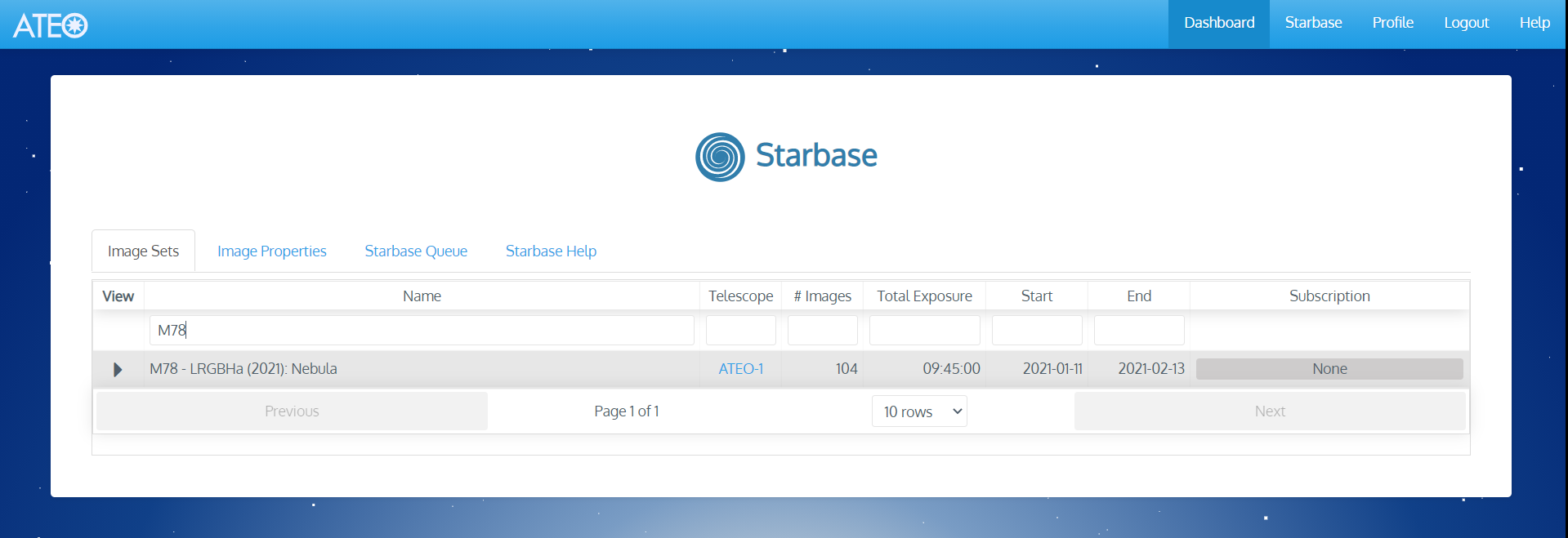
Search for M78 in the "Name" field in Starbase and access to the M78 LRGBHa (2021) Nebula image set will display.
Search for M78 in the "Name" field in Starbase and access to the M78 LRGBHa (2021) Nebula image set will display. 

Insight Observatory is currently taking deep-sky image requests for Starbase image sets on its new ATEO Portal dashboard. There is no charge for these requests. If the requests are approved by the Insight Observatory staff, they will be imaged and uploaded to Starbase for anyone to subscribe to for the low rate of $0.05 (cents) USD per imaging minute for standard subscribers and $0.04 (cents) USD for educational subscribers. We only ask that Starbase subscription requests are for at least 5 hours of integration time.

Read More

Thursday, December 26, 2019

Buy A Real Telescope!

There are two kinds of people: those who own an astronomical telescope - and those who want to own one!

If you're of the 2nd variety, you may not own a telescope on the grounds, that, "they're, just too expensive!" Well, some telescopes ARE too expensive! - like those, situated beneath state-of-the-art observatory domes on the summits of Mauna Kea, and Mauna Loa, in the Hawaiian Islands. Now, THAT'S too expensive; for most of us, anyway.

Believe it or not - there are telescopes on the market, that actually approach the optical quality, and sizes, of some of those gems of the tropics. And, there are some that DON'T! And, it's the ones that don't - that are the, truly, expensive items! I will stay clear of those kinds of "powerful", "600X"-type "mockeries", except to give a brief overview and tell you where they can most likely be found.

Orion StarBlast 4.5 Astro Reflector Telescope Kit.

Certain kinds of telescopes, or, maybe more accurately, items that LOOK like real telescopes, that are marketed using high, but, ambiguous numbers - are likely to have the overall construction, as well as, overall usefulness, of a high-priced "toy". Although there are some rare exceptions, any type of optical instrument sold by department stores, or other chain store outlets, is likely to consist, mostly, of hype - and disappointment. Don't buy one. I could write a short book on my reasons for telling you that (maybe I will!) - but, not here.

There. That's that! Now, let's look at real, astronomical optical instruments that are available for the non-rich, amateur astronomer, or anyone else who wishes to acquire a well-made optical instrument, for other purposes, as well (I understand that "other" purposes exist - but, I'm not familiar with any of them!)


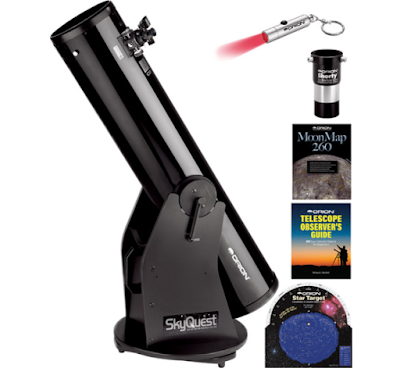
Orion SkyQuest XT8 Classic Dobsonian Telescope Kit.

This will be short, and sweet, mainly because I only know of one telescope manufacturer which meets all, of what, I consider, the most important criteria: quality, price, available accessories, reputation, and general knowledge of telescopes - based on my experience and familiarity them: Orion Telescopes and Binoculars of Cupertino, California.

Because of the necessity of variety, and of combinations of variety - much of it aimed at the more advanced, "intermediate" amateur astronomer - Orion carries many types of telescopes, and telescope 'packages', which, I cannot possibly give decent coverage to here, so, before I briefly go over a few of their more 'general-purpose' telescopes, I'll just mention that, they also carry instruments for the advanced amateur, as well as, professional astronomer.

I will note here - NEVER buy a telescope, based on advertisements of "power". I think that statement should be embossed on every telescope's packaging, just above, "DO NOT USE TO LOOK DIRECTLY AT THE SUN". Any telescope, in theory, can provide high, even very high magnifications. That's not what you're interested in. Advertising a telescope by "power"-"magnification", is a marketing device. It's done, only because it can be, and it sounds so good. But, magnification is the least of your concerns; aperture - is a major concern. The cost is a close second.

Orion SkyQuest XX12g GoTo Truss Tube Dobsonian Telescope.

There are a few, basic types of scopes: Refractors, Reflectors, and Cassegrainian, "folded" optics types. All of these come in a variety of aperture sizes. Refractors, typically, are in the smaller ranges, mainly because they are more expensive to make. Reflectors, come in small, medium, and large. Folded optics types, come in medium and large. My recommendation, for a beginner, is to purchase a reflector telescope of at least a 4-4.5-inch aperture, but that's because I'm partial to reflectors, and there, generally, larger apertures.

Here are three scopes from Orion, that I recommend for someone who has never before purchased a telescope, and/or, is a beginning-intermediate amateur astronomer. Prices are, as of their latest catalog.

  • StarBlast 4.5 Astro Reflector Telescope Kit: This is a 4.5-inch tabletop model, swivel-base, Dobsonian mounting, and is supplied with two eyepieces (for change of magnification) - 17mm and 6mm (26x and 75x, respectively). 0-power finder-scope. This model features an alt-azimuth dual-axis system for manual repositioning. Best suited for the beginner. Good for observing the moon, planets, and brighter deep-space objects.

  • Orion SkyQuest XT8 Classic Dobsonian Telescope Kit: An 8-inch "floor" model-style, Dobsonian mounting. Comes with 2x Barlow lens (doubling mag. of the eyepieces): 35mm and 25mm (34x, 48x, 68x, and 96x w/Barlow) and 0-power finder-scope. This model features an alt-azimuth dual-axis system for manual repositioning. Best suited for, beginner-intermediate. Good for observing the moon, planets, and dimmer deep-space objects.

  • Orion SkyQuest XX12g GoTo Truss Tube Dobsonian: This telescope is my personal "dream-scope". 12-inch aperture, computerized "GoTo" drive mechanism. Laser-based finder-scope. This model features the GoTo computer-automated drive. Stepper-motors, on both axes, and a hand-held computer controller, allow automatic repositioning of the telescope, based on controller input (keyed or voice). Includes 28mm and 12.5mm eyepieces and 2x Barlow (54x, 108x, 120x, and 240x). Best suited for intermediate-advanced amateurs. Good for observing the moon, planets, and harder-to-reach deep-space objects, such as distant galaxies.

I could continue down the list, as, there are other models in all of the classes I've mentioned, with varying degrees of accessory inclusion. All of the models mentioned here will be very good for observing a variety of celestial objects. Orion carries an entire line of accessories, from extra eyepieces, and solar filters, to planetary and deep-space digital CCD cameras and adapters. Your best bet, though, is to view their current, full catalog online, at telescope.com.

Unfortunately, they no longer provide a real, paper catalog! But, according to their associate, Rick, they will likely be back (as soon as people realize that, paper, is actually, a much faster, more intuitive browse than a screen!)

Dale Alan Bryant
Senior Contributing Science Writer
Read More

Sunday, July 14, 2019

Mosaic of Reflection Nebula NGC 6914

Recently we wrote a post covering a collaborative on a mosaic of NGC 7023, The Iris Nebula, imaged by accomplished astrophotographers, Paul C. Swift and Carmelo Falco. This is an image that Insight Observatory was fortunate to be able to contribute to by providing luminance data from the 16" f/3.7 astrograph reflector (ATEO-1). Paul and Carmelo have since produced another astonishing mosaic image, NGC 6914. This deep-sky object is a reflection nebula located approximately 6,000 light-years away in the constellation Cygnus and the plane of our Milky Way Galaxy. The nebula was discovered by Édouard Stephan on August 29, 1881.

This mosaic of the reflection nebula NGC 6914 is made up of data from different focal lengths. 380mm, 1330, 1525mm, and 3400mm. Image processed by Paul C. Swift.

The final image data was processed by Paul C. Swift with data acquired from his backyard with a VSD Vixen 380mm & AG14 1330mm Newtonian astrograph. The filter wheel is an SX-46 with an SX Maxi wheel from Starlight Xpress Ltd. A formatted array of 27 x 21.6 mm and 6uM square pixels. Newtonian telescope at 1330mm and Chroma Filters RGBL mounted on a Paramount MX.

Data for the central area of the nebula was imaged by Camelo Falco using his Ritchey-Chretien C 410mm f7.8 customized at 3400mm and an Apogee Aspin GG16m imaging camera. The mount is a customized RM500 Mount. Carmelo's guiding system is an Orion SteadyStar + Lodestar. The filter used by Carmelo was a Baader LRGB set.

Finally, additional Luminance data for outer areas was taken from Insight Observatory's 16" f/3.7 Astrograph reflector 1525mm (ATEO-1).

The Three imaging systems used to collect data of NGC 6914, a reflection nebula in Cygnus. Carmelo Falco's 16" f/7.8 Ritchey-Chretien (left), Paul Swift's VSD Vixen 380mm & AG14 1330mm Newtonian astrograph (above right) and Insight Observatory's 16" f/3.7 Dream astrograph reflector, ATEO-1, (lower right).
The Three imaging systems were used to collect data on NGC 6914, a reflection nebula in Cygnus. Carmelo Falco's 16" f/7.8 Ritchey-Chretien (left), Paul Swift's VSD Vixen 380mm & AG14 1330mm Newtonian astrograph (above right), and Insight Observatory's 16" f/3.7 Dream astrograph reflector, ATEO-1, (lower right).

From the image of NGC 6914 processed by Paul, obscuring interstellar dust clouds appear in silhouette while reddish hydrogen emission nebulae, along with the dusty blue reflection nebulae, fill the cosmic canvas. Ultraviolet radiation from the massive, hot, young stars of the extensive Cygnus OB2 association ionizes the region's atomic hydrogen gas, producing the characteristic red glow as protons and electrons recombine. Embedded Cygnus OB2 stars also provide the blue starlight strongly reflected by the dust clouds. The nearly 1-degree wide telescopic field of view spans about 100 light-years at the estimated distance of NGC 6914.

Read More