
Once upon a time, at a tiny cul-de-sac, in the village of North Falmouth, Cape Cod, Mass -
"This morning - was something to remember"...
So the note goes, written in pencil, on an official Edmund Scientific observing notes template, on the warm, sunny morning of 8 May 1983, by one, Mike Petrasko - one-third, of that notorious 3-member "gang" of optical aficionados, the "O-Team".
But, I think the tone of the note, was an understatement;
as observing sessions go, this one was outstanding, on several accounts! We had a guest for this session, a friend of Mike's, Shawn, who had never really had an opportunity, before this, to observe the sky with a telescope (and - he may not have, since!)
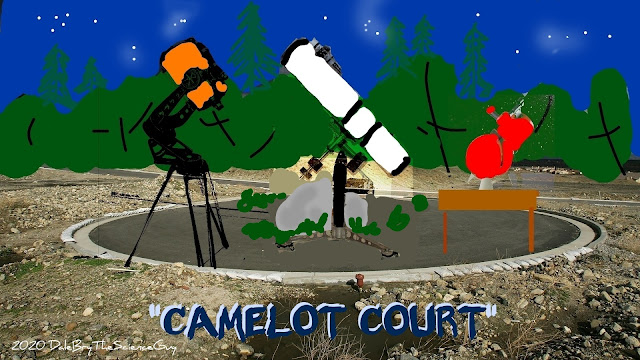
I arrived, on location, at around 2:00am. The others - Mike, Muir, and Shawn, were just waking from a short night's sleep, camped out at the center of an unused, undeveloped, someday-to-be, cul-de-sac neighborhood called, "Camelot Court", in North Falmouth, Mass. We had chosen this location for its proximity, open view of the sky, and, for its relative isolation from outdoor lighting - and other, unwelcomed intrusions.
In the span of 3 hours of telescope time, we had assessed, 5 Messier objects, an unknown open cluster, an unknown globular cluster (to us, at the time), and 8 sporadic meteors.
The wee hours of the night present some of the best opportunities for the amateur observational astronomer: fewer episodes of sporadic lighting, fewer people, less traffic, increased meteor activity, and, most of all, quiet.
Our, "optical ambush", begins with M57 - the "Ring" nebula, in Lyra. Though this emission nebulosity does, indeed, appear ring-like through the eyepiece, that is an illusion of perspective. This structure is, in reality, a spherical shell of excited gas molecules, outlining the shock bow from a centralized supernova event. M56, to me, has always appeared to be, a lone "Cheerio", floating in the darkness! It sits, almost squarely, between the two, lower corner stars of the "lyre" shape, Gamma and Beta Lyrae. It can be observed well with a 4" telescope.
The next object was M27, in Vulpecula - the "Dumbbell" nebula.
This, also, can be seen easily in a 4" inch scope. I know this, because Mike had a 4" Edmund Scientific Astroscan, at the time, and usually found these objects before I did. It is a twin-lobed remnant, also of a supernova. Burnham's Celestial Handbook describes it as, "large and shining", at several times the size of M57. About then, we broke out some nutrition to keep up our ambitions: "Nutty Bars", "M&M's" (plain), and a bag of "Doritos". Now, there's some "energy food"!
Next on our list was M13 - the Hercules cluster (globular cluster, not referring to the cluster of galaxies within that constellation). Easily seen in good binoculars, this is one of my favorite collections. Of stars, that is. A nearly, perfectly symmetrical, uniformly dense, globe-shaped cluster of stars within the halo of globular clusters that orbits the Milky Way galaxy. Well, that's a technical description – but, see it for yourself, and you'll likely choose other, more prosaic wording, I'm sure of it.
M11 - is an open star cluster in the constellations Scutum. Open star clusters are loose congregations of stars, bound together, gravitationally, as are globular clusters, only, not as tightly. It's commonly called, the "Wild Duck" cluster (for reasons I never quite grasped). I have a favorite open cluster, not on this list: the double cluster, NGC'S 864 and 889, in Perseus. At over 7,000 light-years, the stars in the cluster appear as tiny, brilliant, and colorful jewels.
Next up, M51 - the "Whirlpool" galaxy. M51 is another "Grand Design" spiral galaxy, in reference to its near-perfection. Actually, it's an interactive pair of galaxies - the larger one, slowly consuming the smaller of the two. Located in Canes Venatici, its brightness and relative isolation in the darkness make it an easy target for small scopes.
As for the unknown open and globular clusters, I could only guess at what they would have been; likely, something in Ophiuchus - an area, rich, in such wonders.
And that leaves eight meteors; possibly, or not, connected to the Eta Aquarid meteor shower. Meteors are a fascinating subject, all on their own. The months of April and May have, historically, produced some very large fireballs and bolides, in historic times. Ask Mike or me, about that, sometime!
Dale Alan Bryant
Senior Contributing Science Writer
Read More
"This morning - was something to remember"...
So the note goes, written in pencil, on an official Edmund Scientific observing notes template, on the warm, sunny morning of 8 May 1983, by one, Mike Petrasko - one-third, of that notorious 3-member "gang" of optical aficionados, the "O-Team".
But, I think the tone of the note, was an understatement;
as observing sessions go, this one was outstanding, on several accounts! We had a guest for this session, a friend of Mike's, Shawn, who had never really had an opportunity, before this, to observe the sky with a telescope (and - he may not have, since!)

I arrived, on location, at around 2:00am. The others - Mike, Muir, and Shawn, were just waking from a short night's sleep, camped out at the center of an unused, undeveloped, someday-to-be, cul-de-sac neighborhood called, "Camelot Court", in North Falmouth, Mass. We had chosen this location for its proximity, open view of the sky, and, for its relative isolation from outdoor lighting - and other, unwelcomed intrusions.
In the span of 3 hours of telescope time, we had assessed, 5 Messier objects, an unknown open cluster, an unknown globular cluster (to us, at the time), and 8 sporadic meteors.
The wee hours of the night present some of the best opportunities for the amateur observational astronomer: fewer episodes of sporadic lighting, fewer people, less traffic, increased meteor activity, and, most of all, quiet.
 |
| M57, The Ring Nebula in Lyra imaged on ATEO-1 processed by Utkarsh Mishra (left), and M27, The Dumbell Nebula in Vulpecula imaged on ATEO-1 processed by Michael Petrasko (right). |
Our, "optical ambush", begins with M57 - the "Ring" nebula, in Lyra. Though this emission nebulosity does, indeed, appear ring-like through the eyepiece, that is an illusion of perspective. This structure is, in reality, a spherical shell of excited gas molecules, outlining the shock bow from a centralized supernova event. M56, to me, has always appeared to be, a lone "Cheerio", floating in the darkness! It sits, almost squarely, between the two, lower corner stars of the "lyre" shape, Gamma and Beta Lyrae. It can be observed well with a 4" telescope.
The next object was M27, in Vulpecula - the "Dumbbell" nebula.
This, also, can be seen easily in a 4" inch scope. I know this, because Mike had a 4" Edmund Scientific Astroscan, at the time, and usually found these objects before I did. It is a twin-lobed remnant, also of a supernova. Burnham's Celestial Handbook describes it as, "large and shining", at several times the size of M57. About then, we broke out some nutrition to keep up our ambitions: "Nutty Bars", "M&M's" (plain), and a bag of "Doritos". Now, there's some "energy food"!
 |
| Edmund Scientific's Astroscan 4" f/4.2 reflector telescope (left) with the original observing log entry this post was adapted from back on May 8th, 1983 written by Insight Observatory Co-Founder Michael Petrasko when he was 17 years old. Image credits: Astroscan - Glenn Votava, Observers Log - Dale Alan Bryant. |
Next on our list was M13 - the Hercules cluster (globular cluster, not referring to the cluster of galaxies within that constellation). Easily seen in good binoculars, this is one of my favorite collections. Of stars, that is. A nearly, perfectly symmetrical, uniformly dense, globe-shaped cluster of stars within the halo of globular clusters that orbits the Milky Way galaxy. Well, that's a technical description – but, see it for yourself, and you'll likely choose other, more prosaic wording, I'm sure of it.
M11 - is an open star cluster in the constellations Scutum. Open star clusters are loose congregations of stars, bound together, gravitationally, as are globular clusters, only, not as tightly. It's commonly called, the "Wild Duck" cluster (for reasons I never quite grasped). I have a favorite open cluster, not on this list: the double cluster, NGC'S 864 and 889, in Perseus. At over 7,000 light-years, the stars in the cluster appear as tiny, brilliant, and colorful jewels.
 |
| M13, The Great Hercules Globular Cluster imaged on ATEO-1 processed by Utkarsh Mishra (left), and M51, The Whirlpool Galaxy in Canes Venatici imaged on ATEO-1 processed by Michael Petrasko (right). |
Next up, M51 - the "Whirlpool" galaxy. M51 is another "Grand Design" spiral galaxy, in reference to its near-perfection. Actually, it's an interactive pair of galaxies - the larger one, slowly consuming the smaller of the two. Located in Canes Venatici, its brightness and relative isolation in the darkness make it an easy target for small scopes.
As for the unknown open and globular clusters, I could only guess at what they would have been; likely, something in Ophiuchus - an area, rich, in such wonders.
And that leaves eight meteors; possibly, or not, connected to the Eta Aquarid meteor shower. Meteors are a fascinating subject, all on their own. The months of April and May have, historically, produced some very large fireballs and bolides, in historic times. Ask Mike or me, about that, sometime!
Dale Alan Bryant
Senior Contributing Science Writer

