-->

Bringing the Universe to Classrooms
and Homes Around the World!

What's Happening at Insight Observatory...

Sunday, February 18, 2018

ATEO Primary Mirror Gets a Cleaning

The 16" primary mirror from Insight Observatory's remote-operated Dream Astrograph imaging telescope (Astronomical Telescope for Educational Outreach) received its first cleaning. The staff at SkyPi Remote Observatories (the hosting site of the remote robotic telescope) performed the cleaning using a polymer solution known as First Contact™ Polymer.  This polymer solution is a one-part easy-to-use strip coating. It cleans and protects precision optics, telescopes, mirrors, and surfaces in use, storage, assembly, and in shipping. Using this method you paint, spray, dip or pour liquid on, let it dry, and peel off the flexible, strong, resilient film. First Contact™ is specially formulated to minimize surface adhesion and yet clean surfaces safely and effectively while leaving zero residues.  It is an inert, non-toxic polymer system designed to remove dust, fingerprints, residues, and contaminants from delicate, sensitive, and precision surfaces such as telescope mirrors, without scratching or damaging them.

SkyPi Remote Observatories Technician,  Caleb Ramer,  applies the polymer solution to the 16" primary mirror.   Photo by John Evelan.
SkyPi Remote Observatories Technician,  Caleb Ramer,  applies the polymer solution to the 16" primary mirror. 
Photo by John Evelan.

First Contact Polymer™ Solutions will safely clean and protect nanostructures, precision surfaces, optics, glass, fused silica, silicon, crystals, nonlinear crystals, metals, first surface mirrors, and precision aerospace surfaces. First Contact™ Polymer also cleans and protects diffraction gratings, phase masks, and pinholes! All reflective coatings and surfaces can be safe, easily cleaned, and protected with First Contact™. The fluid solution conforms to any contour, including nanostructured features, dries, and then the polymer film releases easily.

16" ATEO Primary Mirror Cleaning

This was the crew at SkyPi's first attempt using this method for mirror cleaning and as you can see from the video above, John Evelan, SkyPi Online Observatories Managing Member, can be heard commenting "It really works!". This method of mirror cleaning was also recommended by Dream Telescope's owner and manufacturer as a preferred method of mirror cleaning. This maintenance project was part of our ongoing assurance to provide optimal performance of the remote online imaging telescope.
Read More

Sunday, February 11, 2018

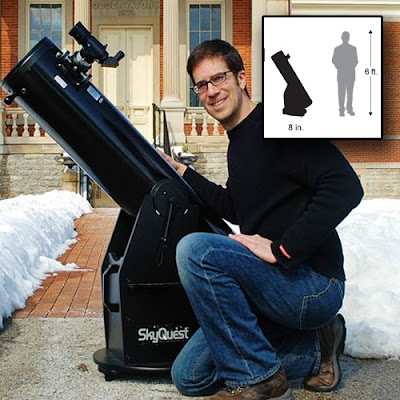
Review: Orion 8945 SkyQuest XT8 Telescope

Since we have been spending so much time focusing on the implementation and operations of the 16" astrograph online telescope in New Mexico, we wanted to take a step back and go back to our roots of simple backyard astronomy. When the crew at Insight Observatory hosted public and private star parties, out of all the backyard amateur telescopes they used, they favored the Orion 8945 SkyQuest XT8 Telescope.

The constellation Orion, named so because of the hunter of Greek mythology, is one of the most recognizable groups of stars in the night sky. The excellent Orion 8945 SkyQuest XT8 allows amateur astronomers to see it like never before, with its state-of-the-art clarity and its value for money. The Orion name brand in the market of telescopes is one of the most popular due to its high-quality products. Orion Telescopes & Binoculars was established in 1975 in California.

Orion 8945 SkyQuest XT8 Telescope is extremely portable. Image by Orion Telescopes.
Orion 8945 SkyQuest XT8 Telescope is extremely portable. 
Image by Orion Telescopes.

The Dobsonian refers to the style of the base, popularized by the famous "Sidewalk Astronomer" John Dobson in the 1960s, designed to produce large and affordable backyard telescopes. The general distinguishing features of this particular variety of telescope include the Altazimuth mount and a large objective diameter relative to its cost.

This instrument falls in the higher range of reflector telescopes, and there is a good balance between costs, convenience, and clarity. It is not as small as the XT6, which has been criticized in the past for not being capable of capturing good views, nor as large as the XT10, which has been said to be too bulky to carry even in the back of a car (we speak from experience). As we had both the XT8 and XT10 Dobsonian telescopes side by side at our star parties, although there is a 2" difference in the primary mirror size, our attendees could not really distinguish a difference in the views using the same powered eyepiece on both telescopes. 

Eight pictures were taken through the Orion XT8 to make this stitched   composite of our Moon, using an Olympus E510.   Image by Justin Mohorich
Eight pictures were taken through the Orion XT8 to make this stitched 
composite of our Moon, using an Olympus E510. 
Image by Justin Mohorich

The Orion XT8 Telescope is suitable for all types of stargazers, whether they are beginners, amateurs or die-hard observers. This means those who are new to the art of astronomy will find this telescope easy to use, and experts will find most of the functions satisfying. It is also family-friendly, allowing children to enjoy the fascinating hobby of stargazing, and the beginning of their sky quests to flourish. The easy-to-use finder and optical tube allow viewing of most extra-terrestrial deep-sky objects like star clusters, galaxies, and nebulae. A camera can be attached to the telescope with a ‘T-adapter’ (not included) for imaging the moon and brighter planets.

Setting up the SkyQuest XT8 is fairly straightforward; the telescope comes in two easily attachable parts, which need to be connected by the integrated springs. It should take around 30 minutes to assemble the telescope solo or 15-20 with someone else lending a hand. 

In Summary... The Orion 8945 SkyQuest XT8 is a great telescope for any kind of observer of the skies, and is especially good for families who want to introduce their children to it. Its specifications are more than capable of observing a wide array of objects, and with surprising detail- satellite craters can be clearly viewed, as well as obscure nebulae. Its minimalistic yet very ergonomic design is also very appealing. Owners of this telescope may want to consider purchasing additional lenses or filters to truly get the best out of this brilliant telescope.

Learn More Here...

Read More

Saturday, February 3, 2018

Astronomy Information for Beginners

Were you bitten by the astronomy bug while you were out stargazing last night? Suddenly feeling inspired to learn the more about wonders of the night sky, the solar system, and all the science behind them all? Sky and Telescope Magazine has a page on its website that will serve as your guide to astronomy for beginners.

Check out what's up in the night sky this week. Get advice for buying your first telescope. And find the best coverage you’ll find online of upcoming celestial events such as eclipses and meteor showers.

Ali Matinfar captured this image of stargazers under the Milky Way from the Mesr Desert in Iran.   Ali Matinfar / Online Photo Gallery
Ali Matinfar captured this image of stargazers under the Milky Way from the Mesr Desert in Iran.
 Ali Matinfar / Online Photo Gallery.

What's Up In the Night Sky Tonight?

The best guide to astronomy for beginners is the night sky. All you really need to do to get started is look up - preferably at night! You'll find an amazing treasure chest of astronomical wonders, even if you don't have a telescope.

Sky and Telescope's most popular (and free) offering, "This Week's Sky at a Glance," guides you to the naked-eye sky, highlighting the major constellations and planets viewable in the evening sky, with occasional dips into a deep-sky territory. Insight Observatory shares this guide weekly on its social media pages such as Facebook and Twitter.

If you'd rather listen while under the stars, download Sky and Telescope's monthly astronomy podcast and take it with you when you venture out tonight for a guided tour of the night sky.

Or do your own sleuthing with their interactive sky chart.

If there are any major celestial events, such as comets, eclipses, or meteor showers, you'll find all the latest information (including instructions on where to look and detailed sky charts) in their observing news section.

For more information on astronomy for beginners please visit http://www.skyandtelescope.com/astronomy-information/
Read More