-->

Bringing the Universe to Classrooms
and Homes Around the World!

What's Happening at Insight Observatory...

Showing posts with label Dream telescope. Show all posts

Monday, March 1, 2021

APOD - The Pelican Nebula Imaged On ATEO-1

Insight Observatory is very proud and honored to announce its very first Astronomy Picture of the Day (APOD)! APOD is a well-known world wide web publication affiliated with NASA of a different image or photograph of our fascinating universe each day, along with a brief explanation written by a professional astronomer.

The image that was selected for today's APOD is The Pelican Nebula (also known as IC 5070 and IC 5067). The final image processed was produced from an image set created between May and September of 2020 for Starbase, Insight Observatory's image set repository. The exposure time is close to 15 hours imaged with H-Alpha, Luminance, Red, Green, and Blue filters on Insight Observatory's 16" f/3.75 Dream Aerospace Systems astrograph reflector (ATEO-1) remote telescope hosted at SkyPi Remote Observatory located in New Mexico.

IC 5070 and IC 5067 - The Pelican Nebula imaged on ATEO-1 by Muir Evenden, pre-processed by Michael Petrasko, and post-processed by Utkarsh Mishra with nearly 15 hours of Ha, LRGB image data available for download on Starbase.

The Pelican Nebula is an emission nebula located near the bright star Deneb in the constellation Cygnus, the Swan. The nebula is named for its resemblance to a pelican and is associated with the neighboring North America Nebula and is one of several notable nebulae found in the area of the Northern Cross. It is an active star-forming region with a particularly active mix of star formation and evolving gas clouds. The position and balance of the stars and gas will gradually change to leave the nebula looking completely different millions of years from now.

The Pelican Nebula is listed as IC 5070 and IC 5067 in the Index Catalogue. The nebula itself is cataloged as IC 5070, while IC 5067 is a prominent part of it, found along the curve of the celestial pelican’s head and neck. It is a ridge of emission spanning about 10 light-years, home to many newly formed stars.

The nebula’s appearance is defined by dark dust clouds, which outline the pelican’s long bill and eye, and bright clouds of ionized gas, which form the curved shape of the pelican’s head and neck.

Sources: Wikipedia and The Constellation Guide.

Search for IC 5070 in the "Name" field in Starbase to access the IC 5070-5067 - Ha (2020) and IC 5070-5067 - LRGB (2020) Pelican Nebula image sets.


Read More

Friday, February 19, 2021

Messier 78 Reflection Nebula

In this post, Insight Observatory features deep-sky object Messier 78. This target was requested to be added to Insight Observatory's image set repository, Starbase by one of its loyal Starbase subscribers.

The image set data was acquired on the 16" f/3.75 Dream Aerospace Systems astrograph reflector (ATEO-1) remote telescope located in New Mexico. There are nearly 10 hours of Luminance, Red, Blue, Green, and Ha image data of Messier 78 available for download on Starbase.


Messier 78 reflection nebula located in the constellation Orion imaged on ATEO-1 and processed by Utkarsh Mishra. Image set now available for download on Starbase.
Messier 78 reflection nebula located in the constellation Orion imaged on
ATEO-1 and processed by Utkarsh Mishra. The image set is now available
for download on Starbase.

Messier 78 or M78, also known as NGC 2068, is a reflection nebula in the constellation Orion. The nebula was discovered by Pierre Méchain in 1780 and included by Charles Messier in his catalog of comet-like objects that same year.

M78 is the brightest diffuse reflection nebula of a group of nebulae that includes NGC 2064, NGC 2067, and NGC 2071. This group belongs to the Orion B molecular cloud complex and is about 1,350 light-years distant from Earth. Messier 78 is easily found in small telescopes as a hazy patch and involves two stars of 10th and 11th magnitude. These two B-type stars, HD 38563 A and HD 38563 B, are responsible for making the cloud of dust in M78 visible by reflecting their light.

Source: Wikipedia

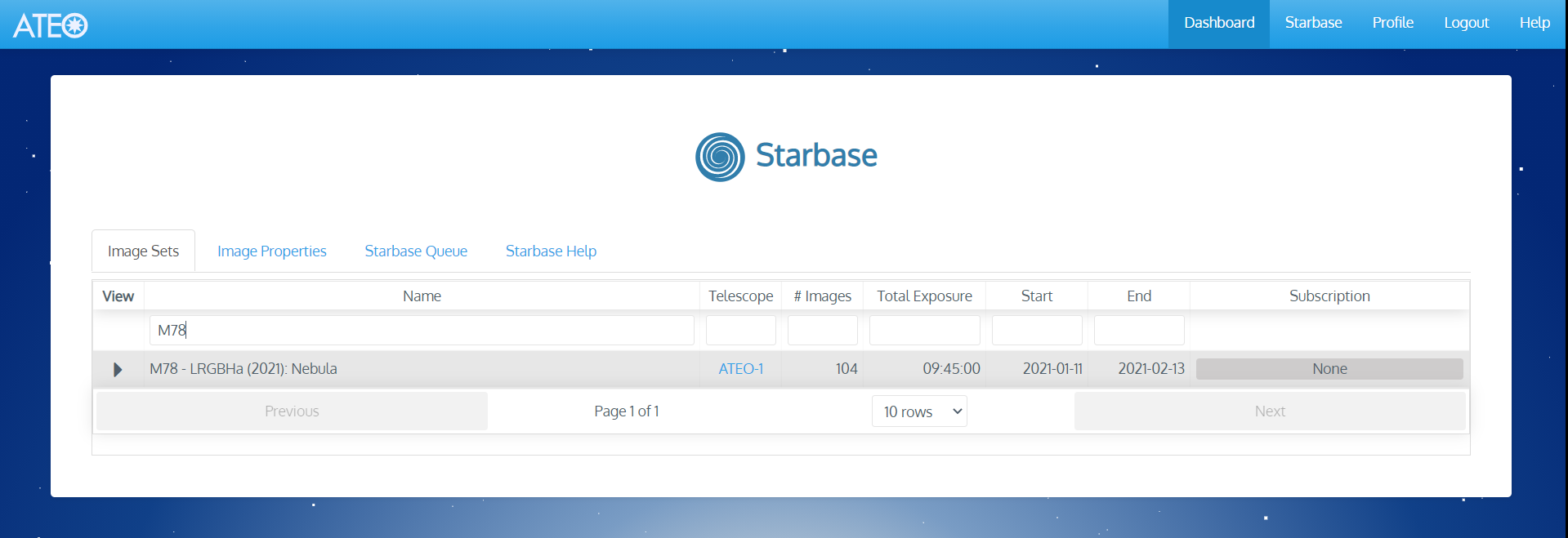
Search for M78 in the "Name" field in Starbase and access to the M78 LRGBHa (2021) Nebula image set will display.
Search for M78 in the "Name" field in Starbase and access to the M78 LRGBHa (2021) Nebula image set will display. 

Insight Observatory is currently taking deep-sky image requests for Starbase image sets on its new ATEO Portal dashboard. There is no charge for these requests. If the requests are approved by the Insight Observatory staff, they will be imaged and uploaded to Starbase for anyone to subscribe to for the low rate of $0.05 (cents) USD per imaging minute for standard subscribers and $0.04 (cents) USD for educational subscribers. We only ask that Starbase subscription requests are for at least 5 hours of integration time.


Read More

Friday, January 15, 2021

New ATEO Portal - Less is More!

Insight Observatory is very excited to announce the release of its new ATEO Portal!

As we gathered valuable feedback from many of our Insight Observatory ATEO Portal subscribers over the past few years, we wanted to ensure that accessing the Astronomical Telescopes for Educational Outreach (ATEO) for educational and standard use was an easy and pleasurable experience.

When we launched the first version of the ATEO Portal in the fall of 2017, we only had one remote telescope available to access, the 16" f/3.75 Dream Aeropace Systems astrograph reflector (ATEO-1). At the time, we didn't foresee the remote telescope network expanding with affiliate imaging systems located around the world.

M42 - The Orion Nebula imaged on ATEO-1 and processed by Utkarsh Mishra using Insight Observatory's new Advanced Image Request application now available on the new ATEO Portal dashboard.
M42 - The Orion Nebula imaged on ATEO-1 and processed by Utkarsh Mishra using Insight Observatory's new Advanced Image Request application, now available on the new ATEO Portal dashboard.

The first version of the ATEO Portal was designed and developed with the advanced astrophotographer in mind, fully automating the imaging process. Well... After listening to and taking suggestions from our portal users, we decided to "tone it down" a bit and get back to basics. The new version of the ATEO Portal is 100% intuitive and user-friendly, to the point where the user instructions fit on one section of the portal's dashboard.

Screen capture of Insight Observatory's new ATEO Portal dashboard displaying its new "Basic Image Request" application.

There are now two options for accessing Insight Observatory's remote telescope network for requesting image data. One option is "Basic Image Request". This option is similar to the Insight Observatory's Personal Image Request (PIR) application. The difference is that there are more imaging parameter options to select.

Screen capture of Insight Observatory's new ATEO Portal dashboard displaying its new "Advanced Image Request" application.

Another option is the "Advanced Image Request". This option will allow users to request specific custom image data from Insight's remote telescopes, including start date, which telescopes to image on, the number of images, filters to use, exposure lengths, and right ascension and declination coordinate input if needed. Image set requests can also be made on this application for Starbase, Insight Observatory's image set repository.

Here are just a few more changes to the image request process using the new ATEO Portal dashboard:
  • Image Credit System Removed - ATEO Portal users will no longer be required to purchase imaging credits in advance. The new portal dashboard works on a "pay as you go" model.

  • Scheduler Removed - The "Advanced Image Request" application will allow users to request an optional start date for acquiring their image data. This allows us to image your object at its best position in the sky and avoid bad weather cancellations.

  • Telescope Console Replaced - The "Advanced Image Request" application has replaced the Telescope Console, making requesting image data from all of our remote telescopes very quick and easy.

  • Automatic Image Data Upload Removed - Image data requests will be reviewed by Insight Observatory staff to confirm the quality of data is 100% satisfactory before uploading to the ATEO Portal user's home folder.

  • Image Queue Added - There is an image queue in the new ATEO Portal dashboard, allowing users to monitor the current status of their image request(s).

You may access the new ATEO Portal dashboard using your previous login credentials, and you still will have access to your user profile and Starbase image set repository from the new ATEO Portal.


Read More