-->

Bringing the Universe to Classrooms
and Homes Around the World!

What's Happening at Insight Observatory...

Sunday, December 9, 2018

ATEO-2 Doubles Up!

Insight Observatory's affiliate telescope ATEO-2 (owned by SkyPi Remote Observatory) which was originally set up solely with a Williams Optics 5" f/7 refractor now has a companion. The staff at SkyPi Remote Observatory has installed a Celestron 11" Schmidt-Cassegrain Telescope (ATEO-2B) to the same mounting system in the observatory. The 11" SCT is planned to be used primarily for remote planetary imaging. The crew at SkyPi has also been working tirelessly, testing and fine-tuning the mounting system as well as making modifications to the observatory, designated as Omega that houses ATEO-2. The Williams Optics 5" refractor (ATEO-2A) imaging system is now back in operation after it needed to be disassembled to add its companion, the Celestron 11".

ATEO-2 Shown with the Tandem Remote Imaging Sytems inside of SkyPi Remote Observatory's Omega Roll-Off.  Williams Optics 5" Refractor for Deep-Sky Imaging and Celestron 11" Planetary Imaging Telescope.
ATEO-2 Shown with the Tandem Remote Imaging Sytems inside of SkyPi Remote Observatory's Omega Roll-Off.
 Williams Optics 5" Refractor for Deep-Sky Imaging and Celestron 11" Planetary Imaging Telescope.

The planetary imaging system will be equipped with an Optec Focuser and Celestron Skyris 236C Color CMOS Camera. The timeline for the availability of this imaging setup is planned for February 2019. However, being that the 5" refractor is now available, John Evelan, managing partner at SkyPi Remote Observatory, has thoroughly tested the imaging system from his home in Mesa, Arizona. John acquired some imaging data of M38 and NGC 1907 open clusters in the constellation Auriga on the night of December 5th, 2018. This data was taken with the Starlight Xpress SXVR-M25C color CCD camera that replaced the ATIK 490EX Color camera that was originally installed on the refractor. Although the ATIK performed well, we collectively agreed the wider field of view on the SXVR-M25C would be more impressive.

M38 Open Cluster in the Constellation of Auriga. Image Taken by John Evelan and Michael Petrasko on ATEO-2 with the Williams Optics 5" f/7 Refractor Imaging System.
Open Clusters M38 and NGC 1907 in Auriga. Image Taken by John Evelan and Michael Petrasko on ATEO-2
with the Williams Optics 5" f/7 Refractor Imaging System.

ATEO-2 will be accessible on the ATEO Portal in the near future, however, it is now available via Insight Observatory's Public Image Request Form (PIR) and Educational Image Request Form (EIR) for gathering astronomical images from the classroom.
Read More

Sunday, November 25, 2018

Imaging Extragalactic Supernovae

Since the Astronomical Telescope for Educational Outreach (ATEO-1) went online back in May 2017, we have since had the chance to image galaxies and galaxy clusters with a 16" f/3.7 astrograph telescope. Besides using the remote robotic telescope for acquiring "pretty" pictures of deep-sky objects such as galaxies, it can also be used as a tool for gathering data for extragalactic supernovae search.

Professional astronomers distinguish between two main classes of supernovae. The distinctions have to do with the type of explosion occurring, how it is triggered, the resulting light curve, and the atomic elements visible in the spectrum of the supernova. However, for amateur astronomers’ purposes, we can consider two very basic types of a supernova: galactic and extragalactic. Our primary concern is with extragalactic supernovae, as a galactic supernova is far more infrequent an event than even a brilliant comet, solar eclipse, or any of a number of other “rare” astronomical phenomena. In fact, more than a dozen generations have passed without any human witnessing a supernova in our own Milky Way galaxy!

ASASSN-16cs/ SN 2016asf - Image Credit: PanSTARRS-1 Image Access

Imaging supernovae involve imaging galaxies as mentioned above. There are few other considerations than those normally applied to capturing a CCD image of a distant galaxy. Supernovae usually occupy the briefest time span of the three main transient events discussed in this section. Comets are often visible for weeks or even months, and even rapidly-moving near-Earth asteroids stick around for a week or more. Supernovae, on the other hand, may last only a few nights, appearing as a single brilliant star outshining the light of 100 billion companions in its host galaxy.

There is a list published online by the Central Bureau for Astronomical Telegrams that gives the latest discoveries and the name of the host galaxy (or position if the host galaxy is uncataloged). Due to the short time available to image supernovae, subscribing to the IAU Circular is recommended as well. This email circular lists recent astronomical headlines including supernovae, novae, comets, interesting asteroids, and other events. Often the information in the circular is not available immediately through any other source.

Photometric (brightness) measurements can be made of a supernova as it fades. This information tells scientists about the type of explosion and can even lead to information about the distance to the host galaxy of the redshift (recessional velocity) of that galaxy, leading to a better understanding of the universe.

ASASSN-16cs Extragalactic Supernova Confirmation (Right) - Image by Issac Cruz.
ASASSN-16cs Extragalactic Supernova Confirmation (Right) - Image by Isaac Cruz.

One of our neighbors at SkyPi Remote Observatory, Isaac Cruz, discovered an extragalactic supernova on March 7, 2016. This one was in the constellation of Gemini (The Twins). Isaac received a notification of a transient from the ASASSN system from Ohio State University. Isaac stated, "Luckily I've been given the opportunity to do remote observing from the great folks at SkyPi Remote Observatory in New Mexico so this was the perfect time to do it." Isaac connected to his remote system and pointed the telescope to the given coordinates. He took a 10-second image at 1/3 the resolution (Bin 3) and the supernova was obvious just south of the galaxy. Discovery! Isaac then took a 10-minute image at full resolution and sent it for verification. In a few minutes, he received the confirmation that the new star had been certified and designated ASASSN-16cs and SN 2016asf.

Now that our hosting neighbor at SkyPi Remote Observatory has proven this type of discovery is possible with remote robotic telescopes, it has inspired us to craft an extragalactic supernova search program of our own that would allow students and individual users of the ATEO network to participate in such an endeavor.
Read More

Thursday, November 1, 2018

What's In the Sky - November 2018

Clear November night skies offer incredible celestial sights for stargazers to be thankful for, so bundle up and get outside for stargazing fun! Brought to you by Orion Telescopes and Binoculars.

Taurids Meteor Shower

On the night of November 5, the Taurids Meteor Shower will peak, and with an early setting moon, there should be desirable dark skies for viewing. Look near the constellation Taurus, but be aware that meteors can appear anywhere in the sky.

Radiant of the Leonid Meteor Shower - Graphic by Univers Today.
Radiant of the Leonid Meteor Shower - Illustration by Universe Today.

Leonid Meteor Shower

Bundle up and get outside after midnight on November 17th to see the peak of the Leonids meteor shower as "shooting stars" appear to radiate outwards from the constellation Leo. The waxing gibbous Moon will set shortly after midnight, so the best time for meteor-gazing will be in the wee hours of November 18th when the skies will be nice and dark.

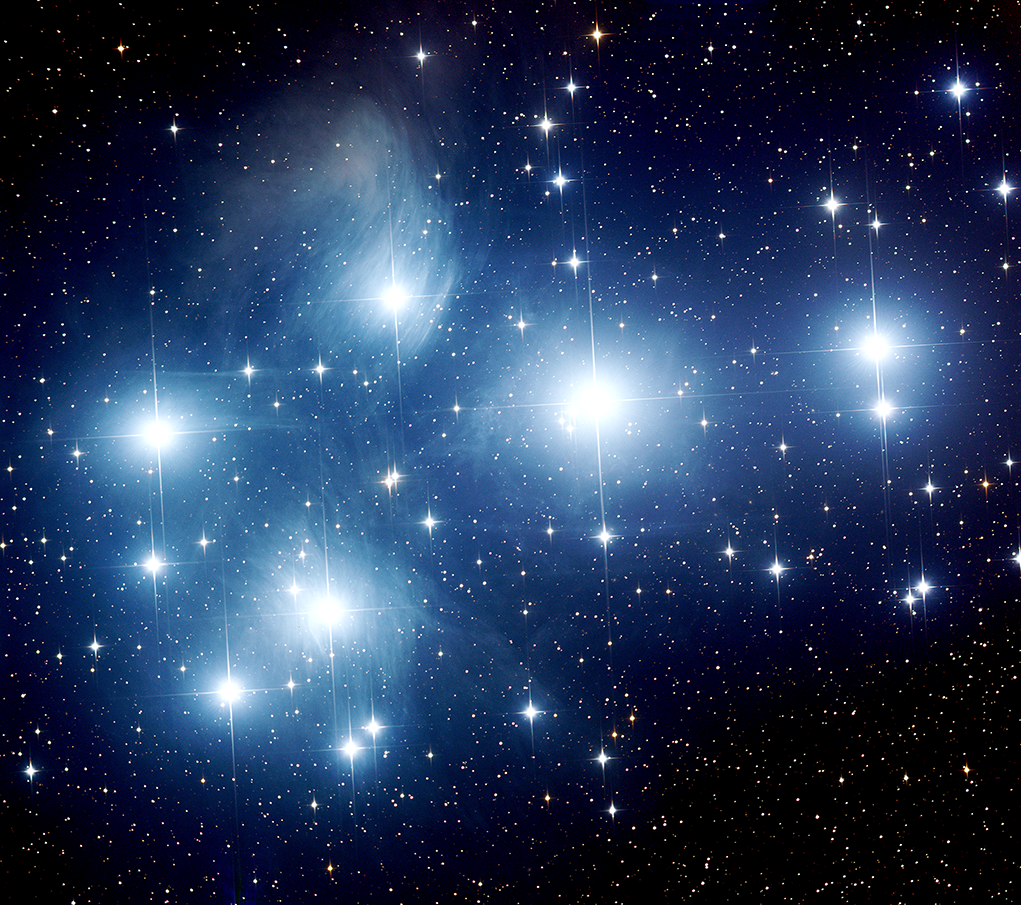
M45 - The Pleiades (the Seven Sisters) - Image by Insight Observatory.

The Pleiades

November is sometimes called "The month of the Pleiades," since the star cluster is visible all night long for observers in the Northern hemisphere. From a dark sky site, M45 is easy to see with the unaided eye and resembles a small "teaspoon" pattern in the sky. Use astronomy binoculars for immersive views of this open star cluster, or use a telescope with a lower-power eyepiece for a closer look at the Seven Sisters.

Mercury

The next night, November 6, will be the best time to observe the smallest and innermost planet in the Solar System as it will be at its greatest eastern elongation. It'll be low in the western sky shortly after sunset.

New Moon

This is the best time of the month to observe the fainter deep-sky objects such as galaxies and star clusters because there is no moonlight to interfere.

Double Cluster in Perseus

Use a pair of big binoculars or a shorter focal length telescope with a wide-field eyepiece in November to seek out the sparkling Double Cluster in Perseus - two side-by-side open star clusters NGC 884 and NGC 869.

All objects described above can easily be seen with the suggested equipment from a dark sky site, a viewing location some distance away from city lights where light pollution and when bright moonlight does not overpower the stars.
Read More