Showing posts with label Double Cluster in Perseus. Show all posts

Tuesday, March 2, 2021

What's In The Sky - March 2021

Take your family on a journey to the stars from the comfort of your own backyard! Here are some of Orion Telescope and Binoculars' top picks for March stargazing:

Orion Continues to Shine

Constellation Orion is still well-placed in March skies for telescopic study. Check out the bright nebula M42, also called the Orion Nebula, which is visible as the middle "star" of Orion's "sword" just south of the three recognizable stars of Orion's belt. While easily detected with binoculars, the wispy Orion Nebula will reveal more intricate details in a telescope. After March, Orion's namesake constellation will get lower and lower in the west, making it harder to see as the Sun moves eastward in the sky.

Planetary group of Saturn, Jupiter, Mercury, and the Moon in the south-eastern sky on March 10th around 5:40 am MST. Graphic created from Stellarium.

Morning Planetary Group

March 10th brings a nice group of planets. Saturn, Jupiter, Mercury, and the Moon will all be grouped together. Get up early, grab a telescope, and take a look!

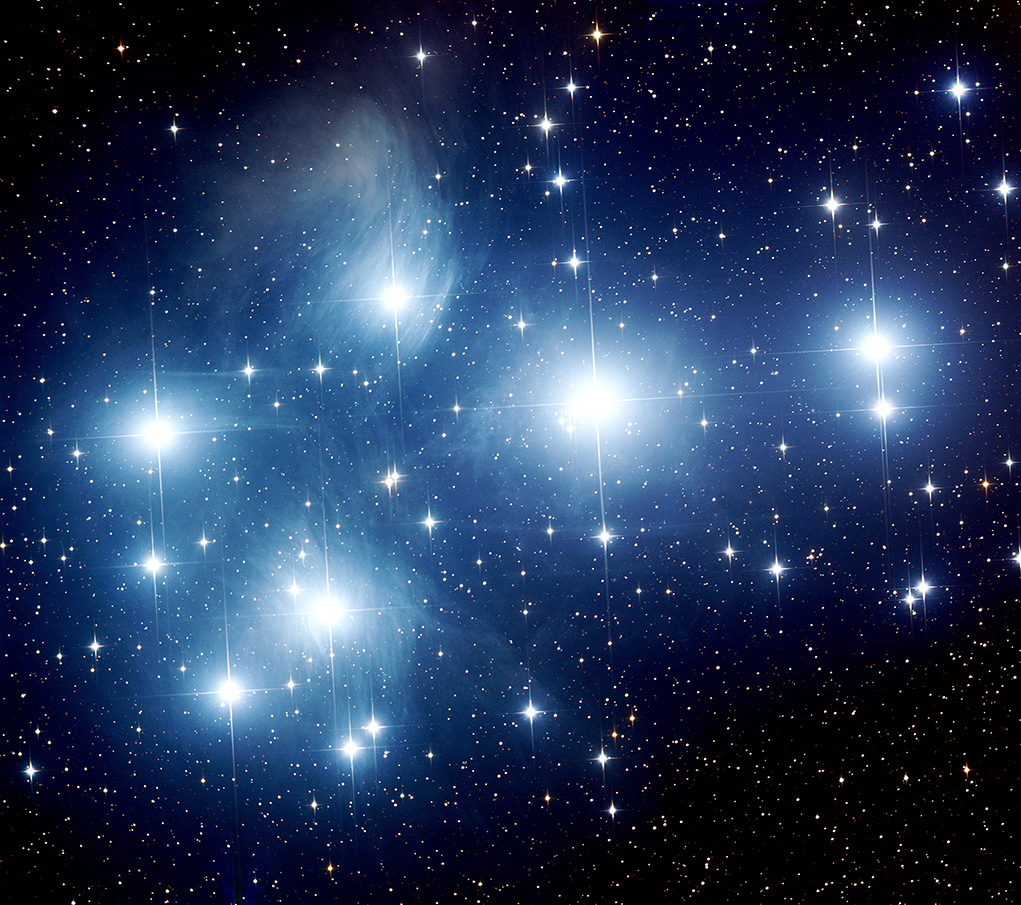
M45 - The Pleiades star cluster (left) imaged on ATEO-1 and processed by Chris Lin using Insight Observatory's online Personal Image Request (PIR) application and the Double Cluster in Perseus imaged and processed by ATEO-1 user Claudio Tenreiro.
M45 - The Pleiades star cluster (left) was imaged on ATEO-1 and processed by Chris Lin using Insight Observatory's online Personal Image Request (PIR) application, and the Double Cluster in Perseus was imaged and processed by ATEO-1 user Claudio Tenreiro.

Brilliant Binocular Clusters

Grab a pair of 50mm or larger astronomy binoculars in March for great views of the Pleiades star cluster (M45), the Beehive cluster (M44), and the must-see Double Cluster in Perseus. These sparkling sky gems are simply beautiful when observed with big binoculars, or use a wide-field eyepiece and a short-focal-length telescope for a closer look.

Leo Triplet of galaxies M65, M66, and NGC 3628 (left) imaged and processed on ATEO-1 by Utkarsh Mishra and M51 - The Whirlpool Galaxy imaged on ATEO-1 and processed by Jeff Padell using Insight Observatory's online Personal Image Request (PIR) application.

Galaxies Galore

By about 9- 10 p.m. throughout March, Ursa Major, Leo, and the western edge of the Virgo galaxy cluster are high enough in the eastern sky to yield great views of some of our favorite galaxies. Check out the bright pair of M81 and M82 just above the Big Dipper asterism. Look east of the bright star Regulus to observe the Leo Triplet of galaxies M65, M66, and NGC 3628. In the northeastern sky, check out the famous Whirlpool Galaxy (M51). While the Whirlpool can be seen with modest 50mm binoculars, using a 10" or 12" telescope in a location with dark skies will display the distant galaxy's beautiful spiral arms. With an 8" or larger telescope and a dark sky, this region of the sky harbors dozens of galaxies - try to find them all!

All objects described above can easily be seen with the suggested equipment from a dark sky site, a viewing location some distance away from city lights where light pollution and bright moonlight do not overpower the stars.
Read More

Sunday, November 1, 2020

What's In The Sky - November 2020

Clear November night skies offer incredible celestial sights recommended by Orion Telescopes and Binoculars for stargazers to be thankful for, so bundle up and get outside for stargazing fun!

Double Cluster in Perseus
Use a pair of big binoculars or a shorter focal length telescope with a wide-field eyepiece in November to seek out the sparkling Double Cluster in Perseus - two side-by-side open star clusters, NGC 884 and NGC 869. 

What's In the Sky - November 2020
NGC 884 and NGC 869 - The Double Cluster in Perseus imaged by Claudio Tenreiro on Insight Observatory's 16" f/3.7 astrograph reflector (ATEO-1).

Mars & The Moon
On November 25th, the Moon passes close to Mars, making them a great observing target! The pair will be separated by approximately 5.5 degrees, which is unfortunately too far apart to be viewed simultaneously at high magnification, but both could be observed together with wide-angle astronomy binoculars.

New Moon
November 14th will be the best time of the month to observe the fainter deep-sky objects such as galaxies and star clusters because there is no moonlight to interfere.

Leonids Meteor Shower
Bundle up and get outside after midnight on November 17th to see the peak of the Leonids meteor shower as "shooting stars" appear to radiate outwards from the constellation Leo. Meteor showers are usually best viewed without optical equipment, but for a closer look, try out some ultra-wide-angle binoculars. The shower peak is very close to the New Moon, which should present little light pollution. The estimated peak rate is approximately 14 meteors per hour.
 
M45 - The Pleiades located in the constellation Taurus imaged by Plymouth South Middle School students Taylor A. and Kyleigh O. using ATEO-1 via Insight Observatory's online Educational Image Request (EIR) application.
M45 - The Pleiades, located in the constellation Taurus, imaged by Plymouth South Middle School students Taylor A. and Kyleigh O. using ATEO-1 via Insight Observatory's online Educational Image Request (EIR) application.

The Pleiades
November is sometimes called "the month of the Pleiades," since the star cluster is visible all night long for observers in the Northern hemisphere. From a dark sky site, M45 is easy to see with the unaided eye and resembles a small "teaspoon" pattern in the sky. Use astronomy binoculars for immersive views of this open star cluster, or use a telescope with a lower-power eyepiece for a closer look at the Seven Sisters.

All objects described above can easily be seen with the suggested equipment from a dark sky site, a viewing location some distance away from city lights where light pollution and bright moonlight do not overpower the stars.
Read More

Friday, November 1, 2019

What's In The Sky - November 2019

Clear November night skies offer incredible celestial sights for stargazers to be thankful for, so bundle up and get outside for stargazing fun!

The May 9th, 2016 Mercury Transit at 9:15 am EDT - Image by Nolan D.

Transit of Mercury

On November 11th from 04:34 to 10:30 PST, Mercury will pass directly in front of the Sun. Visible as a tiny shadow against the disk of the Sun, a telescope with a properly installed solar filter is essential. This transit will next occur 13 years from now in 2032, so don't miss seeing it! Grab a solar filter for your telescope, or a convenient solar telescope to view the transit safely!

CAUTION: Never look at the Sun, either directly or through a telescope, without a professionally made protective solar filter installed that completely covers the front of the instrument, or permanent eye damage could result.

M45 - The Pleiades imaged at LRGB 600 sec, 2x2 bin on ATEO-1 by Insight Observatory.

The Pleiades

November is sometimes called "the month of the Pleiades," since the star cluster is visible all night long for observers in the Northern hemisphere. From a dark sky site, M45 is easy to see with the unaided eye and resembles a small "teaspoon" pattern in the sky. Use astronomy binoculars for immersive views of this open star cluster, or use a telescope with a lower-power eyepiece for a closer look at the Seven Sisters.

November 26th will be the best time of the month to observe the fainter deep-sky objects such as galaxies and star clusters because there is no moonlight to interfere.

Radiant of the Leonid Meteor Shower - Illustration by Universe Today.

Leonids Meteor Shower

Bundle up and get outside after midnight on November 17th to see the peak of the Leonids meteor shower as "shooting stars" appear to radiate outwards from the constellation Leo. The Moon will rise just before midnight, so the best time for meteor gazing will be before then, when the skies will be nice and dark. The estimated peak rate is about 15 meteors per hour.

Double Cluster in Perseus

Use a pair of big binoculars or a shorter focal length telescope with a wide-field eyepiece in November to seek out the sparkling Double Cluster in Perseus - two side-by-side open star clusters, NGC 884 and NGC 869.

All objects described above can easily be seen with the suggested equipment from a dark sky site, a viewing location some distance away from city lights where light pollution and bright moonlight do not overpower the stars.
Read More

Saturday, March 9, 2019

What's In The Sky - March 2019

Take your family on a journey to the stars from the comfort of your own backyard! Here are some of Orion Telescopes and Binoculars' top picks for March stargazing:

Orion Continues to Shine

Constellation Orion is still well-placed in March skies for telescopic study. Check out the bright nebula M42, also called the Orion Nebula, which is visible as the middle "star" of Orion's "sword" just south of the three recognizable stars of Orion's belt. While easily detected in astronomy binoculars, the wispy Orion Nebula will reveal more intricate details in a telescope. After March, our namesake constellation will get lower and lower in the west, making it harder to see as the Sun moves eastward in the sky.

Brilliant Binocular Clusters

Grab a pair of 50mm or larger astronomy binoculars in March for great views of the Pleiades star cluster (M45), the Beehive cluster (M44), and the must-see Double Cluster in Perseus. These sparkling sky gems are simply beautiful when observed with big binoculars, or use a wide-field eyepiece and short focal length telescope for a closer look.

M81 and M82 Galaxies in Ursa Major Imaged on Insight Observatory's 16" f/3.7 Reflector (ATEO-1) - Image by Senior Astronomy Class Students Aidan K. and Trever B. from Barnstable High School, Massachusetts.

Galaxies Galore

By about 9-10pm throughout March, Ursa Major, Leo, and the western edge of the Virgo galaxy cluster are high enough in the eastern sky to yield great views of some of our favorite galaxies. Check out the bright pair of M81 and M82 just above the Big Dipper asterism. Look east of bright star Regulus to observe the Leo Triplet of galaxies M65, M66, and NGC 3628. In the northeastern sky, check out the famous Whirlpool Galaxy (M51). While the Whirlpool can be seen with modest 50mm binoculars, using a 10" or 12" telescope in a location with dark skies will display the distant galaxy's beautiful spiral arms. With an 8" or larger telescope and a dark sky, this region of the sky harbors dozens of galaxies — try to find them all!

March 11-13

In the evening sky, the Moon, Mars, and the Pleiades star cluster will be in close proximity.

Mid- to Late-March

A cone of faint illumination known as the zodiacal light is visible from northern latitudes in the west just after evening twilight for the last two weeks of the month.

March 16-17

On the night of March 16th and the morning of the 17th, the waxing gibbous Moon will have a close encounter with M44, the Beehive star cluster. They come within 0.5 degrees of each other just before they set below the horizon before dawn.

March 20

This month the full moon rises on the same day as the vernal equinox — the start of spring! It is also the final “supermoon” of the year, meaning it will be nearly at its closest distance from the Earth, and thus nearly at its largest apparent size.

March 27

In the morning hours, the Moon and Jupiter make a pretty pair, separated by only about 4 degrees. Also, for the next seven nights, Mars will brush to within 4 degrees of the Pleiades star cluster (M45). Have a look at this cool conjunction with your binoculars!

March 29

Visible in the morning sky, Saturn will appear about 3 degrees from the waning crescent Moon.
Read More

Sunday, January 27, 2019

Featured Deep-Sky Objects - NGC 884 and NGC 869

The Double Cluster is the name for two open clusters, NGC 884 and NGC 869, and are located close together in the Perseus constellation. Also known as h Persei and χ Persei (h and Chi Persei), the open clusters both lie at an estimated distance of 7,600 light-years from Earth and are roughly 12.8 million years old. The Double Cluster is circumpolar (continuously above the horizon) from most northern latitudes. These deep-sky wonders are in proximity to the constellation Cassiopeia and are approximately the radiant of the Perseid meteor shower, which peaks annually around August 12 or 13.

The Double Cluster - NGC 884 (left) and NGC 869 (right) - Imaged by Michael Petrasko on Insight Observatory's Astronomical Telescope for Educational Outreach (ATEO-1).
The Double Cluster - NGC 884 (left) and NGC 869 (right) - Imaged by Michael Petrasko on Insight Observatory's Astronomical Telescope for Educational Outreach (ATEO-1.

NGC 884 and NGC 869 cover an area of 60 arc minutes of the apparent sky, which is twice the size of a full Moon making it a suitable target for backyard telescopes and binoculars. Individually, the clusters have a mass of 3,700 solar masses (NGC 869) and 2,800 solar masses (NGC 884), but as each cluster is surrounded by an extended halo of stars, the total mass of the Double Cluster is at least 20,000 solar masses. The two clusters are separated by only hundreds of light-years.

Each open cluster contains 300 to 400 stars and the brightest stars shine at 7th magnitude. NGC 869, appears slightly brighter, richer, and more compact than NGC 884.

Hipparchus, a Greek astronomer, catalogued the object as a "patch of light" in Perseus as early as 130 B.C. However, the true nature of the Double Cluster wasn’t discovered until the invention of the telescope many centuries later. In the early 19th century William Herschel was the first to recognize the object as two separate clusters. The Double Cluster is not included in Messier's catalogue but is included in the Caldwell catalogue of popular deep-sky objects, designated Caldwell 14.
Read More

Thursday, November 1, 2018

What's In the Sky - November 2018

Clear November night skies offer incredible celestial sights for stargazers to be thankful for, so bundle up and get outside for stargazing fun! Brought to you by Orion Telescopes and Binoculars.

Taurids Meteor Shower

On the night of November 5, the Taurids Meteor Shower will peak, and with an early setting moon, there should be desirable dark skies for viewing. Look near the constellation Taurus, but be aware that meteors can appear anywhere in the sky.

Radiant of the Leonid Meteor Shower - Graphic by Univers Today.
Radiant of the Leonid Meteor Shower - Illustration by Universe Today.

Leonid Meteor Shower

Bundle up and get outside after midnight on November 17th to see the peak of the Leonids meteor shower as "shooting stars" appear to radiate outwards from the constellation Leo. The waxing gibbous Moon will set shortly after midnight, so the best time for meteor-gazing will be in the wee hours of November 18th when the skies will be nice and dark.

M45 - The Pleiades (the Seven Sisters) - Image by Insight Observatory.

The Pleiades

November is sometimes called "The month of the Pleiades," since the star cluster is visible all night long for observers in the Northern hemisphere. From a dark sky site, M45 is easy to see with the unaided eye and resembles a small "teaspoon" pattern in the sky. Use astronomy binoculars for immersive views of this open star cluster, or use a telescope with a lower-power eyepiece for a closer look at the Seven Sisters.

Mercury

The next night, November 6, will be the best time to observe the smallest and innermost planet in the Solar System as it will be at its greatest eastern elongation. It'll be low in the western sky shortly after sunset.

New Moon

This is the best time of the month to observe the fainter deep-sky objects such as galaxies and star clusters because there is no moonlight to interfere.

Double Cluster in Perseus

Use a pair of big binoculars or a shorter focal length telescope with a wide-field eyepiece in November to seek out the sparkling Double Cluster in Perseus - two side-by-side open star clusters NGC 884 and NGC 869.

All objects described above can easily be seen with the suggested equipment from a dark sky site, a viewing location some distance away from city lights where light pollution and bright moonlight does not overpower the stars.
Read More

Sunday, November 9, 2014

Observing Objects in the Summer Milky Way

On the evening of October 27, 2014, Joe Masi, a Science Teacher at Sacred Heart High School, and I had our first successful observing run at the newly renovated Kohout-Dingley Observatory in Kingston, MA. This observing session was the first since the installation of the new Celestron 11 telescope mounted on a Losmandy Equatorial mount. Due to the unstable weather here in New England this fall, we have been challenged with finding a clear night to start getting acclimated to the new telescope system. 

Observing with the 11" Telescope.

Joe and I figured we could do a dry run of with equipment before having the students present. I arrived at the observatory shortly before sundown. The waxing crescent moon was hanging in the western sky. As I waited for Joe and total darkness to arrive, I thought I would get a glimpse of the moon through the C11 for the first time. The full disk of the moon (due to earthshine) fits nicely in the field of view of the 23 mm Axiom 2" eyepiece. The optics displayed fine detail in the moon's terminator, especially when steady pockets of air passed allowing good seeing. When Joe arrived at the observatory, I still had the moon in the eyepiece which allowed him a chance to get a good look at the moon as well. Joe was just as impressed with the optics performance as I was.

As the sky became darker, we configured the telescope and mounting system so we could utilize the Gemini 2 GOTO system. Once we completed the two-star alignment method with the GOTO system, our goal was to slew our way up through the summer Milky Way. The first targeted object was M8, the Lagoon Nebula. The object was so slow in the sky; the nebulosity was faint due to the murkiness of the horizon. The next object of choice was M11, the "Wild Duck" open star cluster in the constellation of Scutum. We then observed common deep-sky objects in the summer Milky Way such as M57, The "Ring Nebula" in Lyra, and M27, the "Dumbbell Nebula" in Vulpecula.

NGC 869 and 884, "Double Cluster in Perseus" Imaged by Tristan and Alek, students from the Plymouth Community Intermediate School
NGC 869 and 884, "Double Cluster 
in Perseus"Imaged by Tristan and Alek, 
from the Plymouth Community 
Intermediate School

I noticed the constellation of Pegasus was getting higher up in the sky and knew we could get a good view of M15, a nicely condensed globular cluster that rivals M13, the Great Globular Cluster in Hercules. Joe very impressed with this deep-sky object commented on how bright the cluster was. As we winded down our observing session, we ended with a nice view of M31, the Andromeda Galaxy, and the double open clusters NGC 869 and NGC 884 Cluster in Perseus. As Joe sat in the observing chair comfortably, he could detect the difference in the colors of some of the stars.

Content with this successful dry run, Joe and I then closed up the dome and parked the new telescope system. This observing session inspired us to introduce the students in the school's astronomy club and science classes to this newly renovated observatory with its new state-of-the-art instrumentation.
Read More

Sunday, September 28, 2014

Observing the Summer Milky Way with Binoculars

Late summer is one of the best times of year to observe the full brilliance of our home galaxy, the Milky Way.

The Milky Way used to be visible on every clear, moonless night, everywhere in the world. Today, however, most people live in places where it's impossible to see the Milky Way because of overall light pollution caused by lights left on all night long. Seeing the Milky Way requires a special effort for most people, but it's well worth the effort. 


Milky Way with North America Nebula and Comet Hale-Bopp Image by Michael Petrasko, Muir Evenden and Tom Lucia
Milky Way with North America Nebula and Comet Hale-Bopp Image by Michael Petrasko 
Muir Evenden and Tom Lucia
To see the Milky Way, you'll need to travel far from any city, to a rural area. Even in a rural farming country, there are still a lot of bright lighting fixtures that wipe out the night sky. I am fortunate to live in a dark area on Cape Cod where there are no street lights of any kind to hinder my view of our galaxy.

The clearest skies appear just after a cold front passes through. This time of year in September, this happens more often. Even then, you need to spend some time under a dark sky before your eyes become fully adapted to the darkness. It takes about 15 to 20 minutes for human eyes to become fully sensitive to faint light.

What does the Milky Way look like? Not like any of the photographs you see online because those are made with cameras that accumulate light in ways the human eye cannot. What you will see is a faint, whitish glow, stretching in a huge arc from the southern to the northeastern horizon. It has a mottled effect, kind of like a fluffy cloud. There are brighter areas, especially down toward the core of the galaxy in the southern part of the sky. There are also darker patches, where nearby clouds of interstellar dust block the light from beyond.


Orion 9x63 Mini Giant Astronomy Binoculars

The most obvious of these dark nebulae is the Northern "Coal Sack", just below and to the right of the bright star Deneb in the constellation Cygnus. Just below Deneb is one of the brightest parts of the northern Milky Way, worth examining with binoculars. This is the North America Nebula, famous in pictures for its resemblance to the continent of North America. Under a very dark sky, seeing with my 9x63 Orion astronomy binoculars, I am just able to see the "continent" feature.

One thing you won't see in the Milky Way, either in binoculars or with the naked eye, is any color. Images register the reddish glow of hydrogen gas, but the light is too faint to trigger the color receptors in the human eye, so all you'll see are shades of grey.

In the northern range of the Milky Way's arc, you'll see the constellations Cassiopeia and Perseus. When you look in that direction, you're looking outward from the spot within the disk of the Milky Way toward its outer edge, and the stars are far less dense than when you look inward toward Sagittarius.

On a clear dark night, it's easy to see the grand sweep of the Milky Way galaxy and discover all of the deep-sky treasures it possesses.
Read More