-->

Bringing the Universe to Classrooms
and Homes Around the World!

What's Happening at Insight Observatory...

Showing posts with label image sets. Show all posts

Saturday, January 8, 2022

New Affiliate Remote Telescopes on Starbase

We are excited to introduce three affiliate remote telescopes added to Insight Observatory's image set repository, Starbase

The first two are an AG Optical 10" truss iDK (AFIL-1) located at Gemini Observatory and a Skyrover 130 APO Pro (AFIL-2) located at Yunling Observatory, China. These two imaging systems are owned and operated by Alpha Zhang.
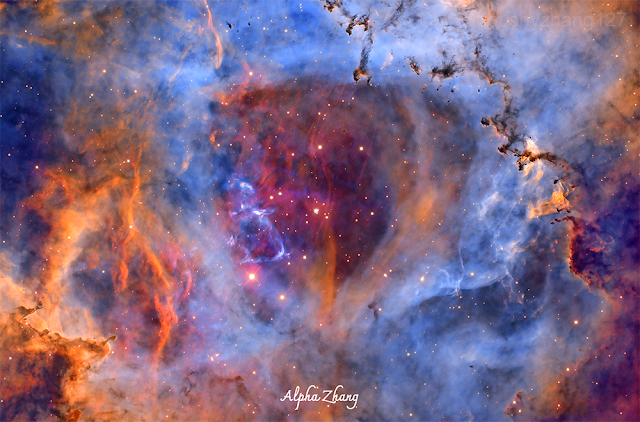
Heart of the Rosette Nebula (NGC 2244) - Imaged data acquired and processed by Alpha Zhang combining image data from image sets on both AFIL-1 and AFIL-2. Both image sets are available on Starbase for purchase.
Heart of the Rosette Nebula (NGC 2244) - Imaged data acquired and processed by Alpha Zhang combining image data from image sets on both AFIL-1 and AFIL-2. Both image sets are available on Starbase for purchase. 

The Heart of the Rosette Nebula (also known as Caldwell 49) is an H II region located near one end of a giant molecular cloud in the Monoceros region of the Milky Way Galaxy. The open cluster NGC 2244 (Caldwell 50) is closely associated with nebulosity, the stars of the cluster having been formed from the nebula's matter.

The third telescope is a Veloce 200 RH f/3 in Hakos, Namibia (AFIL-5). This remote imaging system has been on our remote telescope network for over a year now, offering services on our Basic Image Request (BIR) and Advanced Imaging Request (AIR) online applications. The BIR and AIR are available via the ATEO Portal. AFIL-5 is owned and operated by Lukas Demetz from SkyGems Observatories.
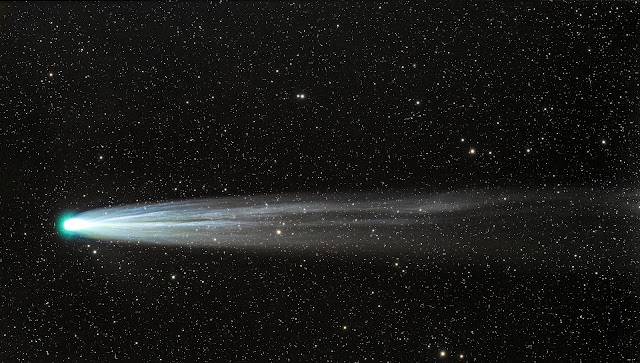

C/2021 A1 Leonard 3x1 mosaic taken from Insight Observatory’s affiliate remote telescope AFIL-5, Veloce 200 RH f/3 in Namibia, on December 30, 2021. 35 minutes of image data acquired by Lukas Demetz and processed by Michael Lewis. Image set available on Starbase for purchase.
C/2021 A1 Leonard 3x1 mosaic taken from Insight Observatory’s affiliate remote telescope AFIL-5, Veloce 200 RH f/3 in Namibia, on December 30, 2021. 35 minutes of image data were acquired by Lukas Demetz and processed by Michael Lewis. The image set is available on Starbase for purchase.

C/2021 A1 (Leonard) is an inbound long-period comet discovered by G. J. Leonard at the Mount Lemmon Observatory on 3 January 2021 when the comet was 5 astronomical units (AU) from the Sun. This was the first comet discovered in 2021, and it has a retrograde orbit.
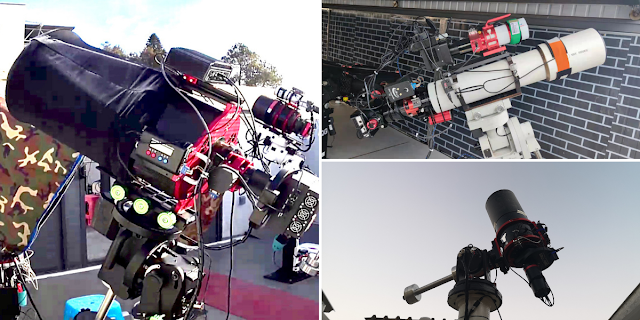


AFIL-1: AG10 CDK f/6.7 f=1665mm (left), AFIL-2: SkyRover 130 APO Pro f/7 f=910mm (upper right), and AFIL-5: Officina Stellare Veloce 200mm f/3 Astrograph (lower left).

Starbase is a repository of image data captured by the Astronomical Telescopes for Educational Outreach (ATEO) and our affiliate remote telescopes (AFIL), organized by the image target into image “sets”. These image sets can be purchased (referred to as “subscribing” to the image set) and downloaded. All proceeds from Starbase subscriptions go towards funding our educational outreach programs.

Read More

Saturday, April 24, 2021

New Galaxy Image Sets from ATEO-3

Insight Observatory's affiliate remote telescope, the 12.5" f/9 Ritchey Chretien (ATEO-3) located at Deep Sky Chile has been very busy as of late producing additional image sets for Starbase. The latest additions to Starbase from ATEO-3 are image sets of Messier 83, the "Southern Pinwheel Galaxy", and NGC 1313, also known as the "Topsy Turvy Galaxy".

Messier 83 - the Southern Pinwheel Galaxy imaged on ATEO-3 and processed by Franck Jobard from Deep Sky Chile now available for download from Starbase
Messier 83 - the Southern Pinwheel Galaxy imaged on ATEO-3 and processed by Franck Jobard from Deep Sky Chile, now available for download from Starbase.

Messier 83 or M83, also known as NGC 5236, is a barred spiral galaxy approximately 15 million light-years away in the constellation borders of Hydra and Centaurus. Nicolas Louis de Lacaille discovered M83 on February 23, 1752, at the Cape of Good. Charles Messier added it to his catalog of nebulous objects (now known as the Messier Catalogue) in March 1781. It is one of the closest and brightest barred spiral galaxies in the sky and is visible with binoculars. Its nickname the Southern Pinwheel derives from its resemblance to the Pinwheel Galaxy (M101) in the northern constellation Ursa Major.

Starbase image set "M83 - Lum (2021): Southern Pinwheel Galaxy" has over 10 hours of Luminance image data and set "M83 - RGB (2021): Southern Pinwheel Galaxy" consists of 3 hours each of Red, Green, and Blue image data. 

Image Set Rates:
  • M83 - Lum (2021): Southern Pinwheel Galaxy is only $24.40 USD for Education and $30.50 USD for Standard. 

  • M83 - RGB (2021): Southern Pinwheel Galaxy is only $21.60 USD for Education and $27.00 USD for Standard.


NGC 1313 - the Topsy Turvy Galaxy imaged on ATEO-3 by Franck Jobard and processed by Utkarsh Mishra.
NGC 1313 - the Topsy Turvy Galaxy imaged on ATEO-3 by Franck Jobard and processed by Utkarsh Mishra from Deep Sky Chile is now available for download from Starbase.

NGC 1313 is a field galaxy and a barred spiral galaxy discovered by the Scottish astronomer James Dunlop on 27 September 1826. It has a diameter of about 50,000 light-years or about half the size of the Milky Way. NGC 1313 lies within the Virgo Supercluster. NGC 1313 has a strikingly uneven shape and its axis of rotation is not exactly in its center. The galaxy also shows strong starburst activity and associated super-shells. NGC 1313 is dominated by scattered patches of intense star formation, which gives the galaxy a rather ragged appearance. The uneven shape, the ragged appearance, and the strong starburst can all be explained by a galactic collision in the past. However, NGC 1313 seems to be an isolated galaxy and has no direct neighbors. Therefore, it is not clear whether it has swallowed a small companion in its past.

Sources: Wikipedia.

Starbase image set "NGC 1313 - Lum (2021): Topsy Turvy Galaxy" has over 8 hours of Luminance image data and set "NGC 1313 - RGB (2021): Topsy Turvy Galaxy" consists of over 7 hours of Red, Green, and Blue image data.

Image Set Rates:
  • NGC1313 - Lum (2021): Topsy Turvy Galaxy is only $20.00 USD Education and $25.00 USD Standard.

  • NGC1313 - RGB (2021): Topsy Turvy Galaxy is only $18.40 USD for Education and $23.00 USD Standard.


Read More

Friday, February 19, 2021

Messier 78 Reflection Nebula

In this post, Insight Observatory features deep-sky object Messier 78. This target was requested to be added to Insight Observatory's image set repository, Starbase by one of its loyal Starbase subscribers.

The image set data was acquired on the 16" f/3.75 Dream Aerospace Systems astrograph reflector (ATEO-1) remote telescope located in New Mexico. There are nearly 10 hours of Luminance, Red, Blue, Green, and Ha image data of Messier 78 available for download on Starbase.


Messier 78 reflection nebula located in the constellation Orion imaged on ATEO-1 and processed by Utkarsh Mishra. Image set now available for download on Starbase.
Messier 78 reflection nebula located in the constellation Orion imaged on
ATEO-1 and processed by Utkarsh Mishra. The image set is now available
for download on Starbase.

Messier 78 or M78, also known as NGC 2068, is a reflection nebula in the constellation Orion. The nebula was discovered by Pierre Méchain in 1780 and included by Charles Messier in his catalog of comet-like objects that same year.

M78 is the brightest diffuse reflection nebula of a group of nebulae that includes NGC 2064, NGC 2067, and NGC 2071. This group belongs to the Orion B molecular cloud complex and is about 1,350 light-years distant from Earth. Messier 78 is easily found in small telescopes as a hazy patch and involves two stars of 10th and 11th magnitude. These two B-type stars, HD 38563 A and HD 38563 B, are responsible for making the cloud of dust in M78 visible by reflecting their light.

Source: Wikipedia

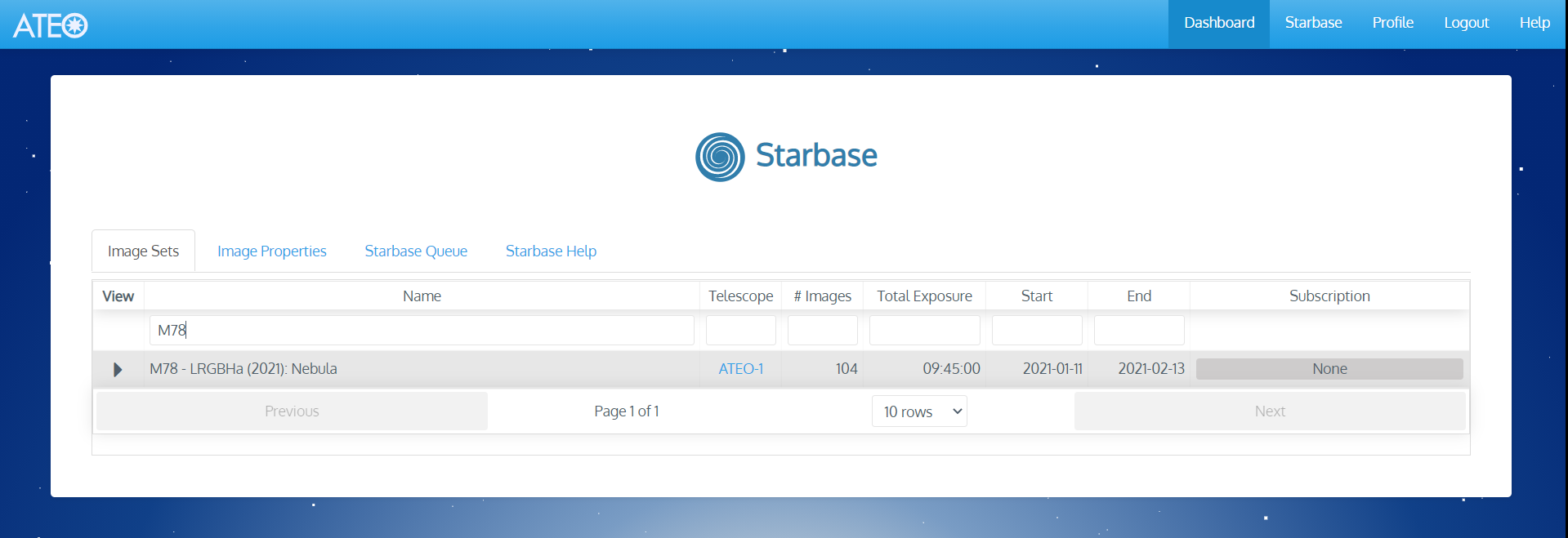
Search for M78 in the "Name" field in Starbase and access to the M78 LRGBHa (2021) Nebula image set will display.
Search for M78 in the "Name" field in Starbase and access to the M78 LRGBHa (2021) Nebula image set will display. 

Insight Observatory is currently taking deep-sky image requests for Starbase image sets on its new ATEO Portal dashboard. There is no charge for these requests. If the requests are approved by the Insight Observatory staff, they will be imaged and uploaded to Starbase for anyone to subscribe to for the low rate of $0.05 (cents) USD per imaging minute for standard subscribers and $0.04 (cents) USD for educational subscribers. We only ask that Starbase subscription requests are for at least 5 hours of integration time.


Read More