Showing posts with label eyepieces. Show all posts

Sunday, November 1, 2020

What's In The Sky - November 2020

Clear November night skies offer incredible celestial sights recommended by Orion Telescopes and Binoculars for stargazers to be thankful for, so bundle up and get outside for stargazing fun!

Double Cluster in Perseus
Use a pair of big binoculars or a shorter focal length telescope with a wide-field eyepiece in November to seek out the sparkling Double Cluster in Perseus - two side-by-side open star clusters, NGC 884 and NGC 869. 

What's In the Sky - November 2020
NGC 884 and NGC 869 - The Double Cluster in Perseus imaged by Claudio Tenreiro on Insight Observatory's 16" f/3.7 astrograph reflector (ATEO-1).

Mars & The Moon
On November 25th, the Moon passes close to Mars, making them a great observing target! The pair will be separated by approximately 5.5 degrees, which is unfortunately too far apart to be viewed simultaneously at high magnification, but both could be observed together with wide-angle astronomy binoculars.

New Moon
November 14th will be the best time of the month to observe the fainter deep-sky objects such as galaxies and star clusters because there is no moonlight to interfere.

Leonids Meteor Shower
Bundle up and get outside after midnight on November 17th to see the peak of the Leonids meteor shower as "shooting stars" appear to radiate outwards from the constellation Leo. Meteor showers are usually best viewed without optical equipment, but for a closer look, try out some ultra-wide-angle binoculars. The shower peak is very close to the New Moon, which should present little light pollution. The estimated peak rate is approximately 14 meteors per hour.
 
M45 - The Pleiades located in the constellation Taurus imaged by Plymouth South Middle School students Taylor A. and Kyleigh O. using ATEO-1 via Insight Observatory's online Educational Image Request (EIR) application.
M45 - The Pleiades, located in the constellation Taurus, imaged by Plymouth South Middle School students Taylor A. and Kyleigh O. using ATEO-1 via Insight Observatory's online Educational Image Request (EIR) application.

The Pleiades
November is sometimes called "the month of the Pleiades," since the star cluster is visible all night long for observers in the Northern hemisphere. From a dark sky site, M45 is easy to see with the unaided eye and resembles a small "teaspoon" pattern in the sky. Use astronomy binoculars for immersive views of this open star cluster, or use a telescope with a lower-power eyepiece for a closer look at the Seven Sisters.

All objects described above can easily be seen with the suggested equipment from a dark sky site, a viewing location some distance away from city lights where light pollution and bright moonlight do not overpower the stars.
Read More

Wednesday, July 1, 2020

What's In The Sky - July 2020

Get ready for summer stargazing! With the weather warming up, July is a great time of year to enjoy relaxing evenings under starry skies with your telescope or astronomy binoculars. Here are a few of Orion Telescopes and Binoculars picks for July stargazing...

Gas Giants at Opposition

Jupiter and Saturn both reach opposition one week apart this year, making July the perfect opportunity for planetary viewing! Opposition is when the Earth passes directly between a planet and the Sun. This coincides with the planets' closest approach to Earth, providing an excellent opportunity for great views in a telescope. Both planets are easy to find in the Southern sky, about 7 degrees apart from each other. Jupiter reaches opposition on July 14th and Saturn about a week later on the 20th. During opposition, Saturn’s rings will be inclined at 21 degrees towards Earth, close to their maximum angle of 27 degrees. Combined with the planet's close approach to Earth, this makes July an excellent time to observe Saturn and its rings!

Jupiter imaged on 12/07/2012 with an Orion 180mm Maksutov-Cassegrain Telescope Optical Tube. Imaged by Cherdphong V. from Bangkok, Thailand.

Grab a high-magnification eyepiece or a Barlow lens, and check out the gas giants during opposition!

New Moon

July 20th is the darkest night of the month and therefore the best time to observe the fainter objects like galaxies and star clusters. Grab your observing gear and enjoy!

Hercules almost directly overhead and Scorpius

With constellation Hercules almost directly overhead and Scorpius to the south, there's plenty to see in July skies as summer continues. Check out globular star clusters M13 and M92 in Hercules, and explore Scorpius to find numerous deep-sky objects including open clusters M6 and M7, and globular clusters M4 and M80.

The Summer Milky Way

From a dark sky location in mid-July, the glorious Summer Milky Way shines as a band of light that stretches from the southern horizon to nearly overhead. As the night progresses, the Milky Way will arch across the entire sky. From a dark observing site, scan the Milky Way with 50mm or larger binoculars or a wide-angle telescope to explore some of the hundreds of open star clusters, emission nebulae, and planetary nebulae that lurk among the star clouds.

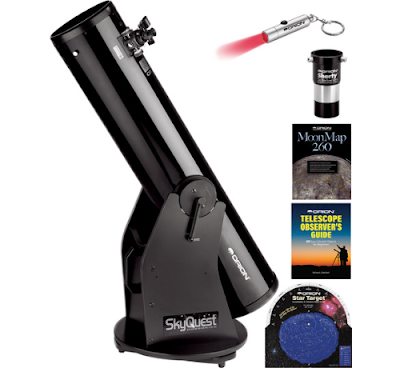
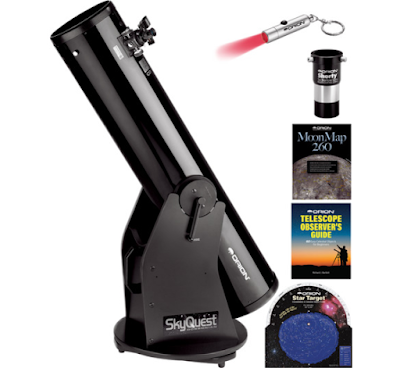
Orion SkyQuest XT8 Classic Dobsonian Telescope Kit.

July Challenge Object — Hercules Galaxy Cluster

About half a billion light-years from Earth in the constellation Hercules, not far from the star Beta Hercules in the southwest corner of the "keystone" asterism, lies the "Hercules Galaxy Cluster." This association is a group of 200-300 distant galaxies, the brightest of which is NGC 6050 at about 10th magnitude and can be seen with an 8" reflector like the Orion SkyQuest XT8 Classic Dobsonian under very dark skies with good seeing conditions. A larger aperture, 14"-16" telescope like the Orion SkyQuest XX14g GoTo Truss Dobsonian will begin to show about a half-dozen or more galaxies in one field of view. How many can you see in your telescope?

Orion SkyQuest XX14g GoTo Truss Tube Dobsonian Telescope.

All objects described above can easily be seen with the suggested equipment from a dark sky site, a viewing location some distance away from city lights where light pollution and bright moonlight does not overpower the stars.
Read More

Thursday, December 26, 2019

Buy A Real Telescope!

There are two kinds of people: those who own an astronomical telescope - and those who want to own one!

If you're of the 2nd variety, you may not own a telescope on the grounds that "they're just too expensive!" Well, some telescopes ARE too expensive! - like those, situated beneath state-of-the-art observatory domes on the summits of Mauna Kea and Mauna Loa, in the Hawaiian Islands. Now, THAT'S too expensive; for most of us, anyway.

Believe it or not - there are telescopes on the market that actually approach the optical quality and sizes of some of those gems of the tropics. And some DON'T! And, it's the ones that don't - that are the truly expensive items! I will stay clear of those kinds of "powerful", "600X"-type "mockeries", except to give a brief overview and tell you where they can most likely be found.


Orion StarBlast 4.5 Astro Reflector Telescope Kit.

Certain kinds of telescopes, or, maybe more accurately, items that LOOK like real telescopes, that are marketed using high but ambiguous numbers are likely to have the overall construction, as well as overall usefulness, of a high-priced "toy". Although there are some rare exceptions, any type of optical instrument sold by department stores, or other chain store outlets, is likely to consist mostly of hype - and disappointment. Don't buy one. I could write a short book on my reasons for telling you that (maybe I will!) - but not here.

There. That's that! Now, let's look at real, astronomical optical instruments that are available for the non-rich, amateur astronomer, or anyone else who wishes to acquire a well-made optical instrument, for other purposes, as well (I understand that "other" purposes exist - but I'm not familiar with any of them!)


Orion SkyQuest XT8 Classic Dobsonian Telescope Kit.

This will be short and sweet, mainly because I only know of one telescope manufacturer which meets all of what I consider the most important criteria: quality, price, available accessories, reputation, and general knowledge of telescopes - based on my experience and familiarity with them: Orion Telescopes and Binoculars of Cupertino, California.

Because of the necessity of variety, and of combinations of variety - much of it aimed at the more advanced, "intermediate" amateur astronomer - Orion carries many types of telescopes and telescope 'packages', which I cannot possibly give decent coverage to here, so, before I briefly go over a few of their more 'general-purpose' telescopes, I'll just mention that they also carry instruments for the advanced amateur, as well as professional astronomers.

I will note here: NEVER buy a telescope based on advertisements of "power". I think that statement should be embossed on every telescope's packaging, just above "DO NOT USE TO LOOK DIRECTLY AT THE SUN". Any telescope, in theory, can provide high, even very high magnifications. That's not what you're interested in. Advertising a telescope by "power" or "magnification" is a marketing device. It's done only because it can be, and it sounds so good. But magnification is the least of your concerns; aperture is a major concern. The cost is a close second.


Orion SkyQuest XX12g GoTo Truss Tube Dobsonian Telescope.

There are a few basic types of scopes: Refractors, Reflectors, and Cassegrainian, "folded" optics types. All of these come in a variety of aperture sizes. Refractors are typically in the smaller range, mainly because they are more expensive to make. Reflectors come in small, medium, and large. Folded optics types come in medium and large. My recommendation for a beginner is to purchase a reflector telescope of at least a 4-4.5-inch aperture, but that's because I'm partial to reflectors, and there are generally larger apertures.

Here are three scopes from Orion that I recommend for someone who has never purchased a telescope before and/or is a beginning-to-intermediate amateur astronomer. Prices are as of their latest catalog.

  • StarBlast 4.5 Astro Reflector Telescope Kit: This is a 4.5-inch tabletop model, swivel-base, Dobsonian mounting, and is supplied with two eyepieces (for change of magnification) - 17mm and 6mm (26x and 75x, respectively). 0-power finder scope. This model features an alt-azimuth dual-axis system for manual repositioning. Best suited for the beginner. Good for observing the moon, planets, and brighter deep-space objects.

  • Orion SkyQuest XT8 Classic Dobsonian Telescope Kit: An 8-inch "floor" model-style Dobsonian mounting. Comes with a 2x Barlow lens (doubling mag. of the eyepieces): 35mm and 25mm (34x, 48x, 68x, and 96x w/Barlow) and a 0-power finder scope. This model features an alt-azimuth dual-axis system for manual repositioning. Best suited for beginner-intermediate. Good for observing the moon, planets, and dimmer deep-space objects.

  • Orion SkyQuest XX12g GoTo Truss Tube Dobsonian: This telescope is my personal "dream-scope". 12-inch aperture, computerized "GoTo" drive mechanism. Laser-based finder scope. This model features the GoTo computer-automated drive. Stepper motors on both axes and a hand-held computer controller allow automatic repositioning of the telescope, based on controller input (keyed or voice). Includes 28mm and 12.5mm eyepieces and 2x Barlow (54x, 108x, 120x, and 240x). Best suited for intermediate-advanced amateurs. Good for observing the moon, planets, and harder-to-reach deep-space objects, such as distant galaxies.

I could continue down the list, as there are other models in all of the classes I've mentioned, with varying degrees of accessory inclusion. All of the models mentioned here will be very good for observing a variety of celestial objects. Orion carries an entire line of accessories, from extra eyepieces and solar filters to planetary and deep-space digital CCD cameras and adapters. Your best bet, though, is to view their current, full catalog online at telescope.com.

Unfortunately, they no longer provide a real, paper catalog! But, according to their associate, Rick, they will likely be back (as soon as people realize that paper is actually a much faster, more intuitive browse than a screen!)

Dale Alan Bryant
Senior Contributing Science Writer
Read More

Friday, November 1, 2019

What's In The Sky - November 2019

Clear November night skies offer incredible celestial sights for stargazers to be thankful for, so bundle up and get outside for stargazing fun!

The May 9th, 2016 Mercury Transit at 9:15 am EDT - Image by Nolan D.

Transit of Mercury

On November 11th from 04:34 to 10:30 PST, Mercury will pass directly in front of the Sun. Visible as a tiny shadow against the disk of the Sun, a telescope with a properly installed solar filter is essential. This transit will next occur 13 years from now in 2032, so don't miss seeing it! Grab a solar filter for your telescope, or a convenient solar telescope to view the transit safely!

CAUTION: Never look at the Sun, either directly or through a telescope, without a professionally made protective solar filter installed that completely covers the front of the instrument, or permanent eye damage could result.

M45 - The Pleiades imaged at LRGB 600 sec, 2x2 bin on ATEO-1 by Insight Observatory.

The Pleiades

November is sometimes called "the month of the Pleiades," since the star cluster is visible all night long for observers in the Northern hemisphere. From a dark sky site, M45 is easy to see with the unaided eye and resembles a small "teaspoon" pattern in the sky. Use astronomy binoculars for immersive views of this open star cluster, or use a telescope with a lower-power eyepiece for a closer look at the Seven Sisters.

November 26th will be the best time of the month to observe the fainter deep-sky objects such as galaxies and star clusters because there is no moonlight to interfere.

Radiant of the Leonid Meteor Shower - Illustration by Universe Today.

Leonids Meteor Shower

Bundle up and get outside after midnight on November 17th to see the peak of the Leonids meteor shower as "shooting stars" appear to radiate outwards from the constellation Leo. The Moon will rise just before midnight, so the best time for meteor gazing will be before then, when the skies will be nice and dark. The estimated peak rate is about 15 meteors per hour.

Double Cluster in Perseus

Use a pair of big binoculars or a shorter focal length telescope with a wide-field eyepiece in November to seek out the sparkling Double Cluster in Perseus - two side-by-side open star clusters, NGC 884 and NGC 869.

All objects described above can easily be seen with the suggested equipment from a dark sky site, a viewing location some distance away from city lights where light pollution and bright moonlight do not overpower the stars.
Read More

Wednesday, July 11, 2018

Buying A Good Telescope - One Very Good Option

Thinking about buying a *good* telescope someday?

I'm glad you are because I've got some news for you about telescopes, generally.

Most people who are considering having a telescope in their lives look for them in a department store. Now, department stores are great! At least, I love them. But they are limited in scope (oh, what a perfect spot for that pun!), naturally, where specialty items are concerned - and telescopes are a big one.

Some of the names of the telescopes found in some department stores will be familiar to you, such as, "Celestron®", Meade®, or Tasco®. But, though these are three of the *big* names in telescopes, the models you'll find are built for the masses - for those who aren't likely to be very discerning, in an area you really *need* to be very discerning with. The associated advertising agencies use a factor in telescopes regarding magnification as their main selling point, which is, inherently, not exactly 'wrong' - but not relevant, either.

Ken from Orion Telescopes and Binoculars Demonstrates the XT-8 SkyQuest Plus Dobsonian Telescope Image by Orion Telescopes and Binoculars.
Ken from Orion Telescopes and Binoculars Demonstrates the XT-8 SkyQuest Plus Dobsonian Telescope
Image by Orion Telescopes and Binoculars.

You'll see such wording on their packaging, such as: "300x",  "300-power", "300 times", etc., meaning that the instrument will/can magnify an object to 300 times its normal diameter, or its apparent size as seen with the unaided eye. DON'T, DON'T, DON'T DO IT! There are two areas that I know of, personally, where the quality of an instrument can make or break a beginner, particularly, and especially children: guitars, and telescopes...

*Any* telescope, can achieve *any* of the "powers", or magnifications, available to it; all you have to do, is, insert a 'high-power' eyepiece, known as an 'ocular', into the focuser's draw-tube; most telescopes are supplied with a small assortment of eyepieces of various focal-lengths, which will change the 'power' (in that context) of the instrument. That action can make or break a telescope. The real 'power' of a telescope is in the size of its aperture; i.e., in the diameter of its primary mirror or lens, depending on the type of telescope it is. Having a better quality instrument will be the difference between one that is actually used and one that ends up in the attic or basement - collecting dust - for the next 25 years. I've seen it myself, and it happened to me - but only once - as a kid. I was fortunate enough to have the presence of mind to research telescopes, and decide on one that I could really use.

If you're considering a telescope for a child and are concerned about putting up an amount of money for something that may just end up getting abandoned, then you need to avoid the department stores, absolutely. You'll save money and get a far better instrument from a well-known, reputable manufacturer of telescopes for the amateur astronomer.

Orion Telescopes and Binoculars is such a place, and, in my opinion, is who you won't take my word for that. Every astronomer, amateur or professional, would most likely agree with this if they're at all familiar with this company. There are a few other manufacturers of good telescopes out there (but not many), but Orion stands out, by their reputation for integrity, alone. They are willing to go the extra mile to satisfy a customer. Their company was started by amateur astronomers, for amateur astronomers. I've been dealing with these telescope 'specialists' since 1982.

The two scopes shown below are, probably, THE best buys in telescopes, period. They are *real* optical instruments, rather than the *toys* found in the department stores that I've referred to. It IS possible to find a good telescope at a department store - but it isn't likely, or worth the risk.

Jupiter and one of its moons imaged through an Orion XT-6 SkyQuest  Imaged by Orion Telescopes and Binoculars.
Jupiter and one of its moons were imaged through an Orion XT-6 SkyQuest
Imaged by Orion Telescopes and Binoculars.

The scopes shown in this article are two configurations of the Orion XT-6 and Orion XT-8 'SkyQuest' series of Dobsonian-mounted, Newtonian, reflector telescopes. The numbers refer to the diameter of the instrument's primary apertures, respectively. As telescopes go, they would be considered *medium-sized* telescopes. Moreover, scopes in this size range are perfectly suited to adults, as well, of course. They are in every respect - "two steps" up from the typical, department store telescope. With these instruments, you will not only be able to observe the moon and planets, but you will also see many of the gaseous, hydrogen nebulosities of the Milky Way, known as "nebulae", as well as many of the other galaxies, beyond our Milky Way galaxy! And - you're not going to beat their price. Orion also makes smaller, and less expensive instruments, all the way down to tabletop telescopes, and - they make much larger instruments, as well - up to 16"-inch, entirely computerized, observatory-sized beauties!


Jupiter imaged through an Orion XT-8 SkyQuest Plus - Image by Orion Telescopes and Binoculars.
Jupiter was imaged through an Orion XT-8 SkyQuest Plus - Image by Orion Telescopes and Binoculars.


You can download one of their catalogs at www.telescope.com

So - good luck, and good judgment, and, as we say:

"Clear Skies!" to you!
Read More

Wednesday, December 14, 2016

The Lonely, Little Telescope That Could

If you own a telescope that is similar to this one - regardless of the particular brand - that is long, thin, and mounted on a tripod, you may have tried to use it, but given up on it in frustration, because of its poor performance, especially for the beginning user.

Telescopes, like this one, are generally found in department stores, camera shops, and similar outlets. Most manufacturers typically supply high-powered eyepieces with these telescopes; these are the short, interchangeable lens barrels that are inserted into the narrow end of the tube, which the viewer puts their eye up to for viewing. The big problem here is that the manufacturers want to sell you a "high"-powered instrument, which, indeed, they are. But the eyepieces that are supplied - typically, two - are usually oculars of high and very high magnification. High power like this sells telescopes - but renders them virtually unusable, by anyone but a very experienced user. To get any kind of acceptable performance from these, otherwise, fine instruments, eyepieces that provide lower magnifications are needed.

Small Refractor Telescope - Image by Celestron
Small Refractor Telescope - Image by Celestron.

Typically, the manufacturer supplies eyepieces with focal lengths in the 4mm to 12mm range. The barrels of the eyepieces will have these figures engraved on them. The "mm" stands for millimeters and the number gives the focal length of the eyepiece, in millimeters.

*Most important* to remember here is: the SMALLER the number on the eyepiece, the HIGHER the magnification, or, "power" of the instrument, as a whole - the BIGGER the number on the eyepiece, the LOWER the magnification. So, in reality, telescopes are neither inherently powerful nor are they not powerful. Telescope eyepieces are interchangeable. Power, all depends on the eyepiece being used at the moment.

If your telescope came with a 4mm, 3mm, or 2mm eyepiece - throw it away - or use it as a paperweight - but that's about all it's good for! But keep the 12mm, or bigger, eyepiece. Contact the manufacturer or any other supplier of telescopes, and order replacement eyepieces in the 9mm to 28mm, or higher-numbered, millimeter range. Eyepieces of up to 40mm can be found, but a good range of magnification will be found in the 9mm to 28mm focal lengths.

The 9mm will now be your high-power eyepiece. Depending on the focal length of the telescope, typically 700mm-900mm, a 12mm-18mm eyepiece will produce medium powers, and a 28mm+ eyepiece will produce low powers. Magnification (power) is determined by the formula:

M=Fo/Fe

where M is the magnification to be found; Fo is the focal length of the telescope's objective, or main lens, and Fe is the focal length of the eyepiece. Rule-of-thumb: maximum usable power (magnification), of ANY telescope is 50-power per inch, or, per 25.4mm of aperture, or objective lens diameter.

For example, if your telescope's objective lens has a diameter of 60mm, your maximum usable power is 120x. Any image, using magnifications beyond this, will be degraded, both in resolution (sharpness) and brightness. A good, usable - "no-frustration" - range of magnification is about 25x-100x.

In a telescope with a 700-millimeter focal length, an 18mm eyepiece will produce a magnification of 39x, meaning that the magnification will produce an image that appears 39 times the diameter of the image as seen with the unaided eye. A 9mm eyepiece will yield a power of 78x diameters; a 6mm eyepiece will yield an image diameter of 117x. This should be about the highest power you'll need from your telescope.

If you're fortunate, your scope also came with a Barlow lens, at either 2x or 2.5x. This, effectively, gives you four eyepieces! A 2x Barlow lens doubles the magnification yielded by any given eyepiece. So, if you've got a scope with a focal length of 700mm and a 2x Barlow lens, with 18mm and 12mm eyepieces, you've actually got powers of 39x, 59x, 78x, and 117x!

It's really a shame that so many of these types of telescopes end up in the attic or basement, out of frustration, because of lousy experiences with them - but it doesn't have to be that way! If you've got one locked up somewhere for that reason - get it back out! Replacing the supplied eyepieces with ones that will work within the usable range of magnifications, it'll seem like a different instrument altogether. You'll find your "new" telescope to be very enjoyable and enlightening. That's a promise!

Dale Alan Bryant
Senior Contributing Science Writer
Read More