-->

Bringing the Universe to Classrooms
and Homes Around the World!

What's Happening at Insight Observatory...

Showing posts with label jupiter. Show all posts

Sunday, December 6, 2020

The Great Conjunction of 2020

Are you ready for the Great Conjunction on December 21st? This rare astronomical event refers to when the planets Jupiter and Saturn appear close to each other in the sky. This event occurs in an approximately 20-year cycle. The approach will be very close, at a separation of only 6 arcseconds between the planets! The last time these planets appeared this close was in 1623, and the next time will be in 2080. Make sure to take the once-in-a-lifetime chance to observe Saturn and Jupiter simultaneously! The planets will be low on the south-western horizon as the sun sets, so get your telescopes and binoculars from Orion Telescopes and Binoculars ready for this rare observing opportunity!

At the 2000 great conjunction, 20 years ago, Jupiter and Saturn were near the sun in our sky and difficult to observe. We are due for a more observable great conjunction, and we’ll get one. In November, Jupiter and Saturn were noticeable for their nearness to each other, and they were in the sky when darkness fell.

In December 2020, Jupiter and Saturn will still be easily visible. They’ll be, if anything, even more beautiful in the western twilight shortly after sunset.

On the 21st December 2020, Jupiter and Saturn will be separated by only 6 arcminutes, the closest conjunction since 1623. Source: Sky Safari 5 Pro.

You’ll recognize Jupiter and Saturn easily from now through the end of the year. Jupiter is brighter than any star. Saturn is not as bright as Jupiter, but it’s as bright as the brightest stars and shines with a distinctive golden color. Also, Jupiter is near Saturn! Saturn is just to the east of Jupiter on the sky’s dome. Unlike the twinkling stars, Jupiter and Saturn both shine steadily.


Over the time between November 21 and the day of the conjunction itself, December 21, Jupiter will travel about 6 degrees and Saturn 3 degrees on the sky’s dome. That movement will mean that Jupiter bridges the 3-degree gap between itself and Saturn.

Whenever Jupiter and Saturn are in conjunction, that is, when they have the same right ascension or celestial longitude, it is referred to as a "Great Conjunction," primarily because, unlike conjunctions with the other bright planets, these two don't get together very often. The average frequency of occurrence is merely the product of their sidereal periods divided by the absolute value of their difference.

A sidereal period is defined as the time required for a celestial body within the solar system to complete one revolution with respect to the fixed stars. Saturn's period of 29.65 years multiplied by Jupiter's period of 11.86 years amounts to 351.65. Dividing this value by the difference in their sidereal periods gives us 19.76 years. So, about every 20 years, Jupiter and Saturn will have a rendezvous.

Insight Observatory's remote telescopes ATEO-1 (left) and ATEO-2A (right) will attempt to gather image data of the "Great Conjunction of 2020" from SkyPi Remote Observatory on the evening of December 21, 2020.

Insight Observatory will be attempting to acquire image data of this rare event on the evening of December 21st on its remote Astronomical Telescopes for Educational Outreach (ATEO) from SkyPi Remote Observatory in New Mexico. The conjunction will be extremely low in the southwest part of the sky from our location at SkyPi; however, we are going to give it a try. If you are interested in receiving image data, please contact us.


Sources: Earthsky.org and Space.com
Read More

Wednesday, July 1, 2020

What's In The Sky - July 2020

Get ready for summer stargazing! With the weather warming up, July is a great time of year to enjoy relaxing evenings under starry skies with your telescope or astronomy binoculars. Here are a few of Orion Telescopes and Binoculars picks for July stargazing...

Gas Giants at Opposition

Jupiter and Saturn both reach opposition one week apart this year, making July the perfect opportunity for planetary viewing! Opposition is when the Earth passes directly between a planet and the Sun. This coincides with the planets closest approach to Earth, providing an excellent opportunity for great views in a telescope. Both planets are easy to find in the Southern sky, about 7 degrees apart from each other. Jupiter reaches opposition on July 14th and Saturn about a week later on the 20th. During opposition, Saturn’s rings will be inclined at 21 degrees towards Earth, close to their maximum angle of 27 degrees. Combined with the planet's close approach to Earth, this makes July an excellent time to observe Saturn and its rings!

Jupiter imaged on 12/07/2012 with an Orion 180mm Maksutov-Cassegrain Telescope Optical Tube. Imaged by Cherdphong V. from Bangkok, Thailand.

Grab a high magnification eyepiece or a Barlow lens, and check out the gas giants during opposition!

New Moon

July 20th is the darkest night of the month and therefore the best time to observe the more faint objects like galaxies and star clusters. Grab your observing gear and enjoy!

Hercules almost directly overhead and Scorpius

With constellation Hercules almost directly overhead and Scorpius to the south, there's plenty to see in July skies as summer continues. Check out globular star clusters M13 and M92 in Hercules, and explore Scorpius to find numerous deep-sky objects including open clusters M6 and M7, and globular clusters M4 and M80.

The Summer Milky Way

From a dark sky location in mid-July, the glorious Summer Milky Way shines as a band of light that stretches from the southern horizon to nearly overhead. As the night progresses, the Milky Way will arch across the entire sky. From a dark observing site, scan the Milky Way with 50mm or larger binoculars or a wide-angle telescope to explore some of the hundreds of open star clusters, emission nebulae and planetary nebulae that lurk among the star clouds.

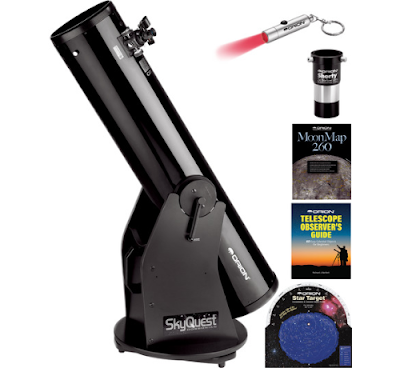
Orion SkyQuest XT8 Classic Dobsonian Telescope Kit.

July Challenge Object — Hercules Galaxy Cluster

About half a billion light-years from Earth in the constellation Hercules, not far from the star Beta Hercules in the southwest corner of the "keystone" asterism, lies the "Hercules Galaxy Cluster." This association is a group of 200-300 distant galaxies, the brightest of which is NGC 6050 at about 10th magnitude and can be seen with an 8" reflector like the Orion SkyQuest XT8 Classic Dobsonian under very dark skies with good seeing conditions. A larger aperture, 14"-16" telescope like the Orion SkyQuest XX14g GoTo Truss Dobsonian will begin to show about a half-dozen or more galaxies in one field-of-view. How many can you see in your telescope?

Orion SkyQuest XX14g GoTo Truss Tube Dobsonian Telescope.

All objects described above can easily be seen with the suggested equipment from a dark sky site, a viewing location some distance away from city lights where light pollution and when bright moonlight does not overpower the stars.
Read More

Saturday, February 1, 2020

What's In The Sky - February 2020

Clear February nights present some great stargazing opportunities. Be sure to bundle up and keep warm while you get outside for some stargazing fun!

Here are a few of Orion Telescopes and Binoculars' top picks for February stargazing:

New Moon

February 23rd should be one of the best nights for deep-sky viewing as the New Moon phase will provide the darkest night of the short month. Use Orion Broadband Filters to enhance your view.

On the evening of Monday, Feb. 10, Mercury (orbit is shown as red curve) will reach its widest separation, 18 degrees east of the sun. With Mercury sitting above a nearly vertical evening ecliptic, this will be the best appearance of the planet in 2020 for Northern Hemisphere observers. The optimal viewing times fall between 6 and 7 p.m. local time. Viewed in a telescope (inset), the planet will exhibit a waning half-illuminated phase. Image credit: Starry Night.
On the evening of Monday, February 9th, Mercury (orbit is shown as a red curve) will reach its widest separation, 18 degrees east of the Sun. With Mercury sitting above a nearly vertical evening ecliptic, this will be the best appearance of the planet in 2020 for Northern Hemisphere observers. The optimal viewing times fall between 6 and 7 p.m. local time. Viewed in a telescope (inset), the planet will exhibit a waning half-illuminated phase. Image credit: Starry Night.

Mercury High In The Sky

On February 9th, Mercury will be at its greatest eastern elongation, meaning it is at its greatest separation from the Sun. Mercury will be at an altitude of approximately 16 degrees when the Sun sets at 17:34 PST, making it an ideal time to observe this tricky target.

Planetary Lineup: Get up early on President's Day, February 17th, to see a lineup of three planets and the Moon. At dawn, the crescent Moon and Mars, Jupiter, and Saturn will form a line spanning about 39 degrees in the southeastern sky.

Before sunrise on the next day, February 18th, viewers in North America can watch the Moon occult Mars! Better yet, try snapping a sequence of high-magnification pics of the event.

Betelgeuse In The News

Betelgeuse has been in the news lately since dimming down to a magnitude of around 1.5, the lowest brightness in more than a century. The red supergiant is normally variable, but the unusual dimming has brought up the question of whether a supernova is imminent. Betelgeuse is close enough that if it went supernova it would be brighter than the full moon, a spectacular astronomical event. However, the consensus is that this probably won't be happening soon. The best estimate is sometime in the next 100,000 years, so it is more likely that this variability is normal, and we've still got a few millennia before the light show.

It may not be as flashy, but if you want to see a supernova now, astronomer Koichi Itagaki discovered a supernova on January 12th. Located in the galaxy NGC 4636 in the constellation Virgo, it should be visible with a 6" or larger telescope. Referred to as SN2020ue, it is currently at magnitude 12.1 and should be visible under dark skies at around 60-100x magnification as a dim star just outside of the galaxy's core.


Galaxies M81 and M82 in Ursa Major - 5 x 300 Second LRGB Image by Insight Observatory.

Bright Galaxies

In late February, bright galaxies M81 and M82 will be about as high in the sky as they will get for North American stargazers. From a dark sky site, these galaxies are visible with a 50mm or larger binocular, but we suggest you use a large telescope to chase these galaxies down just off the leading edge of the Big Dipper asterism. Many observers consider M81 & M82 the best pairing of visual galaxies in the sky!

If you would like to receive image data of galaxies such as M81 and M82 and other deep-sky objects taken on the Astronomical Telescopes for Educational Outreach (ATEO), please visit Insight Observatory's Custom Image Data Request form.

All objects described above can easily be seen with the suggested equipment from a dark sky site, a viewing location some distance away from city lights where light pollution does not overpower the stars, and when bright moonlight does not overpower the stars.
Read More

Saturday, November 2, 2019

The Telescope, and the Center Of The Universe

In the beginning, there was "us" - and just us. (So we liked to think)

(fast-forward a few hundred thousand years...)

Around the Middle Ages, it was discovered that we inhabited a "world" - a round, spherical one. And so now, we and our world were all that there was.

But, a little later, in 1610, a physicist named Galileo Galilei, using a new and revolutionary optical instrument called a "telescope", discovered that the moon, Saturn, and Jupiter were not just dots of light in the sky, but rather, they were actual, "other" worlds. Not only were Jupiter and Saturn planets in their own right, but they possessed satellites, as well. Galileo, and then others, noticed that these satellites were orbiting around their host planets - resembling miniature Solar Systems.

None of this new and revolutionary information would have been revealed, had it not been for a new and revolutionary instrument - Galileo's hand-made, tiny, 2-inch diameter instrument - the refracting telescope. (This new revelation caused a lot of problems - both for Galileo, and for society, in general - because, just maybe, there were "others" on these "other worlds")

While Galilei did not invent the telescope, he very successfully built one and used it for astronomical observations. This image shows two telescopes in his possession. Image Credit - DPA-Picture Alliance.

In 1783, amateur astronomer William Herschel made the discovery that all of these "other worlds" were, actually, a conglomeration of worlds - an "island universe", which we, today, call the "Milky Way" galaxy. Using one of his - very large, for the day (40") - reflector telescopes, Herschel was able to, roughly, determine the general shape of the "Milky Way" (something like a double-convex lens, or, the way I like to imagine it: two, inverted Frisbees!). It was apparent then that we reside in some isolated structure of stars, and we named our isolated home galaxy after the dim band of cloud-like light that splits the sky into two "hemispheres". (This band of diffuse light, or the "Milky Way", can still be seen from some places in the world, so I understand).

William Herschel's sketch of the Milky Way Galaxy.

Sometime later, comet-hunter Charles Messier, using his own small, hand-made reflecting telescopes, had found that the sky contained, seemingly, hundreds of small, cloud-like patches of light, similar to the milky band that circled the sky - ranging in size, up to, just larger, than the full moon. It was thought that these tiny "fogs" were just that - some type of cloudy matter, nearly randomly distributed about the sky. All that Messier knew was that they were not the "comets" he was searching for. And so, they stayed, just fogs.

Then, in the 1920s, a debate took place, now known historically as the "Great Debate", on the nature of these luminous patches of fog. The debate focused on whether these structures were portions of our own galaxy, or whether they were external structures. Around that time, a slightly pompous - but generally brilliant astronomer, Edwin Hubble, had made another revolutionary discovery that ended the debate altogether - these luminosities in the sky were not cloudy in nature. Hubble was able to resolve these hazy patches into individual stars, using the Hooker telescope. It turned out that they were actually distant "island universes" (galaxies) in their own right!

In a spectroscopic analysis of the motions of the millions of other galaxies that lie beyond our own island galaxy, the Milky Way, nearly the entire mass of the universe is receding into the distance - i.e., apparently, away from us. What's more, the velocity of any given galaxy's recession is proportional to its distance - i.e., the farther away the galaxy is, the faster it is receding into the "background"! This situation is what produces what's called the "red-shift effect" - light's own version of sound's "Doppler" effect. The result is that the spectra of those receding galaxies are shifted towards the red (longer wavelength) end of the visible light spectrum; in the same way that the tone from, say, a passing vehicle's horn, in a fluid, continuous way, drops in pitch as it passes by us and on to a direction that carries it farther away from us.

All of this is due to the general expansion of the universe as a whole (hence, the "Big Bang", or "Great Expansion" event, when universal expansion began). This condition was discovered by Edwin Hubble, back in 1929. It was his observations, now, using the 200" reflector at Mt. Palomar, that revealed that the universe was in a general state of expansion. Only a very few galaxies appear not to be receding from us. This includes the 25 or so, member galaxies of what is called, the "Local Group", of relatively nearby galaxies, and the two satellite galaxies of the Milky Way galaxy, called, the Large, and the Small "Magellanic Clouds" (the LMC, and SMC, respectively), as well as the next, nearest, large spiral galaxy similar to our Milky Way galaxy, the Andromeda galaxy, or, M32. That galaxy is so nearby, cosmologically speaking, that it can just be detected in a clear, dark sky with the unaided eye. The galaxy lies in the constellation of Andromeda, and it is a prime target for astrographic imaging, or astrophotography.

But, from our own galactic island, it appears as if the Great Expansion event itself took place at the position of the Milky Way galaxy! And to make matters worse - this expansion is undergoing an apparent acceleration - one that increases proportionally as its distance from the Milky Way! Could it be that we are in some privileged location, in relation to the rest of the universe? Can this really be so?

(I was going to have some fun with this, but I won't!)

The answer is, of course: No, it can't.

From the beginning of human civilization, man has revered himself to be the pinnacle of creation - whether he placed himself at some centralized position, either on the Earth, or whether he placed the Earth itself, at the center of - at first, the Solar System, and then the Milky Way galaxy - both of which were dead wrong. By small gradations, he has slowly discovered that there is no true center to the universe, nor is there any true up or down. Today, we know that our "island universe" is only one of the billions of other island universes - revealed to us, by the power of an inherently very simple, optical marvel - the telescope.

Because of the telescope, we've not only revealed the nature of particular objects in the universe but also general ideas as to the nature of the universe, on the whole.

Dale Alan Bryant
Senior Contributing Science Writer
Read More

Saturday, January 5, 2019

What's In the Sky - January 2019

January kicks off the New Year with wonderful sights for backyard astronomers to enjoy with friends and family. Don't forget to bundle up on clear, cold evenings as you explore the sparkling night sky. Here are a few of Orion Telescopes and Binoculars highlights for January 2019 stargazers...

Quadrantid Meteor Shower

The Quadrantid Meteor Shower will be the first substantial meteor shower of 2019. You'll want to be outside late in the night on January 3, and before dawn on January 4. Those of you in the more northerly latitudes should get some great views, especially with the dark skies as we approach the New Moon on January 6.

New Moon

The nights around January 5 will be the best nights for observations due to the dark skies resulting from the New Moon. Bundle up, grab a telescope and your astrophotography gear and get out there to view and image those elusive fainter deep sky objects.

Total Lunar Eclipse

January 20 — 21 will be your opportunity to witness a Lunar Eclipse. Provided your skies are clear, observers in North and South America and western parts of Europe and Africa should have visibility of a Total Lunar Eclipse. While those of you in Central and eastern Africa, Europe, and Asia won't see a Total Eclipse, you will still see a Partial Eclipse of the Moon.

The conjunction of Venus and Jupiter

Get up early (before sunrise) on January 22 to catch the conjunction of Venus and Jupiter. These 2 bright celestial bodies will appear within 2.5 degrees of each other so make sure you don't miss the view.

The Witch Head Nebula   Image Credit & Copyright: Digitized Sky Survey (POSS II); Processing: Utkarsh Mishra
The Witch Head Nebula 
Image Credit & Copyright: Digitized Sky Survey (POSS-II); Processing: Utkarsh Mishra

January Challenge Object

Just west of Rigel, the bright blue/white star that marks the western "knee" of Orion, lies the Witch Head Nebula (IC 2118), in the neighboring constellation Eridanus. The Witch Head is a reflection nebula that shines from reflected light off of Rigel, like the reflection nebula in the Pleiades, M45. You don't need a big telescope; a wide field of view, low power, and a dark sky are needed to see this challenging nebula. (Hint: Don't use filters)

All objects described above can easily be seen with the suggested equipment from a dark sky site, a viewing location some distance away from city lights where light pollution and when bright moonlight does not overpower the stars.
Read More

Saturday, September 8, 2018

What's In the Sky - September 2018

September nights are full of wonderful treats for amateur astronomers to enjoy with binoculars and telescopes. See some of Orion Telescopes and Binoculars' top September stargazing suggestions below:

Spiral Galaxies

The fall stargazing season kicks off in September with wonderfully placed spiral galaxies M31 in Andromeda, M33 in Triangulum, and M74 in Pisces. Use a big telescope to see these distant galaxies.

The Northern Milky Way

Early in the month, around 9 PM, the "Summer Triangle" of three bright stars, Vega, Deneb, and Altair, will be nearly overhead. In the northernmost portion of the Summer Triangle, you'll see a bright portion of the northern Milky Way. Point a telescope there, and you'll discover that the fuzzy outlines of the Milky Way will resolve into vast fields of stars to explore.

New Moon

For the best conditions to see the galaxies and clusters described above, plan a stargazing session for the night of September 9th, when the New Moon will provide dark skies. This is the best night of the month to observe the night sky since light from stars and faint deep sky objects won't have to compete with bright moonlight.

Three Globular Star Clusters

Off the western side of the constellation Pegasus, three globular star clusters almost line up in a row from north to south in September skies. These globular clusters are, from north to south, M15 in Pegasus, M2 in Aquarius, and M30 in Capricorn. From a dark sky site, you can easily find all of them in 50mm or larger binoculars.

Planetary Nebulas in the Summer Triangle

Use a star chart and see how many of these planetary nebulae you can find in September: the famous Ring Nebula (M57) in the constellation Lyra; the Dumbbell Nebula (M27) in Vulpecula; and the "Blinking Planetary," NGC 6826 in Cygnus. Not far outside the western boundary of the Summer Triangle is a small but intensely colorful planetary nebula, NGC 6572. All these can be seen in a 6" or larger telescope. Enhance your views of these distant clouds of dust and gas with an Oxygen-III filter.

The Great Andromeda Galaxy (M31) - Imaged by Insight Observatory on ATEO-1

The Galaxy Next Door

In early September, lurking low in the northeast sky is another galaxy, separate from our Milky Way - the Great Andromeda Galaxy (M31). From a very dark area without a lot of light pollution, the core of M31 is visible with the unaided eye as a slightly fuzzy spot in the sky. A pair of 7x50, 9x63 or larger binoculars will give you a much better view, and any telescope will help reveal some of the neighboring galaxy's subtle dust lanes.

Dip into the Whirlpool

If you haven't tracked down "The Whirlpool Galaxy," M51, just off the handle of the easily recognizable Big Dipper asterism, do it now while you still can! It will be too low for most to get a good view after September, and you'll need to wait until late winter or next spring to catch a good view of this truly picturesque galaxy. An 8" or larger telescope will help you see the faint details of M51 more clearly.

A Brilliant Open Star Cluster

Off the western end of the constellation Cassiopeia is the beautiful Open Star Cluster M52. You can find it with 50mm or larger binoculars from a dark sky site, but the view is definitely better in a telescope. With an 8" or larger scope, and with the aid of an Orion UltraBlock or Oxygen-III eyepiece filter, you may even be able to catch views of faint nebulosity surrounding M52.

Don't Miss the Double Cluster

If you enjoyed observing M52, you'll love the popular favorite "Double Cluster in Perseus." Lying between constellations Cassiopeia and Perseus is a bright, fuzzy spot in the Milky Way, and a binocular will reveal two bright open star clusters close to one another. For a real treat, use a telescope equipped with a wide-angle eyepiece to explore these sparkling clusters. In early September, the "Double Cluster" appears low in northeastern skies around 9 PM, but it becomes a real showpiece later in the evening as it climbs higher in the sky.

Planetary Viewing

Viewing planets is always rewarding, and September will provide ample opportunities. Mars and Saturn are still visible until late in the night (early in the morning). Jupiter is still up in the early evenings but will set fairly soon after dark. Go out and enjoy!

A Thinly Veiled Challenge

A challenging object to see in September is the supernova remnant called the Veil Nebula, located in the constellation Cygnus, which is nearly overhead as soon as it gets dark. With the help of a star chart, aim your telescope at the naked-eye star 52 Cygni. One branch of the Veil crosses over this star, and to the east are brighter segments of this roughly circular nebula. While the Veil Nebula can be seen in big binoculars by expert observers under very dark skies, you will likely need at least a 6" aperture telescope and an Orion Oxygen-III eyepiece filter if you are anywhere near city lights.

All objects described above can easily be seen with the suggested equipment from a dark sky site, a viewing location some distance away from city lights where light pollution and bright moonlight does not overpower the stars.
Read More

Friday, August 17, 2018

The Solar System In a Night-Shell

Recently, you may have noticed an extra one or two very bright stars in the sky, just after sunset. That’s because we’re currently experiencing a rather special celestial treat: a relatively rare positioning of all eight planets (and, three minor planets!) into just a bit more than one side of the sky - at nearly the same time! Alignments like this aren’t exactly common, so, go outside and take a look - while it’s still not too late! (This celestial configuration will begin to deteriorate over the coming weeks).

Starting at sunset, in their order of appearance, relative to their apparent distance from the sun, and just to the west of the sun, is Mercury, the first planet out from the sun, which is now so close to our star, from our perspective, that it’s easily lost in the glare and a bit hard on the eyes for that reason, without a telescope, but it’s there -  just about 6 degrees to the southwest, at stellar magnitude +.60.**

The Solar System In a Night-shell

Believe it or not, next up - we’re already at the outer reaches of the Solar system - minor, or dwarf planet, Pluto! But that’s because of its position against the sky, in the relative background, as compared to the other, and much closer planets. For now - just know that it’s there, about 15 degrees to the east of Saturn. It bottoms out at a dim +14.4 magnitude, accessible only in a moderate to large-sized telescope.

Next, moving, now, East of the sun is a dwarf planet, Ceres. You’ll need a small telescope to spot it. Ceres was discovered, telescopically, in 1801, and at that time, it was realized that Ceres was much closer to Earth than were the stars - but smaller than any planet; therefore, it was cataloged as an asteroid. And, it kept that label, until relatively recent years when it was re-labeled a minor planet. Under that heading is the sub-heading of, ‘dwarf planet’, and that’s where Ceres currently resides, "taxonomically", anyway. The reasons for the changes to Ceres, 4 Vesta, and Pluto as dwarf planets are entirely logical and valid; you’ll have to take my word for that. You’ll find Ceres if you dare - and, if you have a medium-sized telescope - between the sun and Venus, at a dim, +8.8 magnitude.

Now, on our way to Venus. Venus, the second planet from the sun - is the brightest thing in the sky (sans the moon and sun). Seemingly hanging there, low in the west, Venus shines its stunning, white brilliance down on us - at a staggering magnitude -4.4, and at about 12 degrees east of the sun. If you miss it - well, you’re just not paying attention!

Now - look down at the ground by your feet. There sits Earth, the third planet from the sun. If you were to see yourself standing there, from the perspective of the orbiting, International Space Station, you’d first note that you were standing, nearby some dividing line - the line delineating light from the darkness: the terminator, dividing night from day. You are just about, literally, to enter and cross into, the "Twilight Zone"! (Now, how many people can say that they’ve, knowingly, done that - hmmm?!) And this is a good thing because it represents the progression of time, and the rotation of Earth on its axis and, thereby, rolling you - or, perhaps, dragging you - into the deep, dark night. But this is an even better thing because the passage of the early evening hours will bring, up into the sky, from over the eastern horizon, three of our Solar system's showpieces; Jupiter, Saturn, and Mars.

First, sitting, watchfully - almost “king-like” - and due South, at an elevation of around 30 degrees, is His Deified Majesty, Jove - also known by the Romans, as Jupiter. With just about any pair of binoculars, you’ll get to see four of, giant Jupiter’s, giant moons - Callisto, Europa, Ganymede, and Io - that is, unless one or two of them happen to be in Jupiter’s shadow at the time of your observation. But don’t worry; they don’t stay in the shadow behind the planet long! With a telescope, you may also see some, very pastel, cloud bands, near the planet’s equatorial region. Jupiter is now, the third brightest light, in the sky, at a bright, white-ish, magnitude of -2.70.

Have you ever seen ‘rings’ around any celestial object before?; I mean, for yourself - with your very own eyes?! Probably, you haven’t - so now’s your chance! - that is if you happen to have access to, at least, a small telescope, or high-powered binoculars.

If not, don’t worry about it; you still cannot help but notice Saturn, anyway, because it’s now such a  bright, yellowish-white, at an apparent magnitude of +.70: one of the very brightest lights currently in the sky, best seen around 9:00PM. But in a telescope, you will make out Saturn’s ring system, currently lying at an oblique angle to its plane of rotation, so that they will appear to be, almost, “wide-open” at this time around the planet - and that is a wonderful, and rare thing, indeed; Saturn’s rings go through long cycles of appearing open or closed, from our perspective, about every 27 years! Right now they are “wide-open” - you may never get to see this, again…

After Saturn is another object out there, just worth noting, and going unseen without a telescope: dwarf planet, and former asteroid, 4 Vesta. Its feeble light, just creeps through our atmosphere at a dismal +6.4 magnitude, well beyond the abilities of the average, human eye.

Now, comes Mars. Make sure you identify this small-ish, ruddy world for long-term memory: Mars is closer to Earth than it has been in 157 years! Though the red planet closes in on Earth every two years, due to the proximity of the orbits of both planets, there is another component to the Martian orbits’, slightly elongated shape which brings it even closer, periodically. This happens when the point in its orbit that lies closest to the sun, is in sync with the Earth’s position - and that is right about now!

Mars is currently experiencing one of the relatively rare, long-duration, global sandstorms that it's known for. The raging storm has been going on, for about 3 months now. I saw Mars through the telescope about two weeks ago, at high magnification. Though the planet, normally, has a variety of surface features to offer the observer, in the form of dark grey patches, volcanic calderas, white polar caps, and such, it now presents a uniform, planet-wide rust color, as atmospheric particulates from the dust storm circulate around its small, thin blanket of air. However - Mars is the second brightest thing in the sky, right now, after Venus - looking more like a reddish "blob", hanging in the air, toward the South than it does a star or a planet. There is a distinct perception of a disk to this orb, due to its slightly larger angular size in the sky than that of the other planets and, due to its current proximity to Earth. Mars is now glowing, distinctly reddish, at magnitude -2.6, rising at around 8:30PM and well placed for viewing, high up in the sky, by 11:00PM. It’s worth the view, with or without a telescope or binoculars!

And, nearly last, but not, nearly least - by any stretch - are Uranus and Neptune - the seventh and eighth planets of our Solar system - far beyond the reach of the unaided eye, but within telescopic range. They are nearby each other, well into the small hours, at around 30 degrees and 60 degrees, east, of Mars, and +5.7 and +7.8 magnitudes, respectively.

This leaves our own, familiar moon, Luna, now (at the time of this writing), as a dainty, waxing crescent, sitting just above Venus, but moving progressively toward the east, as the nights of the month wear on. And, there you have It - our entire Solar system, in a “night”-shell (well, you just know I couldn’t resist that one!)

** The system used by astronomers to denote the relative, apparent brightnesses in celestial objects, is the Stellar Magnitude Scale. Beginning at 0, the scale uses both positive and negative numbers: those in the minus range, are brighter than those in the plus range. Though it's called the ‘stellar’ magnitude scale, it is used to mark the brightnesses of all celestial objects; stars, planets, comets, and asteroids included. On that note, the consistently, brightest point of light that can be seen from the Earth, is the star, Sirius, in the constellation Canis Major (the 'Big Dog'). It is given the negative magnitude number, -1.4. The planet Venus, currently, is at magnitude -4.3 - several times brighter than Sirius - but Venus’ albedo varies over time, and,  although Venus is the brightest object in the sky, after the sun and moon - it is a planet.  On the plus side of the scale, the human eye can see stars down to about, a fairly dim, magnitude +6, on a very dark, clear night. And so, the answer to the oft-asked question: “What is the brightest star in the night sky?”, is, technically, the star Sirius, at magnitude -1.4.
Read More

Wednesday, May 2, 2018

What's in the Sky - May 2018

Get outside with your telescope (or without a telescope) on clear May evenings to see celestial treats recommended by Orion Telescopes and Binoculars! With the weather warming up and skies clearing up, there's no shortage of celestial delicacies to view with telescopes and binoculars. Here are a few of Orion's top suggestions for May observing:

Radiant of the Eta Aquarid Meteor Shower peaking before dawn on May 6th.

Eta Aquarid Meteor Shower

Grab a blanket or a comfy lounge chair to sit back, relax, and watch the Eta Aquarid meteor shower, one of two annual showers caused by dust particles from Halley's Comet. Catch the peak of the dazzling show before dawn on May 6. The waning gibbous Moon might outshine some of the fainter meteors, but there will still be opportunities to see meteors streak across the night sky at the approximate peak rate of about 30 per hour. Look for meteors appearing to radiate from the constellation Aquarius.

Bright Jupiter

Jupiter reaches opposition on May 9th, making it the best night of the year to explore the gas giant planet and its four brightest moons Io, Europa, Ganymede, and Callisto. Since Jupiter will be directly opposite the Sun from Earth, it will be visible all night long. Opposition occurs when a planet reaches its closest approach to Earth in its elliptical orbit. Take advantage of Jupiter's brightest night of the year and take a closer look at its cloud band "stripes" and four Galilean moons with any size telescope.

M97, the "Owl Nebula" in Ursa Major (left) and M57, the  "Ring Nebula" in Lyra (right).  Images by Insight Observatory.
M97, the "Owl Nebula" in Ursa Major (left) and M57, the  "Ring Nebula" in Lyra (right).
Images by Insight Observatory.

Four Big Planetary Nebulae

Use a 6" or larger telescope and an Oxygen-III or UltraBlock filter to catch nice views of four relatively large planetary nebulae in May skies. See the "Ghost of Jupiter," NGC 3242 in Hydra; M97, "the Owl Nebula" in the Big Dipper; NGC 4361 in Corvus, and the famous "Ring Nebula", M57 in Lyra just a few degrees from the bright star Vega. To help you locate these objects, use The DeepMap 600.

New Moon, Dark Skies

Take advantage of the dark skies provided by the New Moon on May 15th to scope out the many star clusters, galaxies, and other deep-sky gems on display. Pack up your astronomy gear using our full line of telescope and accessory cases and head to a dark sky site for the best viewing conditions.

M13, the "Great Globular Cluster in Hercules (left) and M3, Globular Cluster i n Canes Venatici (right).  Images by Insight Observatory.
M13, the "Great Globular Cluster in Hercules (left) and M3, Globular Cluster in Canes Venatici (right).
Images by Insight Observatory.

Five Glittering Globular Clusters

Five picture-perfect examples of globular star clusters will be visible in May skies. Check out M3 in the constellation Boötes. M13, the "Great Cluster in Hercules," will be visible near the zenith. M5 can be found in Serpens and M92 in the northern section of Hercules. Be sure to track down M4 (NGC 6121) in Scorpius on May 27th, as it will be in a great position for telescopic study throughout the night, reaching zenith around midnight. Big telescopes will provide the best views, but even a pair of humble 50mm or larger binoculars will show you these dense balls of stars from a dark sky site.

Crescent Moon and Venus

After the sun sets on May 17th, you'll find a stunning view of the waxing crescent moon to the left of brilliant Venus. While you're observing the pair, use a telescope to look for the crater Furnerius at the lower right of the crescent moon's face. Try Orion's 1.25" Orion 25% Transmission Moon Filter, perfect for crescent phases, to improve lunar contrast and tone down glare.

M101, Face-On Spiral Galaxy in Ursa Major (left) and M51, Face-On Spiral Galaxy in Canes Venatici (right). Images by Insight Observatory.
M101, Face-On Spiral Galaxy in Ursa Major (left), and M51, Face-On Spiral Galaxy in Canes Venatici (right).
Images by Insight Observatory.

Four Face-On Spirals

Use a large telescope to see the classic pinwheel shapes of galaxies M51 and M101 in the Big Dipper asterism of Ursa Major, and M99 and M100 in the Virgo galaxy cluster. There are also dozens of additional galaxies to explore in the Virgo cluster with a large-aperture telescope.

All objects described above can easily be seen with the suggested equipment from a dark sky site, a viewing location some distance away from city lights where light pollution and bright moonlight do not overpower the stars.
Read More

Saturday, April 29, 2017

Imaging the April Fools Comet

As we have spent most of our time the past few months planning for the big road trip to New Mexico to install the Astronomical Telescope for Educational Outreach (ATEO), I thought it would be nice to do a little remote imaging during one of our weekly ATEO planning conference calls. With all of the comets that have been observable lately, why not quickly capture an image of one remotely from one of iTelescope's remote robotic telescopes, hosted at New Mexico Skies. This remote telescope hosting facility is not too far from where Insight Observatory's ATEO telescope will be hosted just over a month from now at SkyPi Online Observatories.

Comet 41P/Tuttle-Giacobini-Kresák pictured with the star Beta Draconis (lower right).  Image by Insight Observatory
Comet 41P/Tuttle-Giacobini-Kresák pictured with the star Beta Draconis (lower right).
 Image by Insight Observatory.

On the morning of Thursday, April 20, 2017, at 5:05 am EDT, I logged into iTelescope's T14 which is Takahashi FSQ Fluorite with a Petzval Apochromat Astrograph optical design for taking wide-field images. The CCD camera used to image the comet was an SBIG STL-11000M. The image is a simple combined 2 luminances at 5 minutes a piece. The comet's location was just north of the star Beta Draconis in the constellation Draco. If you zoom into the image, you will notice there are two comet nuclei. This demonstrates how much the comet moved between both five-minute images.

Comet 41P/Tuttle-Giacobini-Kresák, a comet whose identity took nearly 100 years to pin down, made its closest approach to Earth on Saturday, April 1st, just in time for April Fools' Day, but it was not a cosmic prank. It was the comet's closest Earth encounter in more than 50 years, and maybe more than a century stated NASA officials.

The comet was first discovered in 1858 by Horace Parnell Tuttle of the Harvard College Observatory, Cambridge, Massachusetts. It was then re-discovered by Michel Giacobini in 1907 and Ľubor Kresák in 1951. The comet had two close encounters with Jupiter that altered its orbit slightly. A member of the Jupiter family of comets, 41P makes a trip around the sun every 5.4 years, coming relatively close to Earth on some of those trips. On this approach, the comet will pass our planet at a distance of about 13 million miles (0.14 astronomical units), or about 55 times the distance from Earth to the moon.

As the comet passed closest to Earth (0.14 a.u.) from mid-March through early April, it continued to hurry across the circumpolar constellations Ursa Major and Draco. Created with Chris Marriott's SkyMap

"Comet hunters in the Northern Hemisphere should look for it near the constellations Draco and Ursa Major, which the Big Dipper is part of," NASA officials said in a statement. "Whether a comet will put on a good show for observers is notoriously difficult to predict, but 41P has a history of outbursts, and put on quite a display in 1973. If the comet experiences similar outbursts this time, there's a chance it could become bright enough to see with the naked eye. The comet was expected to reach perihelion, or its closest approach to the sun, on April 12." The comet should stay visible through the month of July this year.
Read More

Tuesday, March 14, 2017

Introducing iTelescope Sky Tours

iTelescope.net, Insight Observatory's remote robotic telescope network partner, recently started a new program called Sky Tours. iTelescope.Net Sky Tours is a paid, weekly, interactive live video stream of the night sky using iTelescope.net remote robotic telescopes and hosted by Dr. Christian Sasse. In each episode, Dr. Sasse selects targets of interest that are visible from iTelescope.net telescopes and talks about these targets. He gives detailed explanations and tips for imaging the chosen objects. If weather permits, Dr. Sasse takes images of these targets live, answering questions and describing how to best capture the targets.

iTelescope.net Live Sky Tour
iTelescope.net Live Sky Tour.

I was able to attend the first live Sky Tour back on January 23, 2017. The first event covered Dr. Sasse discussing imaging real-time deep-sky objects in the southern hemisphere. The session was greatly attended by interested folks from around the globe. The interactive chat feature is a plus as attendees are allowed to ask Dr. Sasse questions in real time during the imaging session. I found this new feature offered by iTelescope.net to be of value to the educational community. Episode 2 took place live on February 7, 2016, and covered exploring the biggest globular cluster in the Milky Way, Omega Centauri, and one of the most amazing bright nebulae Eta Carina. Unfortunately, I wasn't able to attend this session, however, iTelescope.net archives all of their Sky Tour episodes on Youtube so those who have missed it may view it at a later time.

Fortunately, a group of 6th graders and I were able to attend their Jupiter imaging session this past weekend. It was the first episode covering planetary imaging. The session was very informative and it inspired iTelescope.net members to want to do planetary imaging with their network. That type of setup is a bit different than the normal setups their remote robotic telescopes have for deep-sky imaging. At the end of the session, I thanked Dr. Sasse for sharing his imaging session with us and he mentioned he would be interested in doing other imaging sessions with students in parallel with his Sky Tours. Needless to say that this was very exciting to hear and now we are working on a plan to execute this with science classes in various school districts.

iTelescope.net Sky Tours - A Closeup of Jupiter

iTelescope.Net Sky Tours are included with all of their monthly subscription plans, each of which allows you to take control of the iTelescopes to take your own images. They have also introduced a new subscription plan, SkyTour, which only grants access to the Sky Tours live streams, but at a quarter of the cost of their lowest imaging subscription plan. This new plan is available for $4.95 USD per month and includes access to the Sky Tours live streams, access to the archived videos of those streams (in case you missed the live show), and the ability to download images taken during the streams once they are uploaded. You can see a list of the dates and times of the streams, as well as which targets will be covered by checking the Sky Tours Schedule on their website, www.itelescope.net.

To sign up for iTelescope.Net Sky Tours, you must first register for an iTelescope.Net account. Once registered, you can sign up for the SkyTour subscription plan (or any of their other subscription plans) by following this step-by-step guide, and selecting SkyTour (or their other plans) from the menu. It really is that easy! We could also help you get set up and started with iTelescope.net and their Sky Tours by contacting us here at Insight Observatory.
Read More

Wednesday, June 1, 2016

Variable Stars and the Stories They Tell: Exoplanets and the Search for Extraterrestrial Life

Though the figures are tough to keep up with, as they are changing almost daily, the Kepler space telescope has discovered over 2,300 exoplanets in all. Those are just a few in existence whose orbital planes lie at a favorable incline from our perspective. Of those 2,300+, at least 207 are Earth-sized and at least 48 lie in the so-called 'Goldilocks' or habitable zone. The way Kepler achieves this miracle of detection of extra-solar planets is by measuring the varying light curves of their parent or host stars. As the planet transits or passes in front of a star, as seen from our neighborhood, there is a barely measurable but significant decrease in the star's light, on average about 2%, with another .03% decrease in the presence of a planetary atmosphere. This is roughly equivalent to the amount of light lost by an observer of a housefly passing in front of a car headlight as seen from several miles away. When astronomers can determine a regular pattern of dimming and brightening, they can deduce that the star has at least one planet in orbit around it. Stars vary in their brightness for other reasons, as was seen earlier, but this may be the most exciting one.

An artist imagining Kepler-62f, a potentially habitable exoplanet discovered using data from the Kepler Spacecraft
An artist imagining Kepler-62f, a potentially habitable exoplanet discovered using
 data from the Kepler Spacecraft.

If life is discovered elsewhere in the universe, is it likely it will be found on Earth-like extra-solar planets - planets that fall into that comfy, cozy distance from their host stars that we refer to as the Habitable Zone? We, humans, like to think so, and it may very well be, but life may also be found in much less likely environments. The diversity of life on Earth, itself, is staggering in that it can be found in the deepest ocean trenches, in waters above 600 degrees Fahrenheit and pushing well north and south of the Arctic and Antarctic Circles, respectively, and, on land, in temperatures well below freezing. It should be remembered that we are products of our environment in the struggle for life. Nature has tried out many kinds of organisms through the process of natural selection and most of those organisms were ill-suited to the task of survival. In fact, more species of living things have become extinct than have survived.

The first step in finding extraterrestrial life is to find extra-solar planets, or, exoplanets. The first technique used to detect extra-solar planets was through the measurement of the shift in the radial velocity of a host star. A planet or planets orbiting a star will produce shifts in the spectral lines of the star as they tug on it, making the star appear to wiggle back and forth, as it moved through space. In 1952, Otto Struve suggested that extra-solar planets might be detected by dips in a host star's light during a planet's transit. Even then, techniques were available to detect such a drop in light but it was forgotten about for decades. In 1999, two professional astronomers using a 10-centimeter telescope discovered the first telltale signs of such a transiting extra-solar planet. Amateur and professional astronomers have since detected countless candidates.

NASA's Ames Research Center lists a table of 70-plus confirmed exoplanets discovered by Kepler as of May 2012 and designated by the name 'Kepler' followed by a letter. Planetary characteristics in the table for each planet include the following headings: Jupiter Masses, Earth Masses, Jupiter Radii, Earth Radii, Density, Temperature, Transition Duration, Period, Semi-Major Axis (UA), Eccentricity, Inclination (in degrees) and Distance (in parsecs). The table also lists the characteristics of the host star. It should be noted here that Kepler-23b – Kepler-30b are planets that are within just a few Earth radii, though they are several hundred times more massive and their orbital periods seem much too short (just a few days) to be within the habitable zone. Nevertheless, it tells us that exoplanets, roughly the size of Earth, are detectable and are indeed out there.

Earth-like Exoplanets Discovered by the Kepler  Spacecraft Chart Courtesy of NASA.
Earth-like Exoplanets Discovered by the Kepler
Spacecraft Chart Courtesy of NASA.

The Kepler mission was originally slated to last 3 1/2 years but steps have been taken by its team of engineers to extend its mission another 3 years. Within the first 45 days of operation, Kepler, combined with follow-up ground-based observations, confirmed the discovery of five new exoplanets, including Kepler-7b, the least dense planet discovered at that time. Kepler has also been credited with the discovery of two "super-hot" orbiting companions - companions that appear to be hotter than their respective host stars. That discovery first announced at the 215th American Astronomical Society meeting in Washington, D. C. on January 4, 2010, revealed that the data from Kepler, along with the ground-based data had yet to confirm just what these objects are. One of the objects, KOI-74b measured 70,000 degrees Fahrenheit! Its host star, in comparison, is a mere 17,000 degrees Fahrenheit. The object is roughly the size of Jupiter and orbits its host star every 23 days. The hottest confirmed exoplanet to date has a temperature of 3,700 degrees Fahrenheit. As of June 15, 2010, Kepler had identified 706 stars hosting exoplanet candidates with sizes from as small as that of Earth to larger than Jupiter. On August 26, 2010, two new exoplanets orbiting the same star were discovered via the transit method. Two planets orbiting the star Kepler-9, roughly 2,300 light-years distant have been designated Kepler-9b and 9c and were discovered over a seven-month period. Astronomers at the W. M. Keck Observatory in Hawaii have estimated the masses of these two confirmed planets. Kepler-9b is the larger of the two, the other being only 1.5 Earth radii, making it one of the smallest exoplanets known.

Open Cluster NGC 6819 in Cygnus - Image by Al Kelly.

Other discoveries by Kepler include solar-like oscillations in the light curves of red giant stars using time-series photometry and solar-like asteroseismic events in relatively nearby type-G stars and in the open cluster NGC 6819. Although the Kepler mission was originally designed to find transiting Earth-like exoplanets by continuously observing over 100,000 stars in a field centered in the constellation Cygnus, two years into the mission, it is also providing an extraordinary collection of time-series data for studying the variability of stars in our galaxy. There are online tools available for studying this variability, including the NASA Star and Exoplanet Database's periodogram tool. A periodogram finds the periodicities present in time-series data sets and the probability that an individual period arises by chance. Life "as we know it", would require that it evolve on a planet with the exact same physical makeup as Earth. Life here on Earth is carbon-based, but we should not necessarily exclude, say, even silicon-based life on other worlds. Our body chemistry is that of the Earth. Nevertheless, life will come in many forms. It may be possible to detect life on Earth-like exoplanets possessing an atmosphere by measuring gaseous emissions in its atmosphere by spectroscopy, such as the oxygen given off by vegetation here on Earth. Other forms of life give off carbon dioxide and even methane into the atmosphere. Luckily, the universe operates the same everywhere else as it does locally so we can know what signs to look for. The presence of such gasses can be determined by measuring a planet's transmission spectrum during its transit across the face of a star. If a planetary atmosphere is not present, the light fall-off will be the same at all wavelengths. If certain elements are present in the planet's atmosphere, they will absorb some of the star's light. In one case, sodium present in the atmosphere of a planet made the planet appear to be six percent larger than at other wavelengths. Another way that astrobiologists and exobiologists expect to be able to detect the presence of life is by spectropolarimetry, or, looking for bio-signatures in the reflected polarized light of a host star by one of its planets.

Ultimately, we should not limit our search to Earth-like planets exclusively, but it's a good place to start. Life, as we know it - or not - may be a far more interesting story than we think, and one thing is becoming clearer; the "Habitable Zone" around a given star may be less distinct than many of us imagine!

Dale Alan Bryant
Senior Contributing Science Writer
Read More