-->

Bringing the Universe to Classrooms
and Homes Around the World!

What's Happening at Insight Observatory...

Showing posts with label reflection nebula. Show all posts

Friday, February 19, 2021

Messier 78 Reflection Nebula

In this post, Insight Observatory features deep-sky object Messier 78. This target was requested to be added to Insight Observatory's image set repository, Starbase by one of its loyal Starbase subscribers.

The image set data was acquired on the 16" f/3.75 Dream Aerospace Systems astrograph reflector (ATEO-1) remote telescope located in New Mexico. There are nearly 10 hours of Luminance, Red, Blue, Green, and Ha image data of Messier 78 available for download on Starbase.


Messier 78 reflection nebula located in the constellation Orion imaged on ATEO-1 and processed by Utkarsh Mishra. Image set now available for download on Starbase.
Messier 78 reflection nebula located in the constellation Orion imaged on
ATEO-1 and processed by Utkarsh Mishra. The image set is now available
for download on Starbase.

Messier 78 or M78, also known as NGC 2068, is a reflection nebula in the constellation Orion. The nebula was discovered by Pierre Méchain in 1780 and included by Charles Messier in his catalog of comet-like objects that same year.

M78 is the brightest diffuse reflection nebula of a group of nebulae that includes NGC 2064, NGC 2067, and NGC 2071. This group belongs to the Orion B molecular cloud complex and is about 1,350 light-years distant from Earth. Messier 78 is easily found in small telescopes as a hazy patch and involves two stars of 10th and 11th magnitude. These two B-type stars, HD 38563 A and HD 38563 B, are responsible for making the cloud of dust in M78 visible by reflecting their light.

Source: Wikipedia
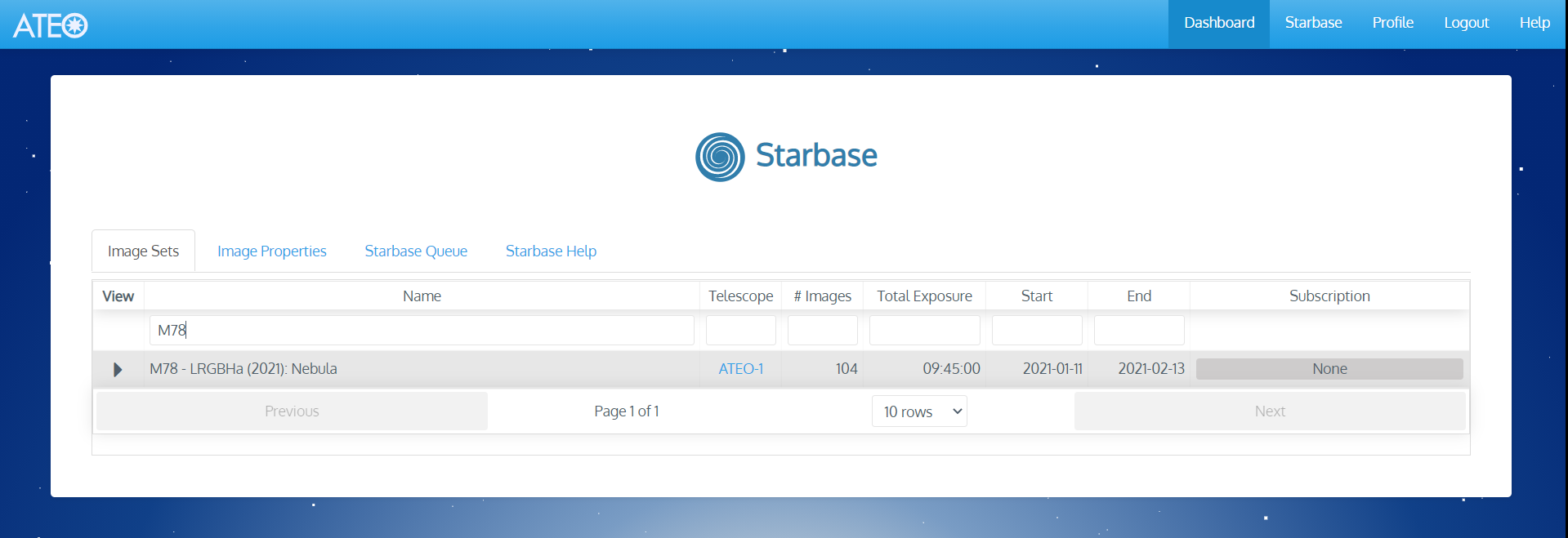
Search for M78 in the "Name" field in Starbase and access to the M78 LRGBHa (2021) Nebula image set will display.
Search for M78 in the "Name" field in Starbase and access to the M78 LRGBHa (2021) Nebula image set will display. 

Insight Observatory is currently taking deep-sky image requests for Starbase image sets on its new ATEO Portal dashboard. There is no charge for these requests. If the requests are approved by the Insight Observatory staff, they will be imaged and uploaded to Starbase for anyone to subscribe to for the low rate of $0.05 (cents) USD per imaging minute for standard subscribers and $0.04 (cents) USD for educational subscribers. We only ask that Starbase subscription requests are for at least 5 hours of integration time.


Read More

Sunday, January 24, 2021

Complimentary Witch Head Nebula Image Data

In appreciation for all of the recent support, Insight Observatory has received from its users and patrons, nearly 5 hours of LRGB complimentary image data of NGC 1909 (IC 2118) - The Witch Head Nebula has been added free of charge to Starbase, Insight Observatory's image set repository. This image data was acquired on the 16" f/3.75 Dream Aerospace Systems astrograph reflector (ATEO-1) remote telescope hosted at SkyPi Remote Observatory located in the dark skies of New Mexico.

NGC 1909 (IC 2118) - The Witch Head Nebula imaged on Insight Observatory's 16" f/3.7 astrograph reflector and processed by Utkarsh Mishra. Complimentary image set available on Insight Observatory's image set repository, Starbase.
NGC 1909 (IC 2118) - The Witch Head Nebula imaged on Insight Observatory's 16" f/3.7 Dream Aerospace Systems astrograph reflector and processed by Utkarsh Mishra. Complimentary image set available on Insight Observatory's image set repository, Starbase.

Some facts about NGC 1909:

NGC 1909 (IC 2118 - also known as Witch Head Nebula due to its shape) is an extremely faint reflection nebula believed to be a supernova remnant or a gas cloud illuminated by the nearby supergiant star Rigel in the constellation of Orion. It lies in the Orion constellation, about 900 light-years from Earth. The nature of the dust particles, reflecting blue light better than red, is a factor in giving the Witch Head its blue color.

Radio observations show substantial carbon monoxide emission throughout parts of NGC 1909, an indicator of the presence of molecular clouds and star formation in the nebula. In fact, candidates for pre-main-sequence stars and some classic T-Tauri stars have been found deep within the nebula.


ATEO-1: 16" Dream astrograph reflector with an image of M63 - The Sunflower Galaxy imaged by Utkarsh Mishra and Gamma Observatory that houses ATEO-1 at SkyPi Remote Observatory.
ATEO-1: 16" Dream astrograph reflector with an image of M63 - The Sunflower Galaxy, imaged by Utkarsh Mishra and Gamma Observatory that houses ATEO-1 at SkyPi Remote Observatory.

The molecular clouds of NGC 1909 are probably placed closely together to the outer boundaries of the vast Orion-Eridanus bubble, a giant supershell of molecular hydrogen blown by the high-mass stars of the Orion OB1 association. As the supershell expands into the interstellar medium, favorable circumstances for star formation occur. NGC 1909 is located in one such area. The windblown appearance and cometary shape of the bright reflection nebula are highly suggestive of a strong association with the high-mass luminous stars of Orion OB1. The fact that the heads of the cometary clouds of NGC 1909 point northeast towards the association is strong support of that relationship.

Source: Wikipedia

Read More

Sunday, July 14, 2019

Mosaic of Reflection Nebula NGC 6914

Recently we wrote a post covering a collaborative on a mosaic of NGC 7023, The Iris Nebula, imaged by accomplished astrophotographers, Paul C. Swift and Carmelo Falco. This is an image that Insight Observatory was fortunate to be able to contribute to by providing luminance data from the 16" f/3.7 astrograph reflector (ATEO-1). Paul and Carmelo have since produced another astonishing mosaic image, NGC 6914. This deep-sky object is a reflection nebula located approximately 6,000 light-years away in the constellation Cygnus and the plane of our Milky Way Galaxy. The nebula was discovered by Édouard Stephan on August 29, 1881.

This mosaic of the reflection nebula NGC 6914 is made up of data from different focal lengths. 380mm, 1330, 1525mm, and 3400mm. Image processed by Paul C. Swift.

The final image data was processed by Paul C. Swift with data acquired from his backyard with a VSD Vixen 380mm & AG14 1330mm Newtonian astrograph. The filter wheel is an SX-46 with an SX Maxi wheel from Starlight Xpress Ltd. A formatted array of 27 x 21.6 mm and 6uM square pixels. Newtonian telescope at 1330mm and Chroma Filters RGBL mounted on a Paramount MX.

Data for the central area of the nebula was imaged by Camelo Falco using his Ritchey-Chretien C 410mm f7.8 customized at 3400mm and an Apogee Aspin GG16m imaging camera. The mount is a customized RM500 Mount. Carmelo's guiding system is an Orion SteadyStar + Lodestar. The filter used by Carmelo was a Baader LRGB set.

Finally, additional Luminance data for outer areas was taken from Insight Observatory's 16" f/3.7 Astrograph reflector 1525mm (ATEO-1).

The Three imaging systems used to collect data of NGC 6914, a reflection nebula in Cygnus. Carmelo Falco's 16" f/7.8 Ritchey-Chretien (left), Paul Swift's VSD Vixen 380mm & AG14 1330mm Newtonian astrograph (above right) and Insight Observatory's 16" f/3.7 Dream astrograph reflector, ATEO-1, (lower right).
The Three imaging systems were used to collect data on NGC 6914, a reflection nebula in Cygnus. Carmelo Falco's 16" f/7.8 Ritchey-Chretien (left), Paul Swift's VSD Vixen 380mm & AG14 1330mm Newtonian astrograph (above right), and Insight Observatory's 16" f/3.7 Dream astrograph reflector, ATEO-1, (lower right).

From the image of NGC 6914 processed by Paul, obscuring interstellar dust clouds appear in silhouette while reddish hydrogen emission nebulae, along with the dusty blue reflection nebulae, fill the cosmic canvas. Ultraviolet radiation from the massive, hot, young stars of the extensive Cygnus OB2 association ionizes the region's atomic hydrogen gas, producing the characteristic red glow as protons and electrons recombine. Embedded Cygnus OB2 stars also provide the blue starlight strongly reflected by the dust clouds. The nearly 1-degree wide telescopic field of view spans about 100 light-years at the estimated distance of NGC 6914.

Read More

Sunday, June 30, 2019

Illuminating The Iris Nebula

Insight Observatory had the opportunity to be involved in another imaging collaborative. This time, a mosaic image of The Iris Nebula, also known as NGC 7023 and Caldwell 4. This deep-sky object is a bright reflection nebula in the constellation Cepheus. Paul Swift, a talented and well-known astrophotographer teamed up with another accomplished astrophotographer, Carmelo Falco, to produce this illuminating image of the Iris Nebula below.

Mosaic image of The Iris Nebula, also known as NGC 7023 processed by Paul Swift using data collected by Carmelo Falco, Insight Observatory and the majority of the data by Paul himself.
Mosaic image of The Iris Nebula, also known as NGC 7023 processed by Paul Swift using data collected by Carmelo Falco, Insight Observatory, and the majority of the data by Paul himself.

This mosaic of the Iris Nebula is made up of data from different focal lengths. 380mm, 1330mm, 1525mm, and 3400mm. This image shows some magenta at the core in the form of reddish photoluminescence. The data collected by Paul Swift was from his backyard in Valencia, Spain. His setup consists of VSD Vixen 380mm and 14" Orion Optics AG 1330mm Newtonian astrograph on a Paramount MX mount, an SX-46 CCD camera with an SX Maxi wheel (with Luminance, Red, Green and Blue filters) from Starlight Xpress Ltd.

The central area image data of the nebula was collected by Carmelo using a 16" f/7.8 (customed 3400mm) Ritchey-Chretien telescope on an RM500 mount accompanied by an Apogee Asping GG16m CCD camera, Orion SteadyStar - Lodestar guiding system, and a Baader Luminance, Red, Green and Blue filter set.

The Three imaging systems used to collect data of NGC 7023, The Iris Nebula. Carmelo Falco's 16" f/7.8 Ritchey-Chretien (left), Paul Swift's 14" Orion Optics AG (above right) and Insight Observatory's 16" f/3.7 Dream astrograph reflector, ATEO-1, (lower right).
The Three imaging systems used to collect data of NGC 7023, The Iris Nebula. Carmelo Falco's 16" f/7.8 Ritchey-Chretien (left), Paul Swift's 14" Orion Optics AG (above right), and Insight Observatory's 16" f/3.7 Dream astrograph reflector, ATEO-1, (lower right).

Additional Luminance data for the outer areas of the nebula was collected by Insight Observatory's 16" f/3.7 astrograph reflector, ATEO-1. This image data was purchased by Mr. Swift as part of Insight's "Datasets on Demand" service where astrophotographers may request data to be acquired from ATEO-1 and ATEO-2A for the purpose of combining the image data with their own. After delivery of the requested image data, it is then added to the Starbase dataset library. Starbase is a deep-sky dataset subscription service that will be accessible via Insight Observatory's ATEO Portal this mid-summer.
Read More

Sunday, September 23, 2018

NGC 7023 and NGC 7380 Imaged with ATEO-1

Now that the ATEO Portal (that allows online access to the Astronomical Telescopes for Educational Outreach) has been completed and is fully operational, the crew at Insight Observatory scheduled multiple imaging runs on ATEO-1 for testing. Rather than image popular, brighter objects such as M31, the Andromeda Galaxy, and M33, the Triangulum Galaxy, both used around the time of first light, a few lesser-known deep-sky objects became the targets for this portal test run. NGC 7023, the "Iris Nebula" and NGC 7380, the "Wizard Nebula" were the picks for this automated run on the ATEO Portal.

NGC 7023, the "Iris Nebula" imaged via the ATEO Online Portal at 300 seconds LRGB (Binning 1 for L / 2 for RGB) Image by Insight Observatory on ATEO-1 - 16" f3.7 Astrograph imaging telescope.

The "Iris Nebula", also known as NGC 7023 and Caldwell 4, is a bright reflection nebula and Caldwell object in the constellation Cepheus. NGC 7023 is actually the cluster within the nebula, LBN 487, and the nebula is lit by a magnitude +7 star. The nebula shines at magnitude +6.8 and it lies 1,300 light-years away and is six light-years across.

This reflection nebula can be fully appreciated through astrophotography and imaging, as seen in the 5-minute image above. The dominant color of this reflection nebula is blue, with interstellar dust lit up by the central young star.

NGC 7380, the "Wizard Nebula" imaged via the ATEO Online Portal at 300 seconds LRGB (Binning 1 for L / 2 for RGB) Image by Insight Observatory on ATEO-1 - 16" f3.7 Astrograph imaging telescope.

The Wizard Nebula, also known as NGC 7380, is an open cluster discovered by Caroline Herschel in 1787. William Herschel included his sister's discovery in his catalog and labeled it H VIII.77. It is also known as 142 in the 1959 Sharpless catalog (Sh2-142). This reasonably large nebula is located in Cepheus. It is extremely difficult to observe visually, usually requiring very dark skies and an Oxygen-III filter.

Located 7200 light-years away, the Wizard nebula surrounds the developing open star cluster NGC 7380. Visually, the interplay of stars, gas, and dust has created a shape that appears to some like a fictional medieval sorcerer. The active star-forming region spans about 100 light-years, making it appear larger than the angular extent of the Moon. The Wizard Nebula can be located with a small telescope toward the constellation of the King of Aethiopia (Cepheus). Although the nebula may last only a few million years, some of the stars being formed may outlive our Sun.

Short-timed exposures like these can surprisingly bring out so much detail with this telescope and imaging system and make it ideal for educational exercise as well as personal use. If you are interested in taking images like this with our newly released remote telescope portal, please view our recent instructional video on how to sign up for an account.
Read More

Sunday, December 31, 2017

Featured Deep-Sky Object - IC 405 - Flaming Star Nebula

This Insight Observatory "Feature Deep-Sky Object" post highlights the emission/reflection nebula, IC 405 - The Flaming Star Nebula, located in the constellation of Auriga. On the evening of December 22, 2017, Insight Observatory's managing member and project developer, Michael Petrasko was remoted into their Astronomical Telescope for Educational Outreach (ATEO) system downloading data from a previous observing run to gather image data requested from users utilizing Insight Observatory's ATEO Public Image Request Form. The sky conditions were pristine and as Michael was wrapping up with his tasks, he figured; why not take advantage of the weather conditions and image an object he has never imaged or visually observed through a telescope before.

IC 405 (also known as the Flaming Star Nebula, SH 2-229, or Caldwell 31) imaged on the ATEO  by Michael Petrasko and processed with PixInsight 8.1 by Muir Evenden.
IC 405 (also known as the Flaming Star Nebula, SH 2-229, or Caldwell 31) imaged on the ATEO
by Michael Petrasko and processed with PixInsight 8.1 by Muir Evenden.

Browsing through the open-source planetarium software, Stellarium, Michael spotted a deep-sky object that was placed perfectly in the sky for imaging out in New Mexico where the remote telescope system resides. He then proceeded to acquire 10 images at 120 seconds each with the Luminance filter and 5 120-second exposures each with the Red, Green, and Blue filters.

IC 405 shines at magnitude +6.0 and surrounds the irregular variable star AE Aurigae. It is also located near the emission nebula IC 410, the open clusters M38 and M36, and the K-class star Iota Aurigae. The nebula measures approximately 37.0' x 19.0', and lies about 1,500 light-years away from Earth. It is believed that the proper motion of the central star can be traced back to the Orion's Belt area. The nebula is about 5 light-years across.

Location of IC 405 - The Flaming Star Nebula as displayed on Stellarium.

The full-resolution image of IC 405 can be viewed on Insight Observatory's Image Gallery. If you are interested in imaging deep-sky images like this using the Astronomical Telescope for Educational Outreach (ATEO), please visit the ATEO Image Request Page for more information.
Read More