-->

Bringing the Universe to Classrooms
and Homes Around the World!

Showing posts with label ATEO. Show all posts

Saturday, January 8, 2022

New Affiliate Remote Telescopes on Starbase

We are excited to introduce three affiliate remote telescopes added to Insight Observatory's image set repository, Starbase. 

The first two are an AG Optical 10" truss iDK (AFIL-1) located at Gemini Observatory and a Skyrover 130 APO Pro (AFIL-2) located at Yunling Observatory, China. These two imaging systems are owned and operated by Alpha Zhang.
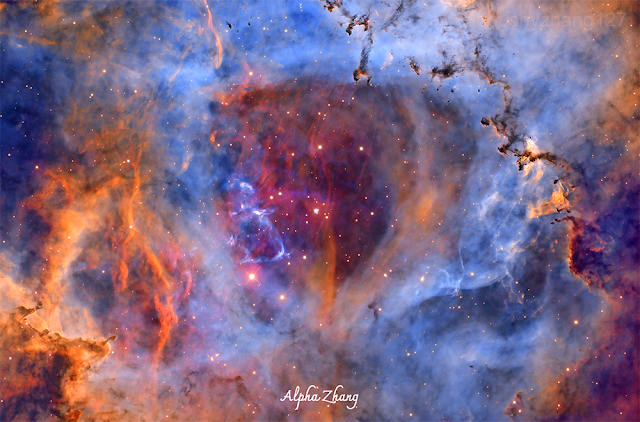
Heart of the Rosette Nebula (NGC 2244) - Imaged data acquired and processed by Alpha Zhang combining image data from image sets on both AFIL-1 and AFIL-2. Both image sets are available on Starbase for purchase.
Heart of the Rosette Nebula (NGC 2244) - Imaged data acquired and processed by Alpha Zhang combining image data from image sets on both AFIL-1 and AFIL-2. Both image sets are available on Starbase for purchase. 

The Heart of the Rosette Nebula (also known as Caldwell 49) is an H II region located near one end of a giant molecular cloud in the Monoceros region of the Milky Way Galaxy. The open cluster NGC 2244 (Caldwell 50) is closely associated with nebulosity, the stars of the cluster having been formed from the nebula's matter.

The third telescope is a Veloce 200 RH f/3 in Hakos, Namibia (AFIL-5). This remote imaging system has been on our remote telescope network for over a year now, offering services on our Basic Image Request (BIR) and Advanced Imaging Request (AIR) online applications. The BIR and AIR are available via the ATEO Portal. AFIL-5 is owned and operated by Lukas Demetz from SkyGems Observatories.

C/2021 A1 Leonard 3x1 mosaic taken from Insight Observatory’s affiliate remote telescope AFIL-5, Veloce 200 RH f/3 in Namibia, on December 30, 2021. 35 minutes of image data acquired by Lukas Demetz and processed by Michael Lewis. Image set available on Starbase for purchase.
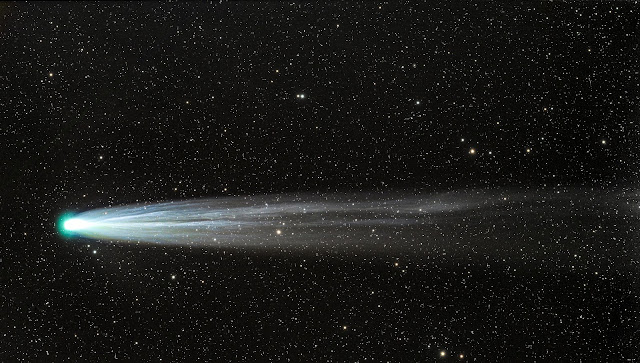
C/2021 A1 Leonard 3x1 mosaic taken from Insight Observatory’s affiliate remote telescope AFIL-5, Veloce 200 RH f/3 in Namibia, on December 30, 2021. 35 minutes of image data were acquired by Lukas Demetz and processed by Michael Lewis. The image set is available on Starbase for purchase.

C/2021 A1 (Leonard) is an inbound long-period comet discovered by G. J. Leonard at the Mount Lemmon Observatory on 3 January 2021 when the comet was 5 astronomical units (AU) from the Sun. This was the first comet discovered in 2021, and it has a retrograde orbit.
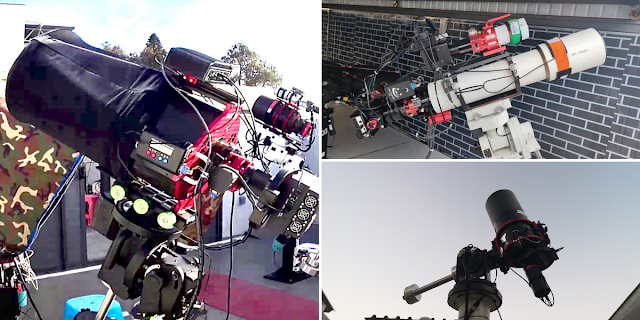


AFIL-1: AG10 CDK f/6.7 f=1665mm (left), AFIL-2: SkyRover 130 APO Pro f/7 f=910mm (upper right), and AFIL-5: Officina Stellare Veloce 200mm f/3 Astrograph (lower left).

Starbase is a repository of image data captured by the Astronomical Telescopes for Educational Outreach (ATEO) and our affiliate remote telescopes (AFIL), organized by the image target into image “sets”. These image sets can be purchased (referred to as “subscribing” to the image set) and downloaded. All proceeds from Starbase subscriptions go towards funding our educational outreach programs.

Read More

Friday, April 2, 2021

Deep-Sky Targets for New Moon - April 2021

The New Moon is fast approaching! Here are some deep-sky target suggestions for imaging on the Astronomical Telescopes for Educational Outreach (ATEO) remote telescope locations by Insight Observatory's partner, Telescopius.com...

M4 - Globular Cluster

M4 - Globular Cluster
Constellation Scorpius
Mag.: 5.40 - Size: 36'
RA 16hr 23' 35" DEC -27º 28' 30"
ATEO-3 - Deep Sky Chile - altitude 87.1º at 05:29 hrs
Tr 16 - Open cluster

Tr 16 - Open Cluster
Constellation Carina
Mag.: 5.00 – Size: 10'
RA 10hr 45' 06" DEC -60º 16' 59"
ATEO-3 - Deep Sky Chile - altitude 87.1º at 05:29 hrs
M101 - Pinwheel Galaxy

M101 - Pinwheel Galaxy
Constellation Ursa Major
Mag.: 7.90 – Size: 28.8'
RA 14hr 03' 12" DEC 54º 20' 58"
ATEO-1 - SkyPi Remote Observatory - altitude 70.0º at 02:34 hrs.
M67 - Open Cluster

M67 - Open Cluster
Constellation Cancer
Mag.: 6.90 – Size: 25'
RA 08hr 51' 17" DEC 11º 48' 59"
ATEO-2A - SkyPi Remote Observatory - altitude 67.5º at 21:22 hrs.
M8 - Lagoon Nebula

M8 - Lagoon Nebula
Constellation Sagittarius
Mag.: 5.00 – Size: 45'
RA 18hr 03' 41" DEC -25º 37' 00"
ATEO-3 - Deep Sky Chile - altitude 84.9° at 07:09 hrs.
M3 - Globular Cluster

M3 - Globular Cluster
Constellation Canes Venatici
Mag.: 6.30 – Size: 18'
RA 13hr 42' 11" DEC 28º 22' 34"
ATEO-1 - SkyPi Remote Observatory - altitude 84.1º at 02:13 hrs.
IC 2948 - Bright Nebula

IC 2948 - Bright Nebula
Constellation Centaurus
Mag.: 7.00 – Size: 1.3º
RA 11hr 39' 24" DEC -64º 31' 59"
ATEO-3 - Deep Sky Chile - altitude 56.0° at 00:45 hrs.
HCG 44 - Galaxy Cluster

HCG 44 - Galaxy Cluster
Constellation Leo
Mag.: 10.00 – Size: 16.4'
RA 10hr 18' 00" DEC 21º 48' 43"
ATEO-1 - SkyPi Remote Observatory - altitude 77.5º at 22:49 hrs.
NGC 3324 - Gabriela Mistral Nebula

NGC 3324 - Gabriela Mistral Nebula
Constellation Carina
Mag.: 6.70 – Size: 16'
RA 10hr 37' 18" DEC -59º 19' 59"
ATEO-3 - Deep Sky Chile - altitude 60.8° at 23:43 hrs.
NGC 5033 - Spiral Galaxy

NGC 5033 - Spiral Galaxy
Constellation Canes Venatici
Mag.: 10.20 – Size: 10.7'
RA 13hr 13' 27" DEC 36º 35' 36"
ATEO-1 - SkyPi Remote Observatory - altitude 87.7º at 01:44 hrs

Help support Insight Observatory's educational outreach efforts by submitting your deep-sky image requests today on our Personal Image Request (PIR) application or logging in to your ATEO Portal account to request on our Basic or Advanced Image Request forms.
Read More

Friday, January 15, 2021

New ATEO Portal - Less is More!

Insight Observatory is very excited to announce the release of its new ATEO Portal!

As we gathered valuable feedback from many of our Insight Observatory ATEO Portal subscribers over the past few years, we wanted to ensure that accessing the Astronomical Telescopes for Educational Outreach (ATEO) for educational and standard use was an easy and pleasurable experience.

When we launched the first version of the ATEO Portal in the fall of 2017, we only had one remote telescope available to access, the 16" f/3.75 Dream Aeropace Systems astrograph reflector (ATEO-1). At the time, we didn't foresee the remote telescope network expanding with affiliate imaging systems located around the world.

M42 - The Orion Nebula imaged on ATEO-1 and processed by Utkarsh Mishra using Insight Observatory's new Advanced Image Request application now available on the new ATEO Portal dashboard.
M42 - The Orion Nebula imaged on ATEO-1 and processed by Utkarsh Mishra using Insight Observatory's new Advanced Image Request application, now available on the new ATEO Portal dashboard.

The first version of the ATEO Portal was designed and developed with the advanced astrophotographer in mind, fully automating the imaging process. Well... After listening to and taking suggestions from our portal users, we decided to "tone it down" a bit and get back to basics. The new version of the ATEO Portal is 100% intuitive and user-friendly, to the point where the user instructions fit on one section of the portal's dashboard.

Screen capture of Insight Observatory's new ATEO Portal dashboard displaying its new "Basic Image Request" application.

There are now two options for accessing Insight Observatory's remote telescope network for requesting image data. One option is "Basic Image Request". This option is similar to the Insight Observatory's Personal Image Request (PIR) application. The difference is that there are more imaging parameter options to select.

Screen capture of Insight Observatory's new ATEO Portal dashboard displaying its new "Advanced Image Request" application.

Another option is the "Advanced Image Request". This option will allow users to request specific custom image data from Insight's remote telescopes, including start date, which telescopes to image on, the number of images, filters to use, exposure lengths, and right ascension and declination coordinate input if needed. Image set requests can also be made on this application for Starbase, Insight Observatory's image set repository.

Here are just a few more changes to the image request process using the new ATEO Portal dashboard:
  • Image Credit System Removed - ATEO Portal users will no longer be required to purchase imaging credits in advance. The new portal dashboard works on a "pay as you go" model.

  • Scheduler Removed - The "Advanced Image Request" application will allow users to request an optional start date for acquiring their image data. This allows us to image your object at its best position in the sky and avoid bad weather cancellations.

  • Telescope Console Replaced - The "Advanced Image Request" application has replaced the Telescope Console, making requesting image data from all of our remote telescopes very quick and easy.

  • Automatic Image Data Upload Removed - Image data requests will be reviewed by Insight Observatory staff to confirm the quality of data is 100% satisfactory before uploading to the ATEO Portal user's home folder.

  • Image Queue Added - There is an image queue in the new ATEO Portal dashboard, allowing users to monitor the current status of their image request(s).

You may access the new ATEO Portal dashboard using your previous login credentials, and you still will have access to your user profile and Starbase image set repository from the new ATEO Portal.


Read More

Friday, August 7, 2020

New Affiliate Remote Telescopes

Insight Observatory is excited to announce a new collaboration with SkyGems Observatories!

Screenshot of AFIL-3: The 20" f/6.7 iDK Dall-Kirkham remote telescope option being selected on Insight Observatory's online Personal Image Request (PIR) application.

Both of Insight Observatory's online image request applications will now have two additional remote telescope options for capturing deep-sky image data. The Educational Image Request (EIR)  and Personal Image Request (PIR) forms now list the following options...

  • ATEO-1: 16" f/3.7 Astrograph - New Mexico, US
  • ATEO-2A: 5" f/5.8 FLT APO Refractor - New Mexico, US
  • ATEO-3: 12.5" f/6 Ritchey-Chretien - Rio Hurtado Valley, Chile
  • AFIL-3: 20" f/6.7 Dall-Kirkham - Namibia, Southern Africa
  • AFIL-7: 20" f/6.8 Corrected Dall-Kirkham - Nerpio, Spain

AFIL-3: 20" f/6.7 Dall-Kirkham located in Hakos, Namibia (left) and AFIL-7 20" f/6.8 Corrected Dall-Kirkham located in Nerpio, Spain (right).
AFIL-3: 20" f/6.7 Dall-Kirkham located in Hakos, Namibia (left) and AFIL-7 20" f/6.8 Corrected Dall-Kirkham located in Nerpio, Spain (right).

Due to the effects of the monsoon season in the southwest of the US, these additional options will allow students and the public to access deep-sky image data in alternate locations in both the northern and southern hemispheres.

Specifications of the AFIL-3 20" Dall-Kirkham Imaging System:
  • 20" f/6.7 AG Optical iDK Dall-Kirkham
  • ASA DDM85XL mount
  • FLI Proline 16803 CCD
  • Filters: LRGB, Ha7 OIII SII

Specifications of the AFIL-7 20" f/6.8 Corrected Dall-Kirkham Imaging System:
  • 20" f/6.8 Corrected Dall-Kirkham
  • Planewave L-500 mount
  • FLI Proline 16803 CCD
  • Filters: LRGB, Ha7, OIII, SII

This is only the first phase of integrating these two fine imaging systems. Phase 2 will be adding 5 hours or more of deep-sky imaging data to Starbase, Insight Observatory's image set repository, and the final phase will be adding them as options on our new version of the ATEO Portal.

LRGB image of NGC 6357 - Diffuse nebula in the constellation Scorpius imaged on AFIL-3   remote telescope located in Namibia. Image courtesy of Lukas Demetz.
LRGB image of NGC 6357 - Diffuse nebula in the constellation Scorpius imaged on AFIL-3 
remote telescope located in Namibia. Image courtesy of Lukas Demetz.

We would like to express our sincere gratitude to Lukas Demetz of SkyGems Observatories for partnering up with Insight Observatory and contributing to our mission of "Bringing the Universe to Classrooms and Homes Around the World!"

For more information on using the EIR for educational use or the PIR for acquiring a deep-sky image for personal use, please Contact Us.

Read More

Thursday, April 23, 2020

Online Learning Opportunities Using ATEO

During these unusual and stressful times, Insight Observatory has been fortunate enough to be able to offer and provide online learning opportunities with teachers and students from their homes. One instance was a recent collaboration with Plymouth South Elementary School 5th-grade teacher, Ms Christine DeSantis, from Plymouth, Massachusetts. Insight Observatory and Ms. DeSantis had scheduled an education program earlier this year to take place in April 2020. Fortunately, due to Insight's online Educational Image Request (EIR) application, Ms. DeSantis and her 5th-grade students could still proceed with the class project as planned.

Plymouth South Elementary School Student, Aidan F., examines his image of M27, The Dumbbell Nebula, taken on Insight Observatory's 16 f/3.7 astrograph reflector (ATEO-1) remote telescope.

"We are very grateful to have been able to benefit from Insight Observatory’s educational outreach program, especially during this difficult and challenging process of distance learning!" states Ms. DeSantis. "Students first visited Insight Observatory's website to learn more about the online remote telescopes and their locations. The students discussed why New Mexico was an ideal location for deep space photography, and how Insight Observatory Co-Founder, Mr. Petrasko, first became interested in space photography. It was inspiring and motivating for the kids to learn how a hobby and interest in space could eventually develop into this type of program."

Plymouth South Elementary School Student, Morgan H., displays her image of M57, The Ring Nebula.  M97, The Owl Nebula and M108 Galaxy on the right were imaged by Brook C. and Cameron J. All deep-sky objects were imaged by the students on Insight Observatory's 16" f/3.7 astrograph reflector (ATEO-1). Plymouth South Elementary School Student, Morgan H., displays her image of M57, The Ring Nebula.  M97, The Owl Nebula (upper right) and M108 Galaxy (lower left) were imaged by Brook C. and Cameron J. All deep-sky objects were imaged by the students on Insight Observatory's 16" f/3.7 astrograph reflector (ATEO-1).
Plymouth South Elementary School Student, Morgan H., displays her image of M57, The Ring Nebula.  M97, The Owl Nebula (upper right), and M108 Galaxy (lower left) were imaged by Brook C. and Cameron J. All deep-sky objects were imaged by the students on Insight Observatory's 16" f/3.7 astrograph reflector (ATEO-1).

"After their research, students were paired up to choose some deep-sky images to have photographed. It was particularly exciting for the students to find out that the spring sky is loaded with galaxies. Students chose from a list of open star clusters, spiral galaxies, globular clusters, and planetary nebulae. They were thrilled when their images arrived. After seeing their images, students discussed the immensity of distances in space and reviewed the variation in galaxy shapes. This was such a wonderful project, especially since it allowed my students to visit faraway places without having to leave their homes."

More images acquired by Plymouth South Elementary School 5th-grade students using ATEO-1. M51, The Whirlpool Galaxy imaged by Trevor B. (left), M27, The Dumbell Nebula, imaged by Aidan F. (upper right), and M3, Globular Cluster imaged by Nathan B.
More images were acquired by Plymouth South Elementary School 5th-grade students using ATEO-1. M51, The Whirlpool Galaxy imaged by Trevor B. (left), M27, The Dumbell Nebula, imaged by Aidan F. (upper right), and M3, Globular Cluster imaged by Nathan B.

Insight Observatory would like to thank Ms. DeSantis and her 5th-grade students for participating in a classroom project for the 3rd year straight year! Even during these challenging learning conditions, we are very happy we could still make it possible!

If you are an educator and would like to participate in an online learning opportunity using our Astronomical Telescopes for Educational Outreach (ATEO) remote telescope network, please Contact Us. 
Read More

Sunday, April 5, 2020

Telescopius - Astronomy Planning Made Easy

Insight Observatory recently developed a beneficial partnership with Telescopius.com (formerly known as DSO-Browser). Telescopius is a great online tool for astrophotographers who are planning an astrophotography session. The website provides plenty of useful information covering the deep-sky objects visible from your telescope's location and hosts an active community with an image gallery to share your images.

The Insight Observatory Astronomical Telescopes for Educational Outreach (ATEO) locations are listed on the Telescopius Observatory Parameters section.
The Insight Observatory Astronomical Telescopes for Educational Outreach (ATEO) locations are listed in the Telescopius Observatory Parameters section.

Since developing and releasing the ATEO Portal, Personal Image Request (PIR), and Educational Image Request (EIR) online applications for accessing Insight Observatory's three remote telescopes, we have always provided a link to Telescopius.com to allow imagers to get some recommendations for deep-sky targets. Our online applications, in text, provided the ATEO remote telescopes' geographic coordinates and locations so the user or student could enter them on Telescopius.com to view and choose targets from our two remote observatory locations. Recommending using Telescopius to our users was very helpful with selecting targets both in the classroom and for personal use.

In late February this year, Insight Observatory and Telescopius partnered up to bring the perfect deep-sky target selection possible with the use of the ATEO remote telescope network. Insight Observatory's two remote telescope locations are now integrated into the website. When a user or student chooses one of our three telescopes to image with, then clicks telescopius.com to look for target recommendations, the location of the telescope and observatory is immediately selected. There is no longer a need to enter in the coordinates and locations manually. If you go directly to telescopius.com and click in the "Observatory Parameters" field, you will see Insight Observatory listed. When clicked on, it displays all three ATEO remote telescope locations. SkyPi Remote Observatory for ATEO-1 and ATEO-2A and Deep Sky Chile for ATEO-3. One of my personal favorite "What's in the Sky Tonight" features is the hourly and monthly altitude graph that displays the rise, transit, and set times of a deep-sky target. That gives the imager information for the best time to capture that object.

Screenshot of Telescopius.com's Telescope Simulator tool demonstrating the field of view of M45, The Pleiades through Insight Observatory's 16" f/3.7 astrograph reflector, ATEO-1.

Telescopius' owner and developer, Sebastian Garcia, went above and beyond in addition to the features he developed previously mentioned. Sebastian also added all three ATEO remote telescopes to the Telescopius Telescope Simulator. This tool allows users and students to select a telescope and deep-sky target to analyze the field of view (FOV). There have been numerous occasions when working in the educational environment when we would receive questions from instructors asking which telescope would be the best to image certain objects. Now users and students can see how the object "fits" in the field of view of the telescope they are choosing. This makes the process of our educational programs more intuitive than they already are.

Insight Observatory would like to thank Sebastian Garcia for his contributions and efforts to our ongoing mission of "Bringing the Universe to Classrooms Around the World!"

Telescopius is a free online application and is funded largely by donations via Patreon and PayPal.
Read More

Friday, February 7, 2020

The Sky Show

Barnstable High School Senior Astronomy students, AKA, "Astro Junkies",  are recently focused on a unit called “The Sky Show” which challenges each student to learn the taxonomy of the heavens.

Barnstable High School astronomy students study the use of Insight Observatory's Astronomical Telescopes for Educational Outreach (ATEO).

Similar to Zoology, where each organism is assigned a Class, Phylum, Order, Family, Genus, and species classification, each object in the nighttime sky is given a classification designation as well. As students learn about open star clusters, globular star clusters, spiral galaxies, elliptical galaxies, irregular galaxies, double stars, planetary nebulae, emission nebulae, reflection nebulae, dark nebula, variable stars, planets, moons, asteroids, and comets, they will select a specific celestial object that they would like to research and image with a partner. Together, they will search the skies, using the website Telescopius.com, to find “that image” that speaks to them and their specific interests.

Barnstable High School astronomy students research and select their deep-sky object to image on the ATEO remote telescope network.

Insight Observatory provides a wonderful opportunity for students to learn about deep-space objects, telescopes (reflectors vs. refractors), and the nighttime sky (in both celestial hemispheres). Students truly enjoy being part of the imaging process. Ownership, which is key to learning, helps create crystallizing memories that will resonate with students for many years to come. If educators are thought of as being in the “memory-making business,” then Astronomy provides the magic for making this happen.

Michael Gyra - Astronomy Teacher, Barnstable High School, Barnstable, MA

A few images of deep-sky objects acquired by Barnstable High School seniors (Astro Junkies) - M1 imaged on the 16" f/3.7 astrograph reflector (ATEO-1), NGC 1499 imaged on the 5" f/5.8 refractor (ATEO-2A) and NGC 2024 imaged on the 12.5" f/9 Ritchey-Chretien (ATEO-3).
 A few images of deep-sky objects acquired by Barnstable High School seniors (Astro Junkies) - M1 imaged on the 16" Dream Aerospace Systems f/3.75 astrograph reflector (ATEO-1), NGC 1499 imaged on the 5" f/5.8 refractor (ATEO-2A) and NGC 2024 imaged on the 12.5" f/9 Ritchey-Chretien (ATEO-3).

More images of deep-sky objects taken by the Barnstable High School senior astronomy students. Sh2-279 imaged on ATEO-3, M31 imaged on ATEO-2A and IC 1848 imaged on ATEO-1.
More images of deep-sky objects were taken by the Barnstable High School senior astronomy students. Sh2-279 was imaged on ATEO-3, M31 was imaged on ATEO-2A and IC 1848 was imaged on ATEO-1.

A special thank you to Mr. Gyra and his senior astronomy students, AKA, "Astro Junkies", for utilizing Insight Observatory's Astronomical Telescopes for Educational Outreach for the second consecutive school year with their class projects. If you are an educator interested in accessing Insight Observatory's ATEO remote telescope network for a classroom project using its intuitive Educational Image Request (EIR) form, please Contact Us.
Read More

Wednesday, February 5, 2020

Seeing Beyond the Stars

Recently, a student of Mrs. Runyon’s 8th-grade science spent this past Christmas holiday traveling around the state of Texas with a stop at the famed McDonald Observatory. This astronomical observatory is located near the unincorporated community of Fort Davis in Jeff Davis County western Texas, United States, where the stars are so brilliant one almost feels like falling up into them! Why are stars so much more brilliant in those western skies than they are to us on the east coast? And how can we see beyond them?

Mrs. Runyon's 8th-grade science students research possible deep-sky targets to image through Insight Observatory's Astronomical Telescopes for Educational Outreach (ATEO) remote telescopes in the computer lab at Plymouth South Middle School. Photo credit: Karen Runyon.

Grade 8 students in Mrs. Runyon’s science class at Plymouth South Middle School, Plymouth, Massachusetts discussed these and other questions before embarking on a journey through space via Insight Observatory's Astronomical Telescopes for Educational Outreach (ATEO) remote telescope network. Students selected deep-sky Messier objects to research, hunting for objects that both inspired them, as well as were visible in the January skies of the northern and southern hemispheres.

ust a few sample images were taken by 8th-grade science students at Plymouth South Middle School, Plymouth, MA. M78 and M45 imaged on Insight Observatory's 16" f/3.7 astrograph reflector (ATEO-1) in New Mexico, USA and M42, and M43 imaged on the 12.5" f/9 Ritchey-Chretien (ATEO-3) located in the Rio Hurtado Valley, Chile.
Just a few sample images were taken by 8th-grade science students at Plymouth South Middle School, Plymouth, MA. M78 and M45 were imaged on Insight Observatory's 16" f/3.75 Dream Aerospace Systems astrograph reflector (ATEO-1) in New Mexico, USA, and M42, and M43 were imaged on the 12.5" f/9 Ritchey-Chretien (ATEO-3) located in the Rio Hurtado Valley, Chile. 

Working in groups, the students presented and taught each other about these objects, and decided which ones to select for imaging using Insight Observatory's Educational Image Request (EIR) form. After the deep-sky image requests were uploaded to the telescope queues, acquired, and processed, the students compared their images with those taken from the Hubble Space Telescope. They discussed the differences between the image qualities gathered from the ATEO remote telescopes and Hubble, both in location and structure.

Mrs. Runyon's 8th-grade students compare images of deep-sky objects such as nebulae, galaxies and star clusters taken with Insight Observatory's ATEO remote telescopes and the Hubble Space Telescope. Photo Credits: Karen Runyon.
Mrs. Runyon's 8th-grade students compare images of deep-sky objects such as nebulae, galaxies, and star clusters taken with Insight Observatory's ATEO remote telescopes and the Hubble Space Telescope. Photo credits: Karen Runyon.

Insight Observatory would like to thank Mrs. Runyon and her 8th-grade science students for participating in its "Bringing the Universe to the Classroom" program. If you are an educator and interested in accessing Insight Observatory's ATEO remote telescope network for a classroom project, please Contact Us.
Read More

Sunday, February 10, 2019

Public Library Deep-Sky Imaging Workshop

On Saturday, February 2nd, 2019, Insight Observatory Science Educator, Steven Davies, and I had the pleasure of presenting Insight Observatory's first public Deep-Sky imaging workshop outside of the classroom. The event was held at the Cotuit Public Library located on Main Street, Cotuit, Massachusetts. The purpose of the workshop was to provide a primer on how remote robotic telescopes acquire deep-sky imaging data and how it is then processed.

Insight Observatory Project Developer, Michael Petrasko and Science Educator, Steven Davies describing the remote location of the Astronomical Telescopes for Educational Outreach (ATEO).  Photo by Michael Davies.
Insight Observatory Project Developer, Michael Petrasko and Science Educator, Steven Davies describing the remote location of the Astronomical Telescopes for Educational Outreach (ATEO).  Photo by Michael Davies.

I started the workshop off with an introduction to Insight Observatory and its mission of astronomy education outreach. I also introduced the organization's network of Astronomical Telescopes for Educational Outreach (ATEO) and how they are accessed and operated. Steve then took over the presentation providing an informative talk on what types of deep-sky objects exist in our night skies, such as galaxies, star clusters, and the different types of nebulae. Steve explained the unique characteristics and scientific origin as well as how images of these astronomical objects are created from data acquired from remote robotic telescopes.

After Steve concluded his part of the talk, I had all the participants go to Insight Observatory's Educational Image Request (EIR) form (also used for classroom projects) on a device connected to the WiFi at the library such as a Chromebook®, iPad®, Smartphone or laptop computer. Adding a little fun, I walked around with a top hat that was filled with names of deep-sky images that the group picked randomly and would image.

Images from the Cotuit Library Deep-Sky Imaging Workshop - M1, The Crab Nebula imaged on ATEO-2A by R. Morrata, M101 - The Pinwheel Galaxy imaged on ATEO-1 by D. Boyd and Barnard 33 - The Horsehead Nebula imaged on ATEO-1 by M. Thomas.

After the deep-sky object names were pulled from the top hat, the group then followed along with instructions on how to submit their deep-sky image request on the EIR form. After all of the image request submissions were completed, I explained how the image requests were uploaded to the remote telescope queues to be acquired. "How long will it take to get our images back?" many of the attendees inquired. Fortunately, we were able to deliver their requested deep-sky images to them completely processed within a week due to clear evenings at our remote telescope's hosting facility, SkyPi Remote Observatory located in Pie Town, New Mexico.

We would like to thank Antonia and Gus at the Cotuit Library for giving Insight Observatory the opportunity to conduct this workshop. If your library or other organization has an interest in having Insight Observatory conduct a remote robotic telescope imaging workshop, please Contact Us.
Read More

Sunday, December 16, 2018

Featured Deep-Sky Object - NGC 2403

It's been a while since we profiled a deep-sky object on our blog, as we have been working hard on getting our affiliate remote robotic telescope, ATEO-2, operational for educational and public use. As Insight Observatory's Project Developer, Michael Petrasko, was preparing a list of deep-sky wonders to possibly image with a class using the Astronomical Telescopes for Educational Outreach, ATEO-1, and ATEO-2, he came across an interesting galaxy in the inconspicuous constellation of Camelopardalis that may be of interest.

NGC 2403 - Spiral Galaxy in the constellation Camelopardalis. Image by Michael Petrasko on ATEO-1 - LRGB 2x300 Seconds each. Binning 2. Image Processed with CCDStack2.
NGC 2403 - Spiral Galaxy in the constellation Camelopardalis. Image by Michael Petrasko on ATEO-1 - LRGB 2x300 Seconds each. Binning 2. Image Processed with CCDStack2.

The constellation contains no bright stars, but some interesting galaxies wait for observers that happen to point their instruments in this part of the sky. One of these galaxies is NGC 2403, the showpiece of Camelopardalis. NGC 2403 (also known as Caldwell 7) is an intermediate spiral galaxy. NGC 2403 is an outlying member of the M81 Group and is approximately 8 million light-years from Earth. The object has a striking similarity to M33, The Triangulum Galaxy being about 50,000 light-years in diameter and containing numerous star-forming H II regions. The northern spiral arm connects it to the star-forming region NGC 2404.

Finder Chart for NGC 2403 - Image Credit: IAU and Sky and Telescope Magazine.

NGC 2403 can be seen easily as a large hazy spot in 10x50 binoculars, and a telescope will show a bright elliptical haze surrounded by a faint outer halo. A definite degree of mottling becomes apparent with larger telescopes, the effect of dust scattered throughout the spiral arms.

Anyone can image this galaxy and other deep-sky wonders by signing up for an account on Insight Observatory's online ATEO Portal or by using our Public Image Request (PIR) form.
Read More

Saturday, October 6, 2018

The Andromeda Galaxy Revisited and NGC 6822

Now that the ATEO Portal is complete and in full use for accessing imaging data on ATEO-1, we decided to revisit an old friend... M31, The Andromeda Galaxy. It was just a little over a year ago that we acquired our first image of our closest galactic neighbor. Insight's first image of M31 was a 60-second Luminance image taken remotely with TheSkyX software on the Raspberry Pi that controls the 16" f/3.75 Dream Aerospace Systems astrograph remote telescope. This was before the ATEO Portal was ready for beta testing.

M31 - "The Andromeda Galaxy" Imaged via Insight Observatory's ATEO Portal on it's 16" f/3.7 Remote Robotic Telescope (ATEO-1).
M31 - "The Andromeda Galaxy" Imaged via Insight Observatory's ATEO Portal on it's
16" f/3.7 Remote Robotic Telescope (ATEO-1). 

The latest image above was taken completely through the ATEO online access portal. This image, a bit more impressive, was taken on the morning of October 5th, 2018, with filters Luminance at 600 seconds along with Red, Blue, and Green at 300 seconds. All binning 2x2 and the image processing were done in PixInight and Photoshop CS6.

While the Andromeda Galaxy makes quite an impression, we thought why not image another galaxy of a completely opposite type. NGC 6822 was loaded into the Telescope Console on the ATEO Portal as a target as well. The specifications of this image are Luminance 300 Seconds, RGB 120s, and all 2x2 binning.

NGC 6822 - "Barnard's Galaxy" Imaged via Insight Observatory's ATEO Portal on it's 16" f/3.7 Remote Robotic Telescope (ATEO-1).
NGC 6822 - "Barnard's Galaxy" Imaged via Insight Observatory's ATEO Portal on it's
 16" f/3.7 Remote Robotic Telescope (
ATEO-1).

NGC 6822 (also known as Barnard's Galaxy, IC 4895, or Caldwell 57) is a barred irregular galaxy approximately 1.6 million light-years away in the constellation Sagittarius. Part of the Local Group of galaxies, it was discovered by E. E. Barnard in 1884, with a six-inch refractor telescope. It is one of the closer galaxies to the Milky Way. It is similar in structure and composition to the Small Magellanic Cloud and is about 7,000 light-years in diameter.

Read More

Thursday, October 4, 2018

21P Giacobini-Zinner On the Move

Comet 21P/Giacobini-Zinner has been putting on a good show recently, so I grabbed some shots of the speedy comet as it cruised through the inner Solar System with the Astronomical Telescopes for Educational Outreach (ATEO).

From the 16" f/3.75 reflector, ATEO-1, I thought it would be interesting to capture the motion of the comet. On September 21st around 5:15 in the morning, I imaged with 2-minute exposures every 10 minutes, for a total of 15 images captured. Since the comet was low on the horizon during the first part of the exposure run, we see some glow near the horizon which you see at the bottom of the image in the first few frames of the loop. After processing: normal image reduction and aligning all the images, the animated GIF was created that you see below. Elapsed time in the GIF: 1 hour 20 minutes.

Time-elapse GIF of Comet 21P/ Giacobini-Zinner imaged by Muir Evenden on ATEO-1.

Next, I wanted a shot from the 5" f/7 refractor, ATEO-2. A few days later on September 23rd at 3:30 in the morning, I captured a 10-minute image with the one-shot color camera while the mount was set to track the comet. The result was this nice picture of the comet moving along...

Comet  21P/Giacobini-Zinner Imaged by Muir Evenden tracking the comet on ATEO-2.
Comet  21P/Giacobini-Zinner Imaged by Muir Evenden tracking the comet on ATEO-2.
Read More

Tuesday, October 2, 2018

ATEO Portal Released with Instructional Videos

Insight Observatory is pleased to announce the official release of its Astronomical Telescopes for Educational Outreach (ATEO) Portal. This online gateway allows educators and the general public to access their network of remote robotic telescopes for astronomical imaging and research. Unlike Insight's Public Image Request Form (PIR), the portal allows users to create a user account, reserve telescope time, and enter specific image data requests. The image data is then uploaded to a secure cloud folder after the observing run is completed.

Screen Capture of the Astronomical Telescope for Educational Outreach (ATEO) Online Telescope Portal.

ATEO Portal Instructional Videos have been published on Insight Observatory's YouTube Channel that covers each module of the online telescope access portal, from creating a new user account to planning what objects are to be imaged during a scheduled reservation.

The Astronomical Telescopes for Educational Outreach (ATEO) Portal can be accessed at https://ateodev.insightobs.com.

ATEO Portal New User Registration

ATEO Portal New User Registration - Instructions on how to sign up for a user account on the Astronomical Telescopes for Educational Outreach (ATEO) Portal that accesses Insight Observatory's network of remote robotic imaging telescopes.

ATEO Portal User Profile

ATEO Portal User Profile - Instructions on how to use the Astronomical Telescopes for Educational Outreach (ATEO) Portal User Profile to edit user information, purchase imaging credits, and access image data.

ATEO Portal Scheduler

ATEO Portal Scheduler - Instructions on how to use the Astronomical Telescopes for Educational Outreach (ATEO) Portal Scheduler to reserve imaging time on Insight Observatory's remote robotic telescopes.

ATEO Portal Telescope Console

ATEO Portal Telescope Console - Instructions on how to use the Astronomical Telescopes for Educational Outreach (ATEO) Portal Telescope Console to plan what objects are to be imaged during a scheduled reservation.

If you are interested in creating an account on the ATEO Portal or have any specific questions, please contact support@insightobservatory.com.
Read More

Sunday, September 30, 2018

Collaboration with SkyPi Remote Observatory

Sublime Skies, LLC DBA Insight Observatory is pleased to announce a joint Education Outreach collaboration with SkyPi Online Observatory, LLC!  

SkyPi Remote Observatory was conceived as an installation of automated roll-off observatories with telescope piers with the purpose of hosting remote imaging telescopes by John and Jan Evelan of Mesa, Arizona back in 2012. "The facility is dedicated to providing a superb remote imaging environment for the discriminating astrophotographer" as stated by John Evelan. "The remote observatory site is located in Pie Town, New Mexico with a population of approximately 200. It is arguably among the darkest sky sites in the lower 48 states. There are many other advantages that come along with this site. As I began planning the observatory, I realized that sharing and hosting the site was a natural evolution for it. The goal is to make remote observing accessible and more affordable to the astronomy community."

Remote Robotic Telescopes hosted in SkyPi Remote Observatory's Alpha Observatory.  Image courtesy of SkyPi Remote Observatory.
Remote Robotic Telescopes are hosted in SkyPi Remote Observatory's Alpha Observatory. 
Image courtesy of SkyPi Remote Observatory.

The comments above are exactly why the founding members of Insight Observatory, Michael Petrasko, and Muir Evenden chose the location for hosting their 16" f/3.7 Dreamscope Astrograph imaging telescope that was installed in May 2017. After carefully searching for the ideal location to host their Astronomical Telescopes for Educational Outreach (ATEO-1), they chose SkyPi Remote Observatory. Not only did the physical location turn out to be phenomenal for imaging and research but the service provided by John and his talented technicians, Michael and Caleb went completely above and beyond what their expectations were during and after the installation of the telescope. Their response time to any technical issues and special requests is extremely prompt. Insight Observatory could not imagine hosting its remote robotic telescope anywhere else.

IC 405 - The Flaming Star Nebula imaged by Insight Observatory on 16" F/3.7 Remote Telescope  hosted at SkyPi Remote Observatory.
IC 405 - The Flaming Star Nebula imaged by Insight Observatory on 16" F/3.7 Remote Telescope 
hosted at SkyPi Remote Observatory.

As their business relationship flourished and Michael Petrasko was onsite this past May on a routine telescope maintenance visit, John and he were discussing the online ATEO Portal Muir had designed and developed for accessing the ATEO-1 remote telescope via the internet. John asked if "any" telescope could be accessed via the online portal and when Michael replied yes, John opened up one of SkyPi's roll-off observatories that houses a Williams Optics 5" f/7 with a one-shot CCD camera attached. John then continued, "Even this one?".  That's when SkyPi's 5" f/7 refractor became Insight Observatory's very first affiliate imaging telescope on its network and has been designated ATEO-2. Currently, the crew at SkyPi is in the midst of configuring an 11" f/10 Schmidt-Cassegrain telescope that will be dedicated to planetary imaging. This imaging system will be known as ATEO-3.

M51 - The "Whirlpool Galaxy" imaged by Bob Birket on his Optics 12-inch RCOS Astrograph hosted at SkyPi Remote Observatory. Automated Roll-Off Roof Observatories Alpha, Bravo, and Gamma to the right.

John and Jan Evelan share the same passion for educational outreach the founding members of Insight Observatory do. After ATEO-2 was configured by the crew of SkyPi to be accessed by Insight Observatory, it became accessible on Insight Observatory's Educational Image Request (EIR) Form for classroom projects. ATEO-2 can also be accessed on their Public Image Request (PIR) Form as well. The telescope will be added to the online ATEO Portal within the next couple of months.

An Observatory housing n 18" Dobsonian Telescope was constructed so clients could enjoy observing in the dark skies at SkyPi. The telescope will also be used for Education Outreach events as well.  Image courtesy of SkyPi Remote Observatory.
An Observatory housing n 18" Dobsonian Telescope was constructed so clients could enjoy observing in the dark skies at SkyPi. The telescope will also be used for Education Outreach events as well. 
Images courtesy of SkyPi Remote Observatory.

Both companies met on a video conference call this past Labor Day weekend to discuss possible joint ventures where both entities may accomplish their common goals for education outreach. Insight Observatory could not be more enthusiastic to partner up with SkyPi Remote Observatory on these!

If you are looking for the ideal spot to host your imaging system, we strongly recommend SkyPi. Other Astro-imagers have found SkyPi Remote Observatory to be the ultimate hosting solution other than Insight Observatory. You may read all of their positive feedback on their Testimonials page on their website. Also, check out the images taken by SkyPi's hosting clients on their image gallery.
Read More